Digital Biomarkers and EATRIS: A New Dimension in Translational Medicine
March 30, 2026
EATRIS is the European research infrastructure for translational medicine that supports the development of new medical solutions by transforming scientific discoveries into real-world applications for patient care. One of the most advanced areas of translational medicine promoted by EATRIS is digital biomarkers - health indicators derived using digital technologies, sensors, and artificial intelligence. These biomarkers provide continuous, real-time insights into a person’s health in everyday environments, complementing traditional laboratory data and making health monitoring far more personalised.
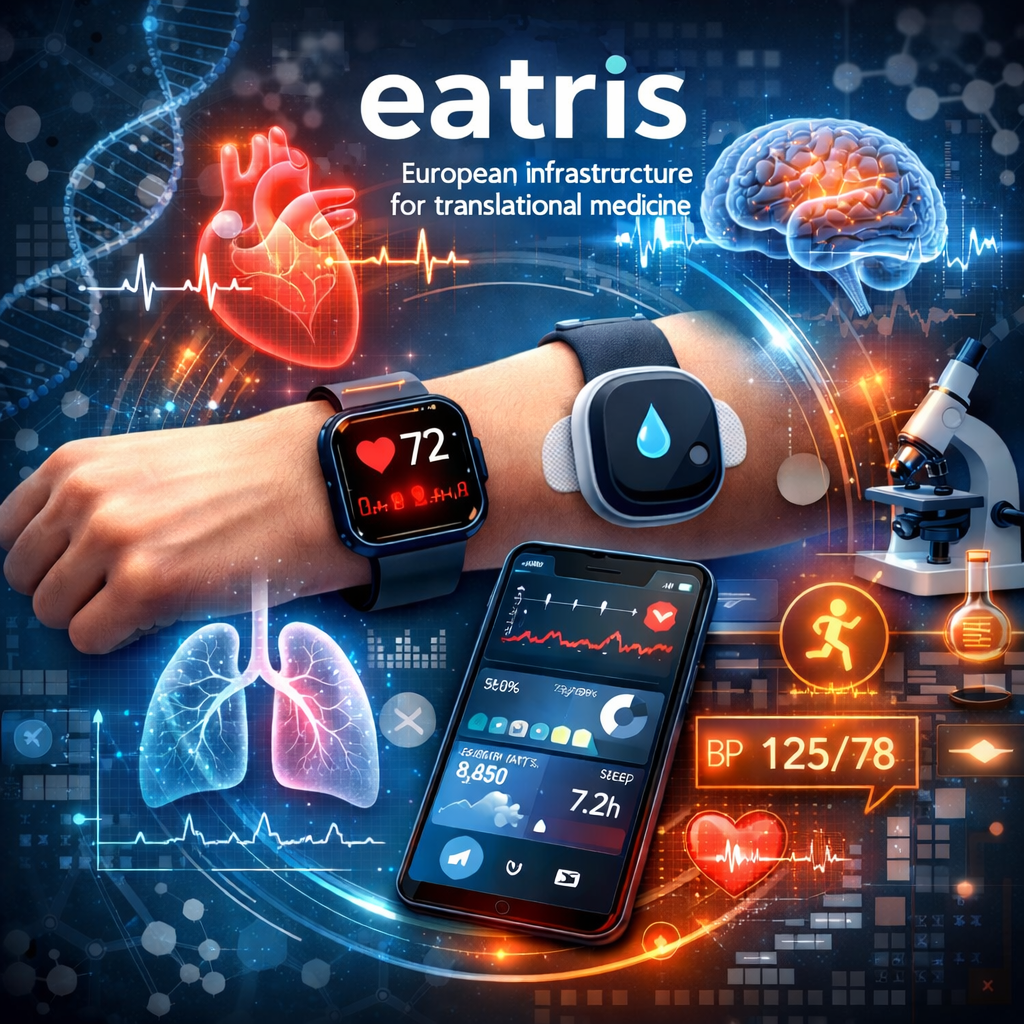
Digital biomarkers enable the analysis of a wide range of parameters - from heart rate and respiratory patterns to sleep behaviour, activity levels, movement habits, and responses to therapy. With the help of artificial intelligence algorithms, these data are transformed into meaningful health indicators, giving researchers and clinicians a much more detailed understanding of a patient’s health dynamics than one-time laboratory tests can provide.
Applications in Translational Medicine
Digital biomarkers within the EATRIS infrastructure are used across various fields:
Diabetes: Monitoring patients’ heart rate, activity, and glucose levels outside the hospital, enabling the prediction of complications and individualised therapy adjustments. Globally, wearable devices and algorithms are being developed to predict interstitial glucose levels and analyse the impact of meals on glucose dynamics.
Chronic diseases and cardiovascular conditions: Digital biomarkers allow long-term tracking of blood pressure, heart rhythm, and activity levels, helping to identify early changes that may signal disease progression.
Neurodegenerative diseases: Gait analysis and motion sensors help assess the progression of Parkinson’s disease and Alzheimer’s disease, enabling more accurate predictions and personalised treatment.
Vaccine and therapy development: Digital biomarkers enable continuous monitoring of immune response and treatment effectiveness, providing more precise clinical data and accelerating the research process.
Personalised medicine: Digital indicators are integrated with traditional biomarkers and genomic data to create individualised treatment plans and optimise therapy for each patient.
The Role of EATRIS and the Latvian Context
At the core of EATRIS activities is the Digital Biomarkers Working Group, where researchers, clinical specialists, data experts, and industry partners collaborate on the validation, standardisation, and translational implementation of digital biomarkers in clinical research. Issues related to data security, quality, and regulation are also addressed to ensure that digital biomarkers become a reliable tool in translational medicine.
In Latvia, EATRIS members, such as Rīga Stradiņš University, provide access to these technologies for translational projects. This enables local researchers to engage with global research directions, collaborate internationally, and develop tailored solutions in areas such as diabetes, chronic diseases, neurodegenerative disorders, and vaccine testing. In this context, digital biomarkers serve as a bridge between laboratory discoveries, clinical testing, and everyday patient health monitoring, allowing for faster development of personalised therapies and diagnostic solutions.
Global Perspective and Future Opportunities
Globally, digital biomarkers are being developed using artificial intelligence capabilities; data from smart wearables that continuously and automatically monitor daily physical activity, heart rate, sleep quality, and other physiological parameters, providing an objective view of an individual’s health status; health information platforms; and big data analytics. This enables translational medicine to become not only more precise but also far more dynamic - data are collected in real time and can provide early warning signs of changes in health. These innovations are particularly useful for predicting disease progression, personalising therapy, and accelerating the testing of vaccines and treatments.
Digital biomarkers within the EATRIS framework are one of the key tools that help translate scientific discoveries into practice more quickly and ensure more effective, individually tailored patient care.
Information provided within the project “RSU participation in the Horizon Europe programme” (No. 1.1.1.5/3/25/I/014).
*project no. 1.1.1.5/3/25/I/014