Modern biomedicine increasingly relies on the ability to analyse cells and their diversity in great detail. One method that allows researchers to obtain extensive information in a short time is flow cytometry. This technology is widely used in immunology, oncology, microbiology, and personalised medicine.
Flow cytometry enables the analysis of thousands to millions of cells within minutes, determining their size, structure, viability and the presence of specific biomarkers. This method is important both in fundamental research and in clinical diagnostics.
Flow cytometry also plays a significant role in translational medicine – a field that helps transform laboratory discoveries into clinical solutions. For this reason, the technology is widely used in international research infrastructures, including EATRIS, which supports the development of new diagnostic and therapeutic approaches across Europe.
How does flow cytometry work?
The method is based on the principle that cells suspended in a liquid are directed one by one through laser beams of different wavelengths (see in figure below). Detectors record how the cells scatter light and what fluorescent signals they emit. This makes it possible to obtain detailed information about the phenotypic and physiological properties of each cell.
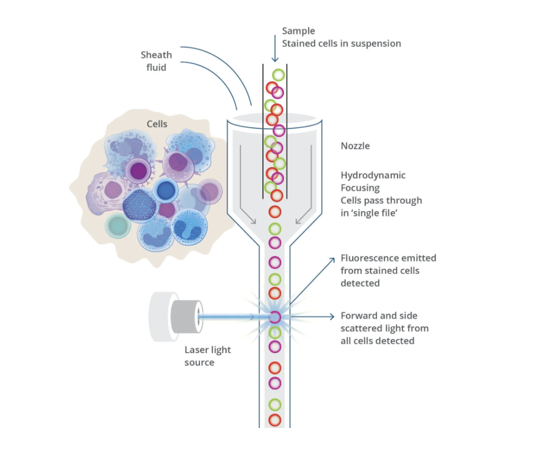
To identify specific proteins or cell types, fluorescent antibodies are used that bind to particular molecules on the cell surface or inside the cell. Conventional flow cytometers can analyse between 10 and 30 parameters, while the latest-generation spectral flow cytometers can simultaneously analyse more than 40 markers.
Flow cytometry is commonly used to determine:
- cell size and structure;
- the presence of various proteins;
- cell viability;
- cell cycle and proliferation;
- immune cell types and activation states;
- responses to medications;
- mechanical separation and collection of specific cell populations (sorters/cell sorters);
- cell visualisation (with next-generation instruments).
What can this method reveal?
One of the most important applications of flow cytometry is immune system analysis. It enables the identification of different immune cell populations, the analysis of inflammatory processes, and the study of the body’s response to infections or therapies.
The method is also particularly important in oncology. In blood cancers such as leukaemia and lymphoma, flow cytometry helps identify abnormal cell populations and evaluate treatment effectiveness. It can detect even very small numbers of residual cancer cells after therapy, known as minimal residual disease.
Flow cytometry is also used in drug development and pharmaceutical research, as it helps analyse cellular responses to various substances, detect cell death, and assess drug efficacy.
Some instruments also function as cell sorters. This means that it is possible not only to identify specific cells but also to physically separate them from the rest of the population for further research.
Flow cytometry in modern medicine
As personalised medicine continues to advance, the importance of flow cytometry is steadily growing. It helps researchers understand how an individual patient’s immune system responds to treatment and which biomarkers may predict therapy effectiveness.
Today, spectral flow cytometry and automated data analysis using artificial intelligence are becoming increasingly widespread. This allows researchers to analyse even more complex cell populations and obtain far more precise data.
Flow cytometry has become one of the most important methods in biomedical research and diagnostics, helping both to understand disease mechanisms and to develop new and more effective therapies.
We invite you to learn more about flow cytometry on May 28. More information and registration: https://www.researchlatvia.gov.lv/en/events/spectral-flow-cytometry-imaging-theory-and-practice-part-eatris-infrastructure
Information provided within the framework of the project “RSU Participation in the Horizon Europe Programme” (No. 1.1.1.5/3/25/I/014).
*Project No. 1.1.1.5/3/25/I/014