Physicists from the Institut Néel in Grenoble, France and the University of Latvia (UL), inspired by sorites paradox sometimes known as the paradox of the heap – how many grains make up a heap? – in a special experiment studied the behaviour of electrons, applying a new universal mathematical method. They have established, how many electrons are needed for them to start behaving collectively and into what groups they split when they encounter an obstacle. The joint work of Latvian and French scientists has resulted in a scientific publication, which was published on 25 June in the world’s most prestigious academic journal “Nature”.
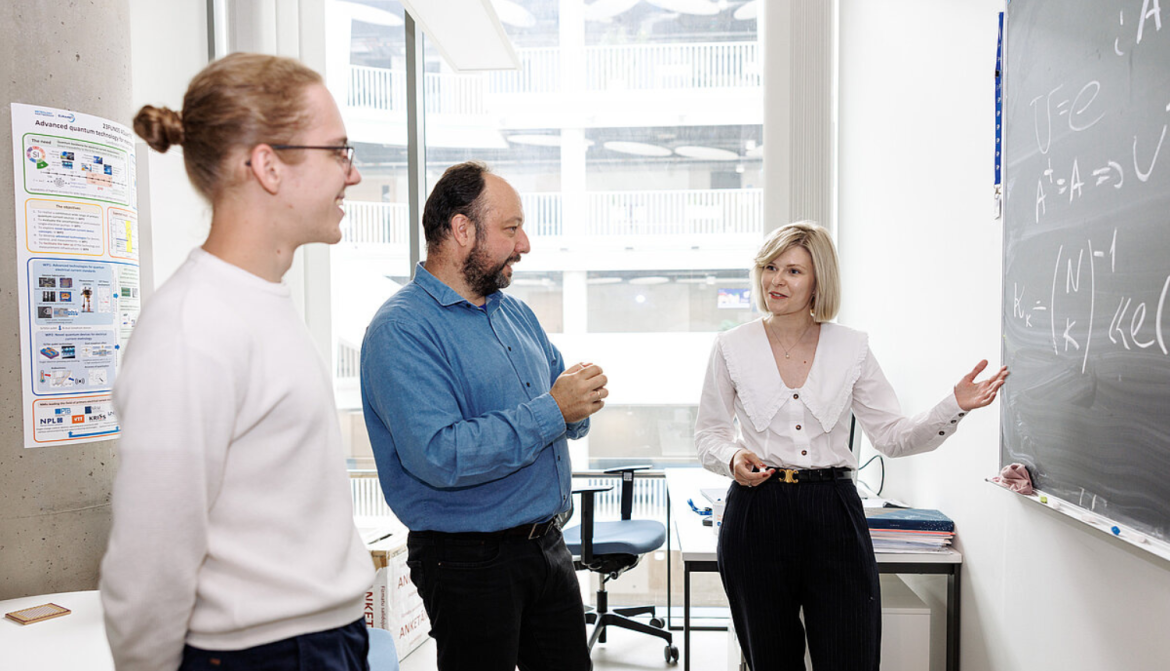
From left: Ralfs Šuba, Vjačeslavs Kaščejevs, and Elīna Pavlovska. Photo: University of Latvia.
“Many scientists dream of the opportunity to publish their research results in the journal “Nature”, because, according to the journal’s editorial board, it publishes the most outstanding research results in all fields of science, taking into account their originality, interest from scientists in other fields, and unexpected conclusions. This is more often the case for extensive, international studies conducted by a large team of authors. For a small team of authors, this is an outstanding achievement!
This is only the fourth time that authors from Latvian scientific institutions have managed to make a decisive contribution to an article published in “Nature”. The previous occasion was in 2008. I am particularly delighted that the current discovery represents the field of quantum technologies,” says Guntars Kitenbergs, UL Vice-Rector for Research, emphasizing the significance of the event.
To arrive at this discovery, scientists at the Institut Néel, France created a microscopic particle accelerator (collider), which enabled them to control from one to five electrons, and “throw” them against an obstacle, then count how many electrons, hitting the obstacle, ended up on one side or the other. The experiment has revealed a surprising result – even just three elementary particles begin to behave as a unified whole, rather than as independent particles. This marks the emergence of a collective state – a situation in which the outcome cannot be explained simply by looking at the behaviour of individual particles. The UL scientists created a universal theoretical model of the collective behaviour of elementary particles, which made it possible to explain the results of this experiment and discover similarities with the phenomena of the collective behaviour of nuclear matter in the Large Hadron Collider.
“In this work, together with scientists from the Institut Néel, we have managed to apply the methods of elementary particle physics to nanoelectronics. Until now, no one had studied how, by putting electrons together one by one, a liquid is formed.
The object of this study is very, very small droplets of electronic liquid. The behaviour of a drop is different from the behaviour of individual particles, and we sought to find how we could grasp the moment when this drop is formed. The novelty of this research is that electrons are sent towards the obstacle not one by one, but several electrons are compressed together with an electric force and sent towards the obstacle at the same time. And here we discover that each electron “looks” at the others to see which way to go. We have measured with mathematical precision to what extent the decision of one electron depends on the others. Electrons are charged particles, between which acts the Coulomb force, determining attraction or repulsion of particles, therefore, at the moment when electrons are greatly compressed due to external conditions, it is possible to predict how many electrons are able to go in one direction, and how many will go in the other direction,” explains Vyacheslavs Kascheyevs, a tenured UL professor of physics.
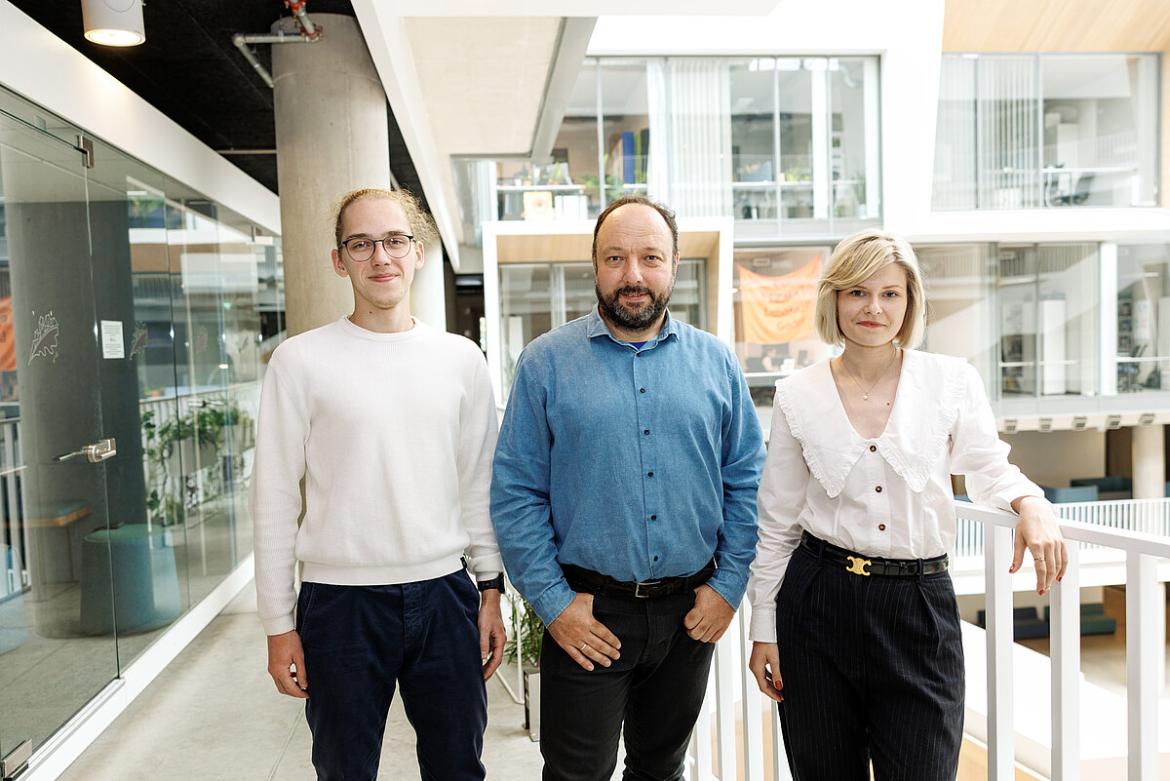
From left: Ralfs Šuba, Vjačeslavs Kaščejevs, and Elīna Pavlovska. Photo: University of Latvia.
To understand at what point electrons no longer behave like individuals, but instead begin to behave like a liquid, UL scientists have developed a universal mathematical method, whereby so-called “patterns” or correlation functions are calculated from measurements of electron movement, which can be compared to a break at school and a dance – during a break, everyone goes somewhere doing their own thing, running in one direction or the other, while in a dance, all steps are planned and dancers move in pairs or larger groups dependent on each other.
This method describes all the “dance movements” of electrons, which can be compared to a universal law or mathematical formula for how electrons should behave if they form an incompressible fluid. The “patterns” of two electrons do not yet comply with this universal law described by scientists, whereas three or more electrons form a “pattern” that complies with the universal law and are therefore considered to be an incompressible fluid. The developed universal mathematical method shows that a “heap” of electrons is formed from as few as three electrons, and these principles are applicable both in nanoelectronics and in particle physics research, for example, in the Large Hadron Collider.
“Our collaboration with the Institut Néel began after the 2023 publications in the journal “Nature Nanotechnology”. At that time, in three independent experiments, three different research groups simultaneously demonstrated that in nanoelectronic circuits, one electron can be used to precisely change the trajectory of another electron. One of these groups was us, UL, in collaboration with colleagues from Germany. This time, the French colleagues conducted the experiment and came to results that needed to be understood and explained, defining exactly what these results showed. As a result of this experiment, we created a universal method, using which we have come to the conclusion that three electrons constitute the lower limit when a liquid droplet forms and electrons begin to behave collectively, and moreover, these three electrons will behave in the same way as 103 electrons.
This study opens up much broader possibilities for conclusions about electron interactions than previous studies, which studied two electrons and collective behaviour had not been observed until now,” acknowledges UL doctoral student Elīna Pavlovska.
From left: Ralfs Šuba, Vjačeslavs Kaščejevs, and Elīna Pavlovska. Photo: University of Latvia.
collaboration with researchers from the Institut Néel in France, UL and Ruhr University Bochum, Germany. The UL research team consisted of Elīna Pavlovska, Ralfs Šuba and Vyacheslavs Kascheyevs (UL Faculty of Science and Technology). The study was supported by the European Union Recovery and Resilience Facility project “Latvian Quantum Technologies Initiative” (No. 2.3.1.1.i.0/1/22/I/CFLA/001) and the Latvian Council of Science Fundamental and Applied Research Programme project “Enabling research for single-electron quantum technologies” (No. lzp-2021/1-0232).
The publication is available here: https://doi.org/10.1038/s41586-025-09139-z