From June 8 to 11, 2026, the international training course "Modern NMR for Biomolecular Interactions: From Solution and Solid-State to Hyperpolarisation and AI" was successfully held at the NMRRI (Nuclear Magnetic Resonance Research Infrastructure). This marked the first time that an Instruct-ERIC (European Research Infrastructure Consortium) course was hosted in Latvia.
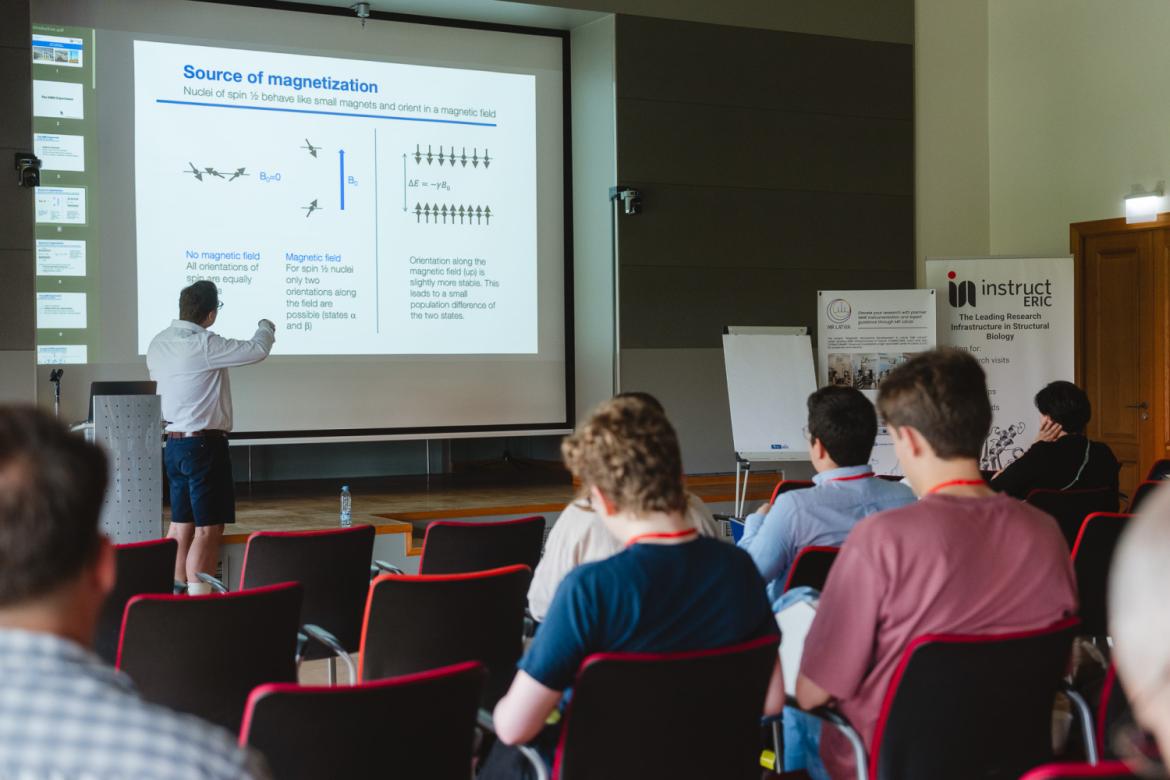
The primary goal of the training was to provide young scientists with advanced knowledge and practical skills in utilizing modern nuclear magnetic resonance (NMR) methods to study biomolecular interactions. The course was organized through a collaboration between Instruct-ERIC and the national research consortium MR LATVIA.
Young Scientists Expand Their Knowledge in the Field of NMR
The intensive four-day program was attended by 13 PhD students, postdocs, and early-career researchers from 8 different countries. Participants had the unique opportunity not only to attend theoretical lectures but also to immediately apply their newly acquired knowledge during practical sessions, working directly with the state-of-the-art NMR equipment of the NMRRI research platform.
The training curriculum covered a wide range of topics—spanning from the fundamentals of solution and solid-state NMR to cutting-edge fields such as hyperpolarization and the integration of artificial intelligence (AI) in data analysis and structural determination.
Lectures Led by Leading European Experts
Nine invited foreign specialists from Italy, France, and Germany shared their expertise during the course.
A highlight of the program was the visit by Professor Harald Schwalbe, Director of Instruct-ERIC and professor at Goethe University Frankfurt. Professor Schwalbe delivered an inspiring lecture on the application of NMR methods in developing new antiviral drugs, demonstrating the direct impact of structural biology on addressing global health challenges.
About Instruct-ERIC
Instruct-ERIC is a pan-European research infrastructure that grants scientists access to high-end technologies and methods in structural biology. One of the consortium's core missions is the regular organization of training and skill-development courses. The successful execution of this course in Latvia highlights the high international standing of our local infrastructure and specialists, as well as their readiness to host European-scale educational events.
The National Institute of Research and Innovation is implementing project No. 1.1.1.5/3/24/I/006 “Development of Latvia’s research potential by strengthening the integration of the Latvian Biomedical Research and Study Centre into European infrastructures and scientific networks”, within which the Latvian National Partnership Plan of the Integrated Structural Biology Infrastructure (Instruct-ERIC) is being implemented.