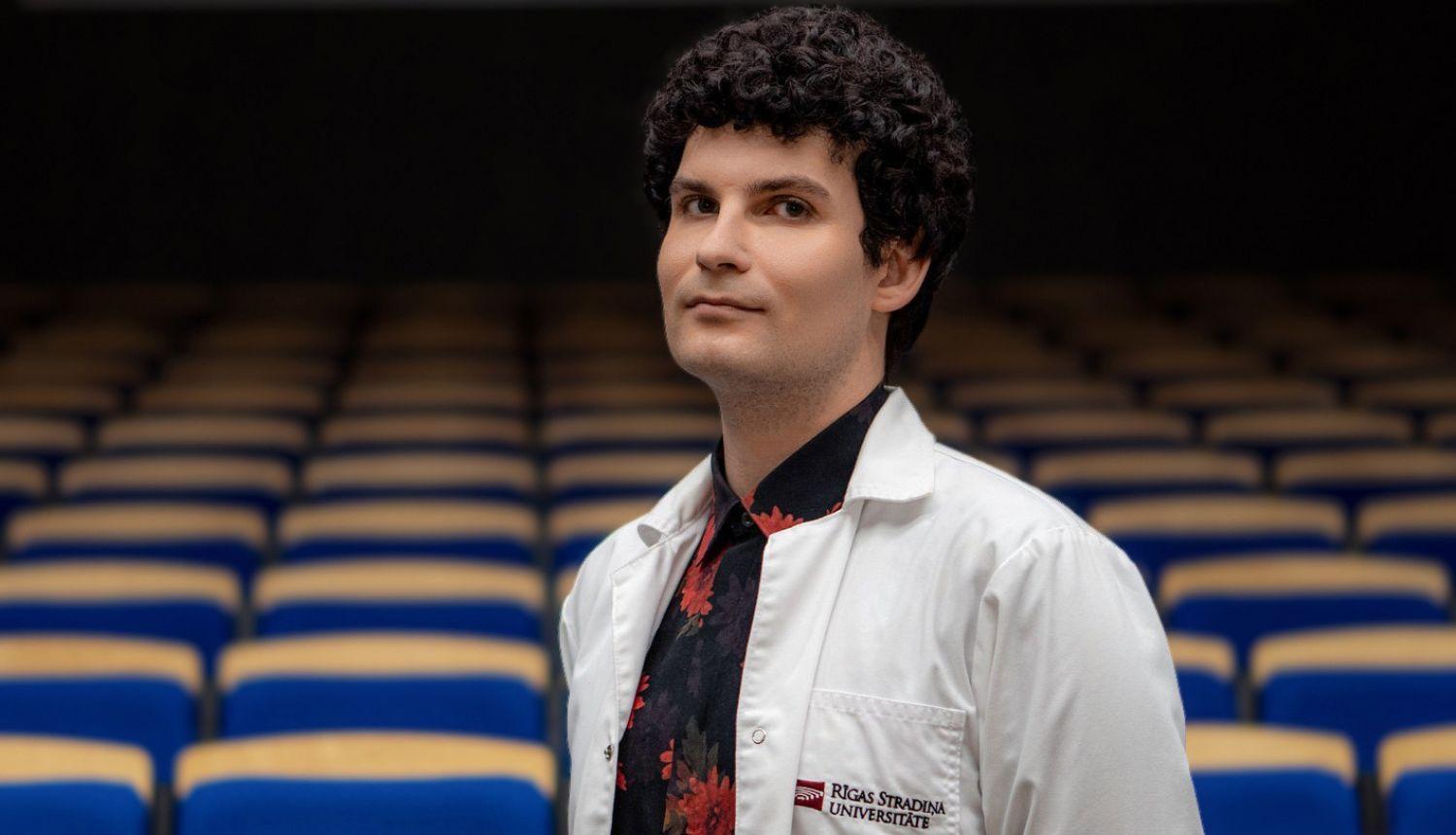
"Science excites me, that's why I'm here! Already in school, I knew I wanted to work in research. It fascinates me because it's never boring: you constantly explore new things and uncover the unknown," says Edgars Edelmers, the energetic winner of Rīga Stradiņš University's (RSU) Doctoral Student of the Year 2025 award.
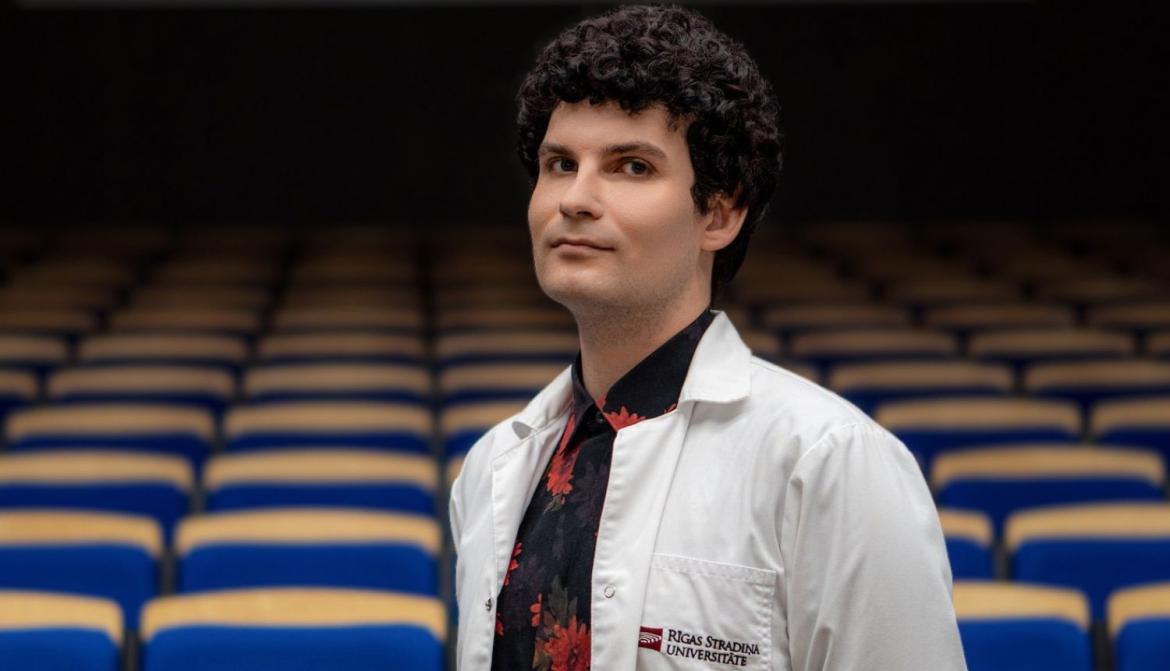
The lively researcher is genuinely passionate about science, and his list of activities is long. Just a glimpse: at the end of this year, he will defend his doctoral thesis related to 3D reconstruction and artificial intelligence (AI). In this work, he has also created a new AI-based tool for diagnostics and research. At the same time, Edgars Edelmers serves as a research associate at the Medical Education and Technology Centre (METC), teaches at RSU and Riga Technical University (RTU), participates in international projects, and contributes to the development of new study courses.
His first degree is in Molecular Biology from the University of Latvia (UL), followed by a master's degree in Biomedical Sciences from RSU. Continuing immediately onward to doctoral studies at RSU was a clear choice.
He explains: "Every day I ask myself: what will I discover today? Maybe nothing; maybe I'll just come a little closer to a discovery. When you finally uncover something new, there's this wow-effect—and you start thinking about how to take it further."
What has been the biggest surprise in your research during the past year?
Definitely everything related to AI!
There is so much to discover. I don't like the cliché term artificial intelligence, because there is nothing "artificial" about it. A book or a machine is also artificially created. In reality, AI is an algorithm that has learned specific patterns, and if you ask it something outside its learned context, it cannot give a comprehensive answer. For instance, I trained AI to recognise malignant formations in X-ray images; if you show it something it has never seen, it simply overlooks the structure. Still, one could say that AI possesses a kind of artificial intuition, because, for example, ChatGPT can answer the same question differently on different days, mimicking human behaviour.
But I hope that one day AI will truly become real artificial intelligence. Scientists and engineers are already discussing the next stage: AGI (artificial general intelligence). In other words, an intelligence that, figuratively speaking, understands everything in this world, physics, medicine, social sciences, and more. A conversation with it will be indistinguishable from talking to a human. That will raise many ethical questions. For example, if such an entity imitates human behaviour and can exist longer than a human lifetime, can we consider it alive? Can we switch it off?
Your doctoral thesis is also related to AI. Where are you in the process, and what have you discovered?
For every doctoral student, the thesis is a heavy subject. When will it be submitted? When will it be defended? My pre-defence went well; a few corrections are needed, and I'm optimistic that I'll defend the thesis by year's end.
In short, the work focuses on using AI to reconstruct 3D models from medical images and to recognise and identify morphological structures automatically. The thesis combines two main themes.
The first is 3D reconstruction, which is where I started my scientific journey.
My colleagues and I once developed a 3D modelling and printing course to modernise the study programme slightly. When I joined RSU's Institute of Anatomy and Anthropology, this field was almost unknown to me, but the more I learned and observed my colleagues' work, the more fascinated I became.
And I'm curious by nature! Everything unknown and new interests me. I could just as well study some aspect of quantum physics; I don't view science as divided into traditional disciplines. It's all interconnected, and no topic belongs to just one field. This is the era of interdisciplinary research, where domains overlap. My thesis is like that too, touching medicine, computer science, and engineering.
The work is carried out at RSU's Institute of Anatomy and Anthropology under the supervision of Associate Professor Dzintra Kažoka and RTU Associate Professor Katrīna Šmite.
The 3D model part explores methods for constructing 3D models and optimising these processes.
And the other part concerns AI.
Yes. AI is a broad term with many subfields. ChatGPT is a multifunctional language model that enables conversational interaction with AI. But in my thesis, I trained two algorithmic models within a custom AI framework to recognise lytic and sclerotic metastases, as well as Cajal interstitial cells. The results of this work formed the foundation for a Fundamental and Applied Research Project (FLPP) and consolidation projects that we now successfully implement together with colleagues.
Is this tool paid or freely available? Is it understandable for clinicians?
It is freely accessible and, I would say, understandable to everyone. Of course, AI is built upon advanced mathematics. I designed the tool for clinical and research use, so it must be simple; not all colleagues are highly technical. The solution must be easy enough that even a secretary could use it.
I always try to simplify complex concepts. The same goes for teaching; if there's interest, people will delve deeper. If the explanation is overly complex, it can frighten or alienate.
Besides creating the tool for radiologists, I developed another programme called Morfista. It can search for specific cell types in large histological images. Histologists typically count cells manually under a microscope; humans cannot count them all, so in a large 10-GB image, they select 10 fields of view, count the cells, and estimate the total. You can imagine how imprecise this method is! AI can automate the entire process, counting cells across the whole sample, not just a small portion. It is faster, more precise, and fatigue-resistant.
If we give AI more computing resources, it performs better. For humans, however, the fifth or tenth cup of coffee doesn't improve performance beyond the first two.
My AI programme automates the detection and counting of Cajal interstitial cells. We had a biopsy cohort of 42 patients, and I trained the AI to recognise these cells without confusing them with other structures.
This process reminds me of teaching students. You must show the AI: this is what the cell looks like, this is its nucleus, and so on. The clearer I explain the material to the AI, the better it recognises it—just like a student's exam performance depends on how well the teacher explained the topic.
Then comes tuning AI hyperparameters, a delicate process, "playing" with mathematics. No magic, just numbers and matrices adjusted to achieve better results.
So the programme is available? And why this name?
Morfista is published and publicly available. Scientists struggle with naming (laughs). I combined morphology and histology, and it worked well. At present, I focus on morphological structures, but I am determined to integrate AI into other research areas too.
A great deal of work has been invested, and you've created a new scientific product. But how does it reach visibility among other researchers worldwide?
That's a good question (sighs). We must go out and share our discoveries, attend conferences, and publish our research. Fundamental science is essential, but we must also strive to find real-world applications. Latvian scientists, in AI and beyond, have much to be proud of.
Often, we don't do enough. Scientists are sometimes shy: they publish a paper and stop there. We must present, travel, and share our achievements. We must communicate not only within closed academic circles but also with society.
If you cannot explain your research to a non-specialist, what you studied and why it matters, then perhaps you do not fully master your topic, or maybe the research isn't as relevant as you think.
Your supervisor, Associate Professor Dzintra Kažoka, praised your work and noted its interdisciplinarity. She also said you're a true scientist at heart and might one day outgrow Latvia and continue your career abroad. What do you think?
I'm ambitious and believe that we are capable of anything. If you want something, you can achieve it with effort and perseverance. I know I'm a workaholic. I enjoy working and could work 24/7, but humans need sleep. And food.
Here we could learn from AI, which doesn't need sleep.
Exactly. It will be fascinating to see what happens when AI reaches the level of a living being, but without our limitations. How will we coexist? AI has far fewer weaknesses than humans. I would love to live long enough to see AGI and, even more, I'd like to contribute to creating such a system.
Regarding a career abroad: science is international. We must attend conferences, stay in touch with foreign colleagues, do internships and bring back new knowledge. This isn't betrayal. True, someone might ask: What guarantees you'll return? We don't know. No one knows their future.
Besides research, you teach at RSU and RTU, and you are also a software engineer at the Institute of Electronics and Computer Science. What are the challenges in teaching?
Teaching is a small part of my daily work, but I integrate new technologies. If you speak monotonously for 10 minutes, you'll lose your audience quickly. You can't rely on old-style presentations full of text and endless slides; you'll end up lecturing only yourself. We must adapt to the new era.
A challenge is adjusting the content to different levels of prior knowledge. For example, together with Tenure Professor Maija Radziņa, we created a course on AI in diagnostic imaging. It's attended by people with AI experience and complete beginners; we must find a way to make it meaningful and engaging for everyone.
You said you're ambitious, and earlier, you also said you've known since school that you wanted to become a scientist. How did this conviction develop?
As a child, I went to the nearby Botanical Garden almost daily. At around seven, I received an extensive encyclopedia as a gift. I studied it constantly and carried it everywhere.
This early interest in biology led me to the UL Faculty of Biology.
I initially studied at two faculties simultaneously, including RTU's Faculty of Computer Science, where I learned programming and engineering. Mondays at one university, Tuesdays at the other.
At first, it worked, but when schedules began to overlap, I had to choose. I decided to learn programming on my own and continued with biology.
I'm always ready to do more than what is written in the job description. That's how excellence is achieved, the excellence we all strive for at RSU. To reach scientific excellence, you must be a true fan of your field.
Passion requires energy. Since you're not an AI and cannot stay awake endlessly, how do you recharge?
Once, I actually fell asleep with my head on the keyboard in my office. That was the moment I realised: I must acknowledge my age and limits. You cannot work 24/7; the mind and body need rest.
I enjoy painting and photography. My focus is macro photography and flora. I once worked at the UL Museum as a collection custodian and as an exhibit photographer. I paint with watercolours and have even entered competitions. I paint nature scenes and flowers. These hobbies help me relax and switch contexts—they're creative, just like science.
I think of scientists as artists; you never know precisely how your painting will turn out, just as you never know how your project will end or what discoveries you'll make.
When photographing, you choose the time of day, the angle of sunlight, the colours, and whether or not to use flash. Later comes the photo editing, something I enjoy immensely. I'm a perfectionist. Until I get the perfect image from 150 photos, if needed, I'll work for hours on just a few shots. Honestly, it's hard to live as a perfectionist.
Realising your perfectionism is already a step toward softening it.
Yes (laughs). But it's not curable.
Your hard work has been recognised with an RSU award. How did it feel?
It was terrific that others acknowledged my achievements. It gave me the confirmation that what I do truly matters. I don't know if it's age or fatigue, but during the Academic Assembly, standing on stage next to Rector Professor Aigars Pētersons, I felt a bit emotional: yes, I now have this award, and soon I'll defend my thesis. And then - what next? Wise colleagues warn me: "Edgar, when you finish your doctorate, you'll face a crisis; you've studied your entire life." My studies have lasted ten years. And everything has been accomplished.
As your defence approaches, are you preparing for a crisis?
Yes, it's coming.
There are post-doctoral programmes.
Yes, there are.
You can become a professor.
True, there is room to grow, but beyond the doctoral degree, there is no higher academic degree. The title of professor is a position, and positions come and go.
I actually like the American approach, where everyone is treated equally and being a professor doesn't make you a special figure. We should respect all colleagues. Hierarchy can hinder progress. We all share a common goal.
Knowledge is a lasting value. We must educate students, patients, and everyone.
You cannot sit in a corner thinking everything is fine, because somewhere in the world, someone will discover something new, and your method will become outdated. We must keep learning and stay curious, that's what I wish for everyone!