Scientific Seminar at VIRAC Brings Together Researchers to Study Solar Activity and Space Weather
March 9, 2026
The Sun has recently passed the peak of its activity cycle, and energetic events occur on its surface almost every day, including solar flares and coronal mass ejections (CMEs). These phenomena directly affect Earth’s magnetic field and ionosphere, creating space weather conditions that can disrupt satellites, communications, and navigation systems.
These topics were discussed at a seminar held at the Ventspils International Radio Astronomy Centre (VIRAC) on 26 February 2026, organized within the framework of the LOFAR-ERIC initiative. The seminar brought together scientists from Ventspils University of Applied Sciences (Latvia), the Institute of Radio Astronomy and the Institute of Geophysics of the National Academy of Sciences of Ukraine, Odesa I. I. Mechnikov National University (Ukraine), and the Sodankylä Geophysical Observatory of the University of Oulu (Finland).
During the seminar, participants discussed recent results in geomagnetic data analysis and studies of ionospheric processes. One presentation demonstrated an automated approach to processing geomagnetic data from the international INTERMAGNET station network, enabling more efficient analysis of large datasets collected from multiple observation stations.
Researchers also presented the first results from observations of the annular solar eclipse on 17 February 2026, using the “Mayaki” geomagnetic station in Ukraine and the URAN-4 decameter radio telescope. These observations help investigate the influence of solar activity on Earth’s magnetic field and the dynamics of the ionosphere.
Another presentation introduced preliminary results from observations of a strong geomagnetic storm near the meridian of the Struve Geodetic Arc. Researchers compiled digital data from 16 geomagnetic stations and analysed variations in the geomagnetic field during intense magnetic storms in January and November 2025. These data will form the basis for the geomagnetic component of a space weather monitoring system and will contribute to a better understanding of changes in Earth’s magnetic field.
The seminar emphasized the importance of an interdisciplinary approach in space weather research. Increasingly, studies rely on integrated observation methodologies that combine radio astronomy observations, geomagnetic field measurements, and cosmic ray data. This approach enables more accurate analysis of ionospheric processes and the effects of solar activity on the near-Earth space environment.
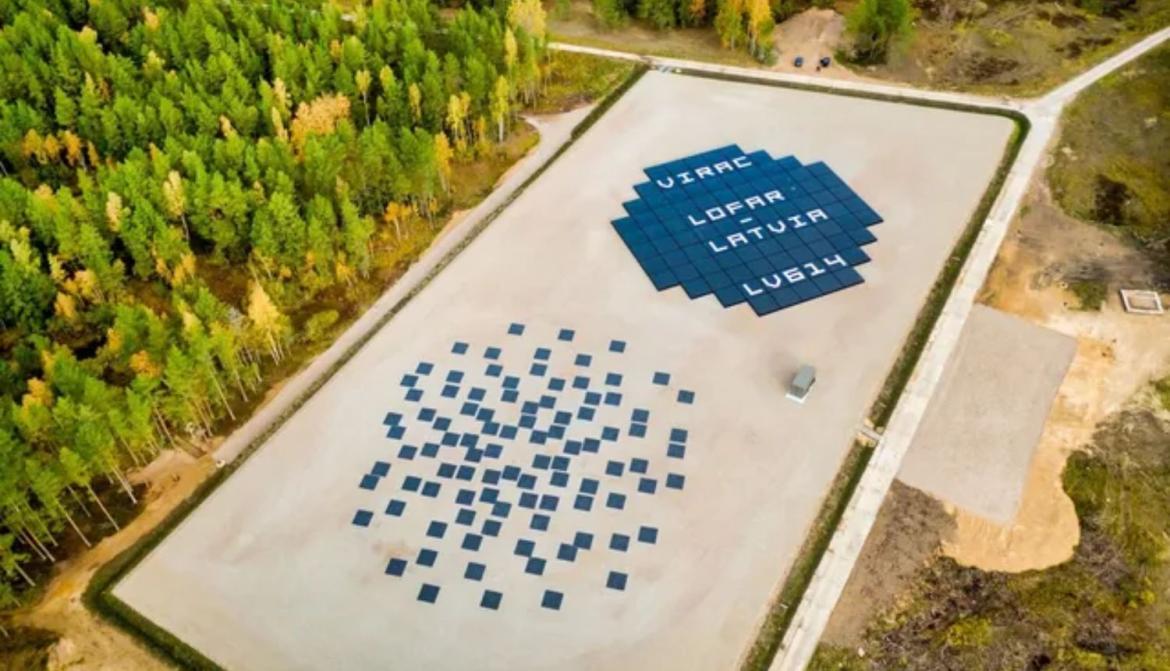
International research infrastructure plays a significant role in these studies. Observations are conducted using the LOFAR LV614 station in Irbene (Latvia), the KAIRA antenna array (Finland), and the URAN-4 radio telescope (Ukraine). Particular attention is paid to observations of ionospheric scintillations from strong cosmic radio sources during periods of intense solar activity, as well as to the influence of geomagnetic anomalies on these processes.
The research also covers space weather effects in the region of the Struve Geodetic Arc, which connects Latvia, Finland, and Ukraine. Of particular importance in this region is the Odesa regional magnetic anomaly, where unique geomagnetic conditions may amplify the effects of solar activity on the ionosphere.
The seminar was organised within the framework of the project “Ventspils University of Applied Sciences` International Cooperation and Innovation for the Development of Latvia’s Smart Specialisation” (No. 1.1.1.5/3/25/I/012), co-financed by the European Regional Development Fund.