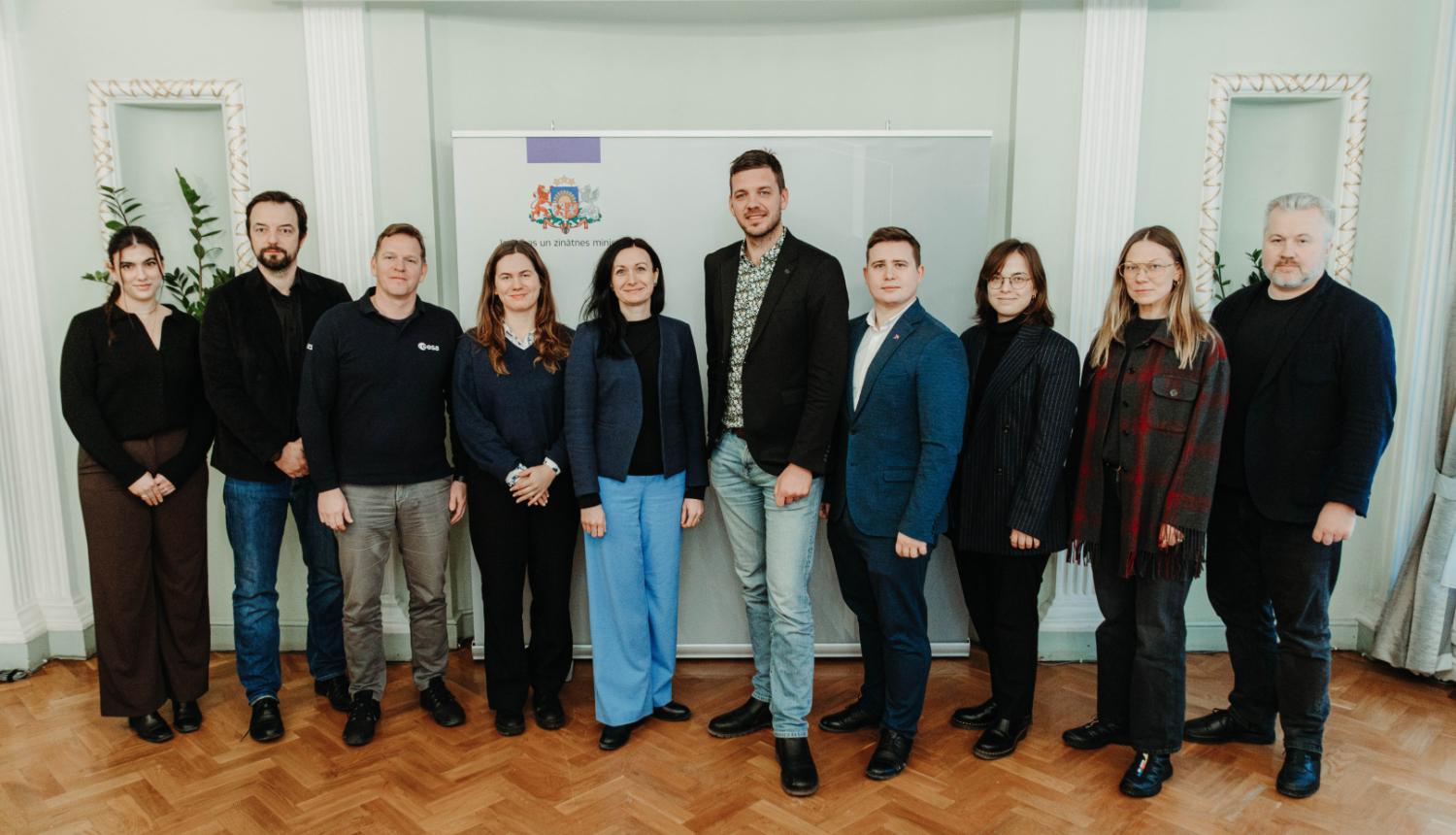
On Wednesday, 14 January, the European Space Agency (ESA) delegate training took place at the Ministry of Education and Science. This was the first time such training was held in Latvia and represents a significant contribution to ensuring effective representation of Latvia within ESA.

The aim of the training was to strengthen delegates’ knowledge of ESA’s operating principles. “Such training is essential for Latvian delegates to effectively represent the country’s interests in ESA decision-making bodies,” emphasizes Kaspars Karolis, Head of the Latvian ESA Delegation. “A better understanding of the agency’s processes helps us to attract funding for Latvian companies and scientific institutions more successfully, as well as ensure greater geographical return, meaning that Latvia’s financial contributions are returned through concrete projects and contracts with Latvian companies as much as possible.”
The training was led by Stephen Airey, head of ESA’s Capability and Country Support Division; Philippe Schweiger (Project Control and Analytics); and ESA Country Desk Officer Karol Brzostowski. Eight representatives participated in the training, representing the Ministries of Education and Science, Economics, and Defence, the Investment and Development Agency of Latvia, the Estonian ESA delegation representative, and ESA’s industrial coordinator in Latvia.
During the training, ESA experts introduced participants to ESA’s governance, financial rules, and the principle of geographical return. The experts also presented ESA’s mandatory and optional programmes, which provide opportunities to strengthen capacity in science, Earth observation, telecommunications, navigation, space safety, and technology development. Particular attention was paid to the procurement system and opportunities for national companies to participate in ESA projects.
Latvia has been an ESA Member State since 2020, and Latvia’s contributions to ESA will reach 6 million euros this year. Well-prepared ESA delegates who understand the agency’s operating principles and represent national interests are a prerequisite for ensuring that this financial investment contributes to the development of Latvian science and the national economy through ESA-implemented projects, including contracts for Latvian companies and scientific cooperation.
The development of space sector policy in Latvia is the responsibility of the Ministry of Education and Science. More information on space-related developments and Latvia’s cooperation with ESA is available on the website www.latviaspace.gov.lv.