Breast milk is far more than a food product — it is a complex composition that supports an infant’s immunity and development from the very first days of life. One of its most significant components is oligosaccharides — specific carbohydrates whose functions and impact on human health are still being actively studied.
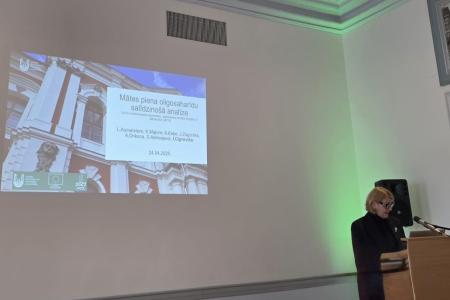
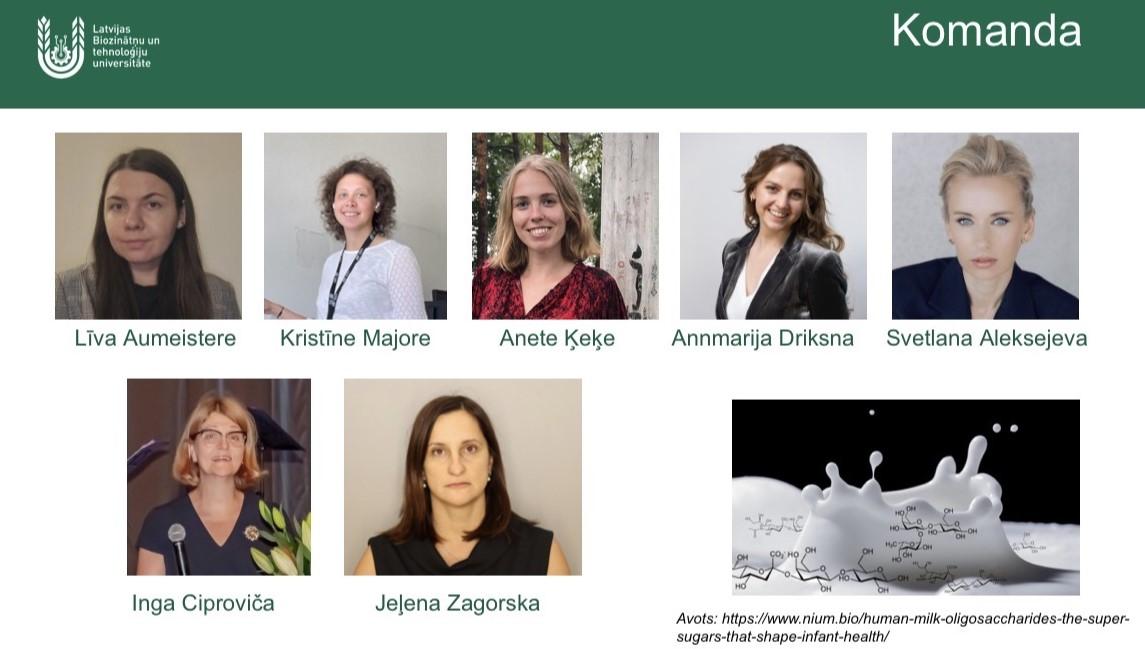
A significant contribution to this field of research has been made by scientists and doctoral students of the Food Institute at the Latvia University of Life Sciences and Technologies (LBTU), who implemented the project “Comparative Analysis of Human Milk Oligosaccharides” (No. 5.2.1.1.i.0/2/24/I/CFLA/002, AF13) within the programme “Strengthening LBTU Institutional Capacity for Excellence in Studies and Research”.
Thanks to the researchers’ dedicated work, a quantitative detection method for oligosaccharides was developed, and the study results were published in the Journal of Food Composition and Analysis (Q1; IF 4.6; Elsevier) and Nutrients (Q1; IF 5.0; MDPI).
Quantitative determination of human milk oligosaccharides often presents major challenges — complex sample pre‑treatment, time‑consuming sample preparation and analysis, as well as difficulties in quantitatively distinguishing structurally similar isomers. To address these challenges, a new analytical method was developed and validated during the project, using ultra‑high‑performance liquid chromatography (UHPLC) coupled with a fluorescence detector (FLD).
The developed method enables simultaneous quantitative determination of eight key human milk oligosaccharides (2′‑fucosyllactose, 3‑fucosyllactose, 6′‑sialyllactose, 3′‑galactosyllactose, 6′‑galactosyllactose, lacto‑N‑difucohexaose I, lacto‑N‑difucohexaose II and lacto‑N‑neotetraose), which are among the most commonly represented in human milk.
The use of ultra‑high‑performance liquid chromatography combined with fluorescence detection provides adaptable detection parameters, high resolution and efficient compound separation, making the method easily applicable to future studies of oligosaccharides of various origins. The method was successfully validated, demonstrating high calibration linearity (r ≥ 0.98) and recovery (71–119%). The limits of detection (LOD) for the analysed oligosaccharides ranged from 5.698 to 7.101 µg mL⁻¹, and the limits of quantification (LOQ) from 17.267 to 21.517 µg mL⁻¹. It shows excellent performance compared with existing HPLC methods, providing a reliable tool for oligosaccharide analysis in human milk and other biological fluids.
Within the study, exclusive data on the composition and concentration of human milk oligosaccharides in breastfed infants’ mothers were obtained for the first time in Latvia, contributing to international research on human milk composition. Moreover, the developed method and the resulting data are of high value for both scientific and applied research, opening new opportunities for interdisciplinary studies.
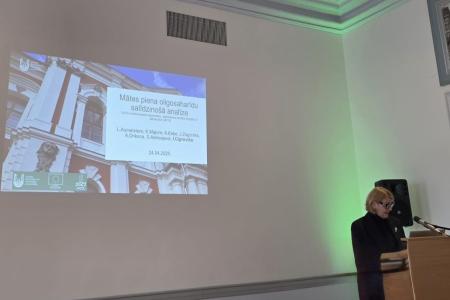
The achievements in method development were presented at the international food science and technology conference FOODBALT 2025 (Kaunas, Lithuania), and the results also received international recognition at the IDF World Dairy Summit 2025 (Santiago, Chile), where the work was awarded as the best poster presentation in the section “Safety & Quality – Chemistry and Composition”.
The study was conducted with the approval of the Ethics Committee of Rīga Stradiņš University (No. 2‑PĒK‑4/616/2024, approved on 21 October 2024). A total of 74 participants took part in the study, and their socio‑demographic and dietary data, as well as milk samples, were analysed, enabling the identification of patterns in the composition and concentration of oligosaccharides in human milk.
The study results are compiled in a data repository and publicly available on the DataverseLV platform via this link.
Authors: Datasets for human milk oligosaccharide comparative analysis / I. Ciprovica, L. Aumeistere, K. Majore, A. Ķeķe, J. Zagorska, A. Driksna, S. Aleksejeva // DataverseLV, Version 2.0 (6 January 2026).