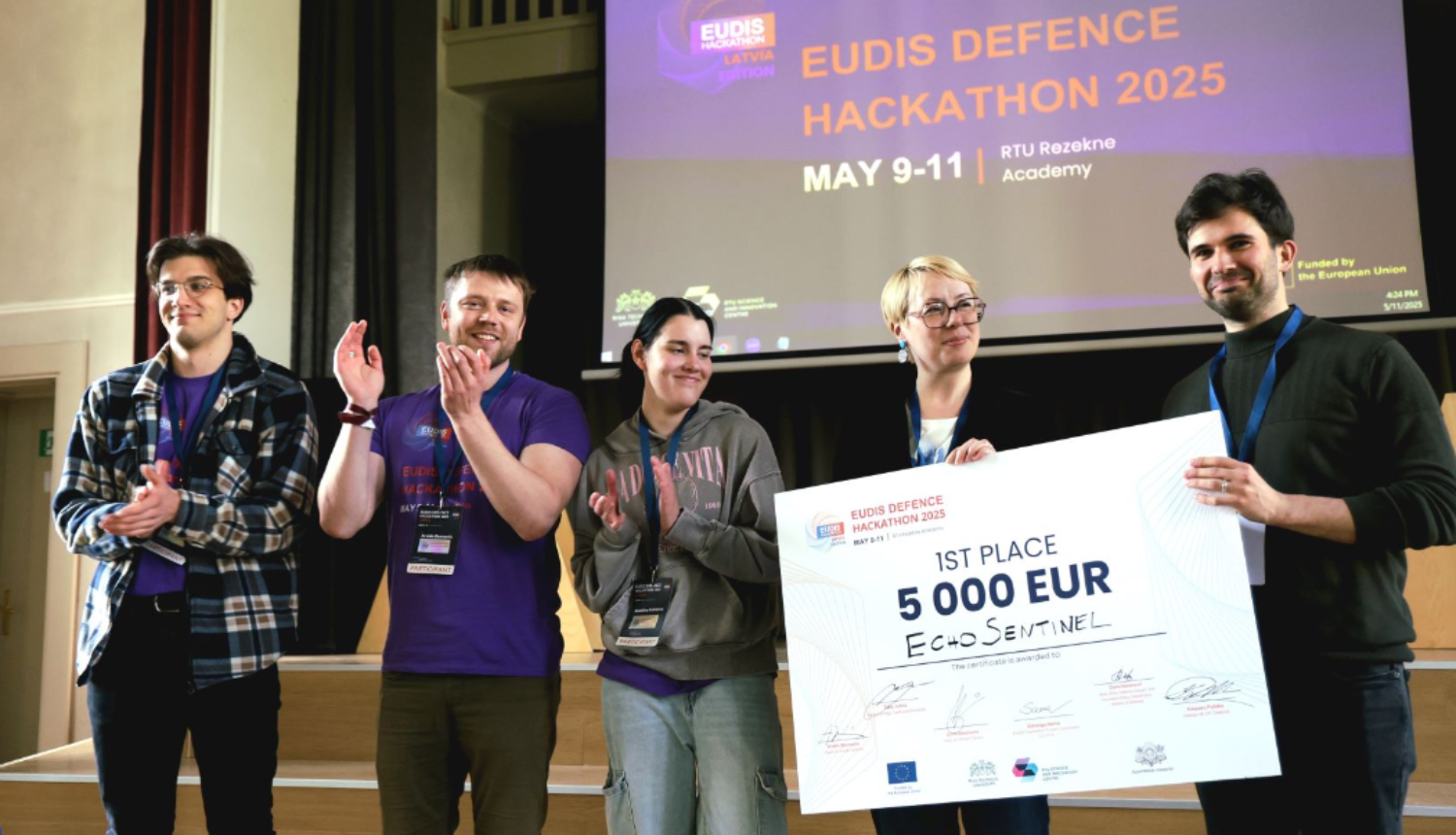
Within 48 hours, the Latvian team EchoSentinel developed a solution that uses artificial intelligence to identify potential threats on the battlefield in real time, winning the Latvian selection of the international defence innovation hackathon EUDIS Defence. In June, the team will represent Latvia in the EUDIS international final, competing against seven other defence innovations.
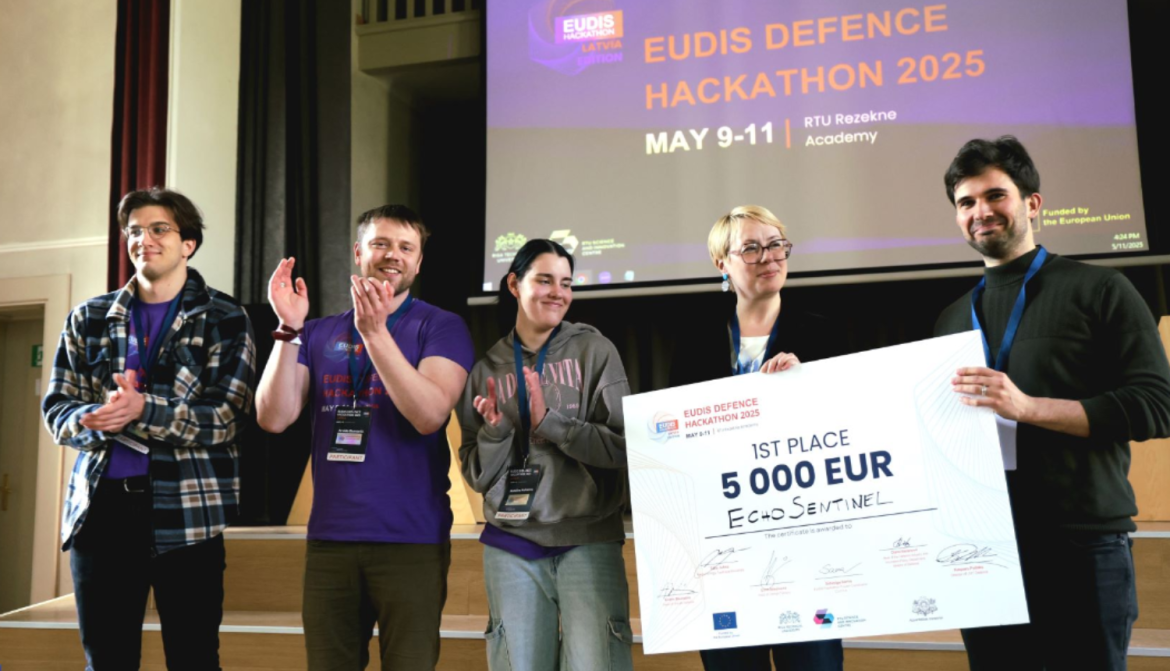
The EchoSentinel team has developed a prototype of a compact acoustic surveillance system specifically suited for complex battlefield conditions, where traditional visual monitoring technologies lose effectiveness. The team includes Latvian scientists and young engineers who have gained their knowledge and skills at Riga Technical University (RTU).
By winning the national selection of the hackathon, the team receives a €5,000 cash prize and the opportunity to further develop their idea in the international EUDIS mentoring program, receiving individual support from experts in defence and innovation. After the mentoring phase, the team will compete in the international finals, where innovators from Germany, Spain, Italy, Poland, Lithuania, Denmark, and the Czech Republic will also present their solutions.
In the national selection, second place and a €3,000 prize was awarded to AiSAT for their satellite-based situational awareness platform. Third place and a €2,000 prize went to GhostNet, which developed a portable and modular surveillance system using a LoRa network. The LMT Defence special prize was awarded to ActionWise for a digital platform aimed at strengthening civilian resilience during crises. A special award from the Latvian National Guard went to Thunder Point/Pērkonpunkts for a portable open-source RF sensor system.
The international defence hackathon was held in Latvia for the first time, bringing together nearly 70 participants. A total of 17 teams developed prototypes and concepts based on identified needs in the defence sector. Around 30 industry mentors – including engineers, researchers, and defence professionals – supported the participants.
“The EUDIS hackathon proves that Latvia not only has technical and academic competence but also a genuine drive to create practical solutions for Europe’s security. This platform successfully brought together young talents, scientists, innovators, and defence experts, fostering close collaboration with the Ministry of Defence, the Defence Innovation and Technology Centre, the National Guard, and entrepreneurs,”
emphasised Elīna Miķelsone, Head of RTU Science and Innovation Centre’s Design Factory.
The hackathon was hosted at the RTU Rēzekne Academy. The decision to organise the event in Rēzekne was a strategic step to boost innovation in Latvia’s regions.
“Large-scale events like this rarely happen outside the capital, so we are especially proud that following the establishment of RTU Rēzekne Academy, this was the first opportunity to hold an international security innovation event right here in Latgale. It allowed local students to engage in current defence processes and demonstrated that distance is no obstacle. This experience marks an important direction for further regional involvement and deeper collaboration with partners such as the Ministry of Defence, the National Guard, LMT Defence, the university incubator UniLab, and others,” said Olga Vindāča, Deputy Director for Science and Innovation at RTU Rēzekne Academy.
EUDIS Defence in Latvia was organised by the RTU Science and Innovation Centre in cooperation with the Ministry of Defence of Latvia and LMT Defence. The hackathon took place simultaneously in eight European countries. A wide range of partners supported the event, including the Defence Innovation and Technology Centre, SIA Belss, SIA Baltic Photonics, the 3rd Latgale Brigade and 32nd Infantry Battalion of the National Guard, and the National Guard Innovation Centre.