We invite you to read literary scholar Zita Kārkla’s analysis of writer Inga Ābele’s short stories, published on the literature and philosophy portal punctummagazine.lv.
“By giving preference to atmosphere, gestures and the subtle intensity of lived experience, the world of Ābele’s stories becomes real not only through recognisable details and events, but also through the way the reader is drawn into and immersed in its material presence.”
Traditionally, when thinking about realism in literature, the first association is familiarity: people, places and events that can be recognised from one’s everyday experience create the sense that the world depicted could also exist outside the text. However, literature does not reflect reality neutrally; it is the result of choices: what to pay attention to and what to leave out. Therefore, the question may be not only: how accurately does literature depict the world, but also: how does literature allow this world to be experienced as real?
The relationship between realism and affect can be clarified through Fredric Jameson’s view of the tension between plot progression and affect – an intensely felt experience of the present that cannot always be fully subordinated to the logic of narrative. Jameson emphasises that a new understanding of realism becomes possible by taking into account both its origins in the tradition of storytelling and its possible dissolution in the literary representation of affect.1 Such a perspective makes it possible to focus not only on how the literary text organises events, but also on how it creates the sensory and emotional intensity of a particular moment.
Hans Demeyer and Sven Vitse, in turn, analysing contemporary prose, question the assumption that a return to realist form in itself means drawing closer to reality. In their view, what matters is not that literature simply returns to reality, but rather how literature’s relationship with it changes. They conclude that in contemporary prose reality is increasingly represented affectively: through sensations, desires, attachment, bodily experience and a person’s efforts to feel themselves as part of the world.2
Reading Inga Ābele’s short stories Mainīga virziena vējš. Vīrietis and Mainīga virziena vējš. Sieviete from the collection Sniega laika piezīmes (2004) from this perspective, it is possible to discern the affective dimension of realism – the world in the text is created not only through recognisable details, but also through the way reality is felt bodily; for example, snow makes walking difficult, cold enters the house and the body, the spring air is almost unbearably dense, and in the warm humidity it becomes difficult to breathe.
When “Nothing Happens”
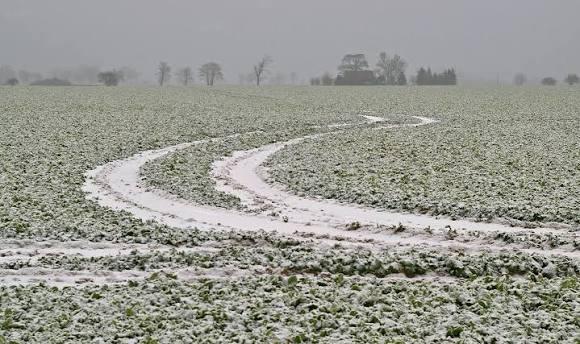
For example, in the short story Mainīga virziena vējš. Vīrietis, Pāvils and Ieva are stuck in the snow on a country road. Their limited possibilities for movement echo the stagnation of their relationship. Ieva thinks about why they are together at all and whether love has been replaced by simple convenience.4 However, these questions are not resolved in an open conversation or a dramatic separation scene; instead, the narrative highlights the bodily experience created by cold and exhaustion.
“The car stuck in the snow creates a parallel with the dead end in the relationship, but this parallel is not merely symbolic – the inability to continue the journey becomes a situation in which the tension in the relationship is experienced bodily: “They had walked only a little over ten metres, but Ieva’s heart suddenly multiplied a hundredfold… a tiny, hot woodpecker hammered in every tissue. [..] They stood in the snow and breathed heavily… Standing still, they immediately became cold.”5 The accelerated heartbeat, heavy breathing and discomfort caused by the cold make the impact of the environment bodily perceptible. The slowing of the plot does not mean that experience comes to a halt, but rather allows the affective dimension of reality to be highlighted, revealing itself in intense sensations and unspoken emotional tension.”
Permeable Bodies
Spring in the short story Mainīga virziena vējš. Sieviete is also experienced intensely through the body: “In this heat and dense fertility, it was difficult to breathe,”8 making it possible to interpret the changing of the seasons not only as life-giving, but also as physically oppressive, almost suffocating. The forest, in turn, by luring Ieva “into its nets” and entangling her in its “side paths,”9 influences her movement, while the verbs denoting entanglement and intertwining create an image of the forest as an active agent that not only surrounds Ieva, but also directs her experience.
The climax of the story is a fire that breaks out as people burn last year’s dry grass. As the wind changes direction, the fire gains uncontrollable force and rises “above a person’s head,”10 revealing the limited ability of human beings to influence the surrounding environment and control the course of events. In the struggle with the fire, Ieva’s possibilities for action narrow down to the necessity of enduring: “[S]he cannot resist, she cannot stop, she cannot do anything.”11 And only when the wind dies down do the flames become calmer. Much like the snow in the winter story, the fire in the spring story makes the bodily vulnerability of the human being and dependence on environmental conditions palpable; in both stories, the environment becomes an active shaper of experience and a directly felt reality.
The Woman Who Watches
In both Mainīga virziena vējš. Vīrietis and Mainīga virziena vējš. Sieviete, the world is revealed largely through the prism of Ieva’s experience: she observes, feels, thinks, doubts, remembers and reacts to what is happening around her. In the episode in which Ieva washes her hair in rainwater: “Her hair slowly sinks into the water, becoming roots. Now she is a tree, greedily pumping into its trembling trunk something from the rainbird’s song…,”12 Ieva’s transformation into a tree not only blurs the boundaries between species, but also marks a possibility of escaping regimes of productivity, control and interdependence, opening up an alternative perspective of knowing based on attunement to the environment and openness to its effects. Later in the story, Ieva’s yielding to the allure of the forest and becoming entangled in its nets embodies what might be called feral intimacy – a bodily openness to experiences that destabilise the model of domesticated femininity.13
Ieva’s fascination with black-and-white photography, in turn, becomes one of the ways in which she chooses what to look at and how to look at it: “Pictures never seen before were revealed. She could walk through the sparklingly bare avenue, lashed by the black whips of branch shadows and bleached by sunlight, and switch on black-and-white vision.”14 Photography not only captures the surrounding environment, but also transforms Ieva’s relationship with it: the familiar landscape becomes visible with a new intensity, and its meaning is shaped through Ieva’s individual, sensory perspective. Ieva’s act of looking also becomes an expression of autonomy, affirming that there are paths each person must walk alone: “Two people cannot look through the camera viewfinder at the same time, and two people cannot press the shutter, that is a law of physics.”15 Pāvils’s presence is not rejected, but it is not necessary. Here, the material environment, sensory perception and Ieva’s desire for autonomy interact with one another, revealing reality as an individually felt and interpreted experience.
By giving preference to atmosphere, gestures and the subtle intensity of lived experience, the world of Ābele’s stories becomes real not only through recognisable details and events, but also through the way the reader is drawn into and immersed in its material presence, where the boundaries between the human being and the environment, subject and object, the familiar and the unfamiliar are no longer self-evident.
Inga Ābele (1972) – writer. Best known as a prose writer and playwright, she also writes poetry. Due to her unique writing style, she is regarded as one of the most significant contemporary Latvian writers. She has received the Latvian Literature of the Year Award for the book "Lugas" (Atēna, 2003), the short story collection "Sniega laika piezīmes" (Atēna, 2004), and the novels "Paisums" (Dienas Grāmata, 2008) and "Klūgu mūks" (Dienas Grāmata, 2014).
The article was written as part of the Fundamental and Applied Research Project Programme funded by the Latvian Council of Science (project “Reclaiming Latvian Realism: Literary Innovations as a Search for Identity” (lzp-2024/1-0341)).
- Jameson, Frederick. The Antinomies of Realism. Verso, 2015. P. 10. (back to the article)
- Demeyer, Hans; Vitse, Sven. Affective Crisis and the Possibility of Attachment: A Comparative Study of Contemporary Fiction in Neoliberal Ruins. London: UCL Press, 2026. Pp. 7–8. (back to the article)
- Berelis, Guntis. Inga Ābele “Sniega laika piezīmes”. Karogs, Nr. 2., 2005. P. 120. (back to the article)
- Ābele, Inga. Mainīga virziena vējš. Vīrietis. Sniega laika piezīmes. Rīga: Dienas Grāmata, 2004. P. 86. (back to the article)
- Ibid., P. 94. (back to the article)
- Ābele, Inga. Mainīga virziena vējš. Sieviete. Sniega laika piezīmes. Rīga: Dienas Grāmata, 2004. P. 150. (back to the article)
- Alaimo, Stacy. Bodily Natures: Science, Environment, and the Material Self. Bloomington: Indiana University Press, 2010. P. 2. (back to the article)
- Ābele, Inga. Mainīga virziena vējš. Sieviete. Sniega laika piezīmes. Rīga: Dienas Grāmata, 2004. P. 132. (back to the article)
- Ibid., P. 131. (back to the article)
- Ibid., P. 158. (back to the article)
- Ibid., P. 157. (back to the article)
- Ibid., P. 102. (back to the article)
- Kukaine, Jana; Kārkla, Zita. Feral Intimacy: Feminist Transformations Through Solitary Forest Walks. Women’s Studies, Vol. 54 (6), 2025. P. 636. (back to the article)
- Ābele, Inga. Mainīga virziena vējš. Sieviete. Sniega laika piezīmes. Rīga: Dienas Grāmata, 2004. P. 137. (back to the article)
Ibid., P. 138. (back to the article)
Literary scholar Zita Kārkla researches the history of Latvian women’s writing in order to highlight women writers’ contribution to literature and analyse the historical role of women in everyday life and society. We invite you to watch a video story about Zita Kārkla’s work: