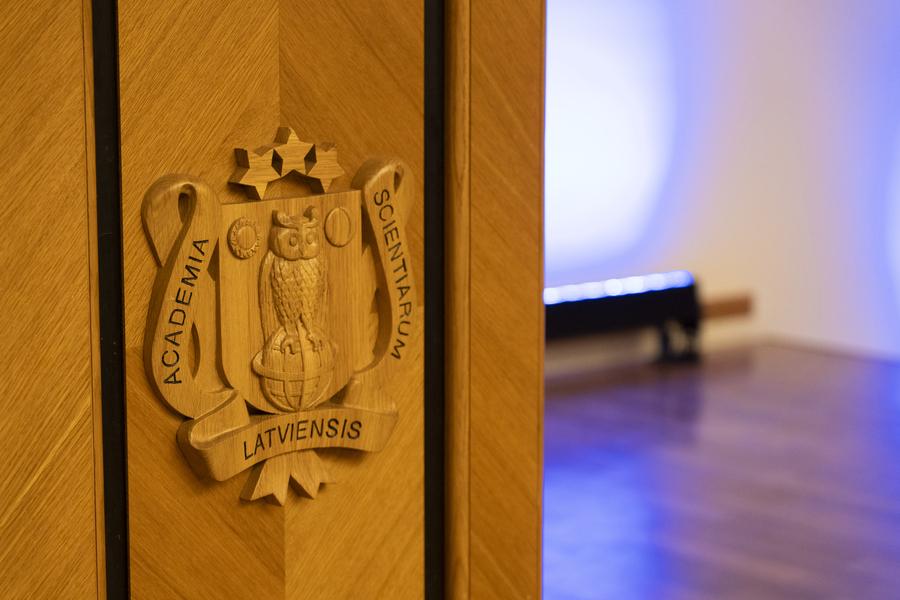
This year, the named awards established by the Latvian Academy of Sciences (LAS) and its cooperation partners will be presented to eleven scientists, including several early-career researchers, and five prizes for young scientists will also be awarded. The awards will be presented on Thursday, April 9, during the LAS Spring General Assembly. The following awards have been granted:
LZA Named Awards
Arturs Balklavs Award for the Popularization of Science – Mg. phys. Rihards Ruska (Institute of Solid State Physics, University of Latvia) for his contribution to bringing science and society closer together.
Edgars Siliņš Award in Physics – Corresponding Member of the Latvian Academy of Sciences (LAS) Aivars Vembris (Institute of Solid State Physics, University of Latvia) for the body of work “Studies and Applications of the Light-Emitting Properties of Organic Small-Molecule Materials.”
Arveds Švābe Award in History – Full Member of LAS Valdis Bērziņš for comprehensive, source-based, and scientifically significant research that substantially enriches the understanding of 20th-century Latvian history.
Heinrich Skuja Award in Biology – Corresponding Member of LAS Viesturs Melecis for long-term ecological research and the publication of its results.
Kaspars Bušs Award in Forest Ecology and Silviculture – Dr. biol. Baiba Bambe (Latvian State Forest Research Institute “Silava”) for her contribution to preserving Kaspars Bušs’s scientific legacy and to the study of forest and peatland ecosystems in Latvia.
Arvīds Kalniņš Award in Wood Science – Full Member of LAS Aivars Žūriņš (Latvian State Institute of Wood Chemistry) for the collection of works “Thermochemical Studies of Wood” and his significant contribution to wood science in Latvia.
Named Awards for Early-Career Scientists
Ludvigs and Māris Jansons Award in Physics – Mg. phys. Adriana Mauručaita (Institute of Solid State Physics, University of Latvia) for the work “Thermoelectric Properties of Antimony Telluride and Organic Small-Molecule Composite Materials.”
Supervisor: Dr. phys. K. Pudžs.
Vitauts Tamužs Award in Mechanics – Mg. sc. ing. Karunamoorthy Rengasamy Kannathasan for the work “Thermomechanical Properties of New Types of Concrete with Advanced Reinforcement.”
Supervisor: Full Member of LAS A. Krasņikovs.
Solomon Hiller Award in Biomedicine and the Development of New Medicinal Products – Ph.D. Viktorija Vitkovska for the work “Simplified Diazonomide A Analogues as Anticancer Agents.”
Supervisor: Full Member of LAS E. Sūna.
Zenta Mauriņa Award in Philosophy – Mg. Dāvis Kaspars Sproģis for the work “The Role of ‘Forgetting’ in the Genesis of Hegel’s ‘System of Science.’”
Supervisor: Dr. phil. E. Šimfa.
Arvīds Kalniņš Award for a Young Scientist – Ph.D. Edgars Kuks (Latvian State Institute of Wood Chemistry) for the collection of works “Study of Degradation Processes and Environmental Risks as a Basis for the Development of Innovative Wood Materials.”
Young Scientist Awards
Young Forest Scientist Award – Dr. silv. Aldis Butlers (Latvian State Forest Research Institute “Silava”) for scientific work on improving methods for the accounting and forecasting of greenhouse gas emissions.
Young Forest Scientist Award – Mg. biol. Gundega Done (Latvian State Forest Research Institute “Silava”) for scientific work on studying the impact of deer species on forest regeneration.
LAS Young Scientist Award – Mg. phys. Didzis Salnājs (Institute of Solid State Physics, University of Latvia) for the work “Long-Persistence Luminescence Properties under Ultraviolet Radiation in Materials Containing Pyrophosphate Groups.”
Supervisor: Dr. phys. Andris Antuzevičs.
LAS Young Scientist Award – Mg. biol. Alise Zommere for the study “Biorefining of Forest Harvest Residues for the Production of Biologically Active Extracts and Their Fractions.”
Supervisor: Ph.D. L. Kļaviņš.
LAS Young Scientist Award – Ph.D. Kristaps Saršūns (University of Latvia) for the work “Formation of Solid Solutions and Characterization of Physicochemical Properties in Multicomponent Systems of Structurally Similar Organic Molecules.”
Supervisors: Dr. chem. A. Bērziņš, Dr. chem. T. Rēķis.