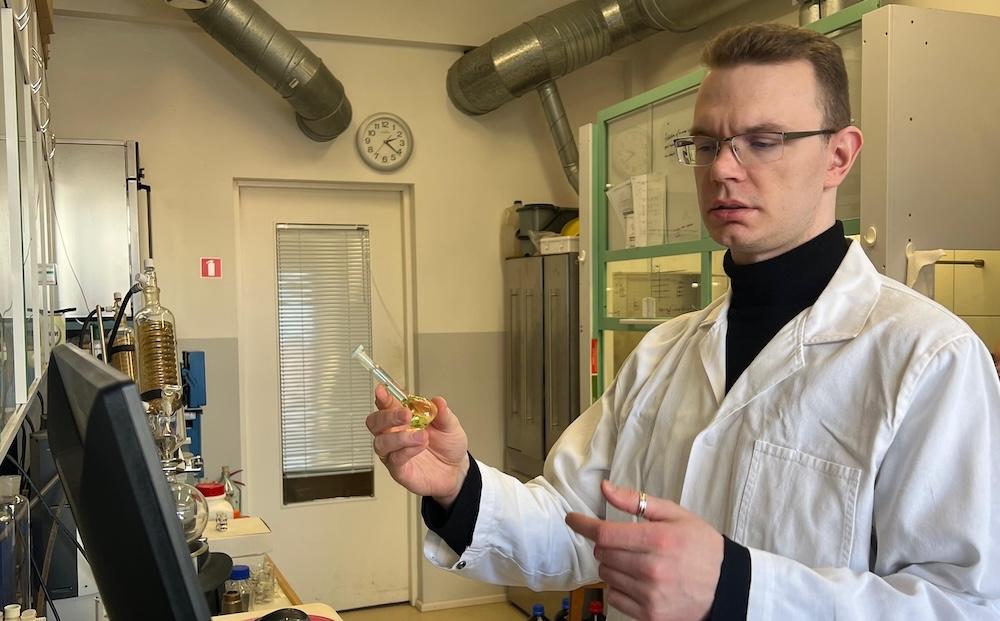
The deep-tech startup “OLEC Technology” is developing a technology that allows thin, flexible, and energy-efficient lighting panels to be manufactured more simply and potentially at lower cost than with traditional LED technologies.
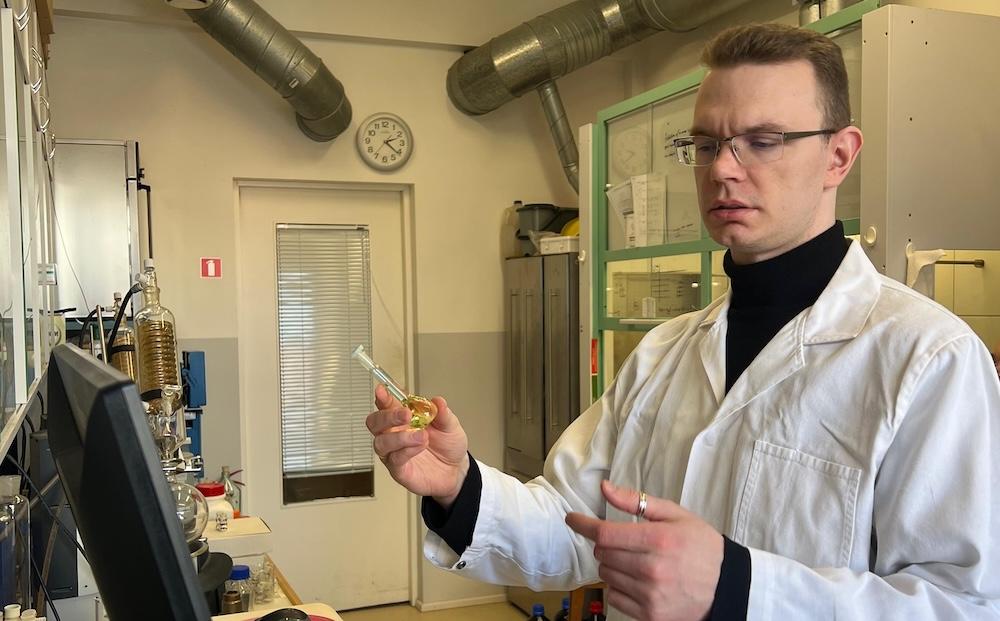
Currently, most LED component manufacturing takes place in China and other Asian countries, making Europe dependent on imports of these technologies.
“Our goal is to develop an alternative technology that can be manufactured in Europe, strengthening technological independence and local industry. Simply put, we are working on next-generation lighting that can be more sustainable, more flexible in design, and strategically important for European industry,” explains Kaspars Leduskrasts, co-founder of “OLEC Technology.”
Born at the Latvian Institute of Organic Synthesis
OLEC Technology originated at the Latvian Institute of Organic Synthesis (OSI), where new organic materials with potential applications in lighting technologies were developed over several years.
“OLEC Technology” as an independent startup was founded at the end of 2023, when OSI scientist Kaspars Leduskrasts met entrepreneur Oskars Gūtmanis through the science commercialization program “Commercialization Reactor.” K. Leduskrasts participated in the program as a scientist, while O. Gūtmanis joined the initiative to better understand what scientists in Latvia and other countries are working on. This is how they met, found a shared vision, and step by step are advancing the project.
“From the very beginning, we understood that the road would neither be easy nor fast, as this is a science-intensive technology at an early stage. However, it is truly inspiring to see people’s surprise when they learn that a solution is being developed in Latvia that could significantly change how lighting is created and used worldwide,” says O. Gūtmanis.
He adds that too often promising technologies remain on laboratory shelves once research funding ends, which is why he is pleased that OSI is commercializing its scientific discoveries.
More sustainable and environmentally friendly
K. Leduskrasts explains that OLEC is a new type of lighting technology in which light is generated by a thin printed layer of organic chemical material supplied with electricity. In contrast, LEDs use a solid crystal that emits light as a bright point, whereas OLEC emits light evenly across the entire surface, making it possible to produce large, flexible, and even transparent light panels.
“Since this material can be printed using relatively simple equipment and widely available substances, such lighting can be manufactured in many parts of the world—not only in China, where 90% of the world’s lighting is currently produced. Moreover, OLEC light chips can be recycled, whereas LEDs are one of the fastest-growing components of electronic waste,” notes K. Leduskrasts.
One of the advantages of OLEC technology is sustainability, which manifests in several ways. First, compared to LEDs, OLEC light chips do not use rare earth materials, which are mostly sourced in China and whose processing is harmful to the environment. Second, the production of OLEC light chips is up to 20 times more energy-efficient than LED manufacturing, as it does not require vacuum and other energy-intensive technologies. Third, unlike LEDs, which are nearly impossible to recycle due to their complex structure, OLEC can be recycled.
Ready to change the world
The short-term goal of “OLEC Technology” is to develop its patent portfolio and bring the technology to industrial readiness in cooperation with international partners in the lighting and materials industries. The long-term goal is to license the technology to global market players and become a significant innovator in sustainable lighting.
“Our technology is the lighting of the future—it may eventually replace LED and OLED lighting in various applications. If that happens, this technology will change the world,” says K. Leduskrasts.
How long will it take? He notes that, based on the development of LED and other lighting technologies, it typically takes decades from scientific discovery to widespread application. The technology must be continuously improved and adapted to different uses. However, “OLEC Technology” does not plan to become a lighting manufacturer—the startup’s goal is to develop the technology and its related intellectual property and license it to established industry companies.
“This is common practice in this industry. To succeed, strong, focused, and persistent people are needed, along with funding and a bit of luck, but I believe that in Latvia we have everything necessary to achieve this,” K. Leduskrasts is convinced.
Laboratory prototypes already developed
On its development path, “OLEC Technology” has participated in several acceleration programs—not only “Commercialization Reactor,” but also Lithuania’s “Plug&Play Accelerator,” “BSV Ventures,” and INAM.
“We have taken something valuable from each acceleration program. The ‘Commercialization Reactor’ and ‘BSV Ventures’ programs helped us better understand the specifics of science-intensive technologies and intellectual property issues. ‘Plug&Play Accelerator’ opened the opportunity to attract them as investors—we are currently finalizing the formalities to make this happen. This gives us access to a broad international cooperation network that will be very important in the next stages of development. Meanwhile, the INAM program provided contacts with industry experts in Germany, whose experience significantly helped refine our business plan,” says K. Leduskrasts.
Laboratory prototypes have now been developed and tested, and the technology is being optimized in preparation for the next development stage—industrial validation. Exclusive commercialization rights to the core patent have also been secured. The first functional prototypes have been developed and tested, and cooperation with research institutions has been established.
For early-stage startups, it is difficult to begin cooperation with large industrial companies, so they use every available opportunity. With the support of the Investment and Development Agency of Latvia (LIAA) and encouragement from Elīza Drāzniece, Head of the Representative Office of Latvia’s External Economic Service in France, “OLEC Technology” applied for the “Grand Prix ACF AutoTech” challenge, focusing specifically on the automotive sector and identifying promising applications of the technology in rear car lights.
“Reaching the finals of this competition gave us the opportunity to present our solution to leaders in the French automotive industry, which led to further discussions. They are currently waiting for our first tangible prototypes with improved performance, which we are already actively developing,” reveals K. Leduskrasts.
Preparing to attract investment
So far, “OLEC Technology” has secured a €50,000 pre-seed investment from “Commercialization Reactor.” The startup has also received an ERDF grant in a joint project with OSI and the Institute of Solid State Physics of the University of Latvia. Together, the partners are researching a new approach to creating a light-emitting material to increase its brightness. The total grant amounts to €655,000, of which approximately €133,000 is allocated to “OLEC Technology.” The startup has also applied to the European Innovation Council’s pre-acceleration program.
“If we receive the funding, it will allow us to develop prototypes that meet automotive industry requirements within two years. In addition, further development will require support from the LIAA startup program and venture capital investments,” notes O. Gūtmanis.
Currently, the startup is in discussions to attract its next round of investment. At this stage, the company’s focus is on research and development. In this pre-seed phase, “OLEC Technology” requires approximately €700,000 over 24 months to advance the technology to a level that would enable proof-of-concept projects with the automotive industry and preparation for a seed investment round.
“We have spoken with various Baltic and international venture capital funds—at this stage, scientific risks remain high, so investors are cautious. Therefore, we plan to secure most of the funding from grant programs and public support instruments, complemented by venture capital investments,” says O. Gūtmanis.
________________
The article was produced with funding from the European Regional Development Fund project “Development of Innovative Entrepreneurship in SMEs.”