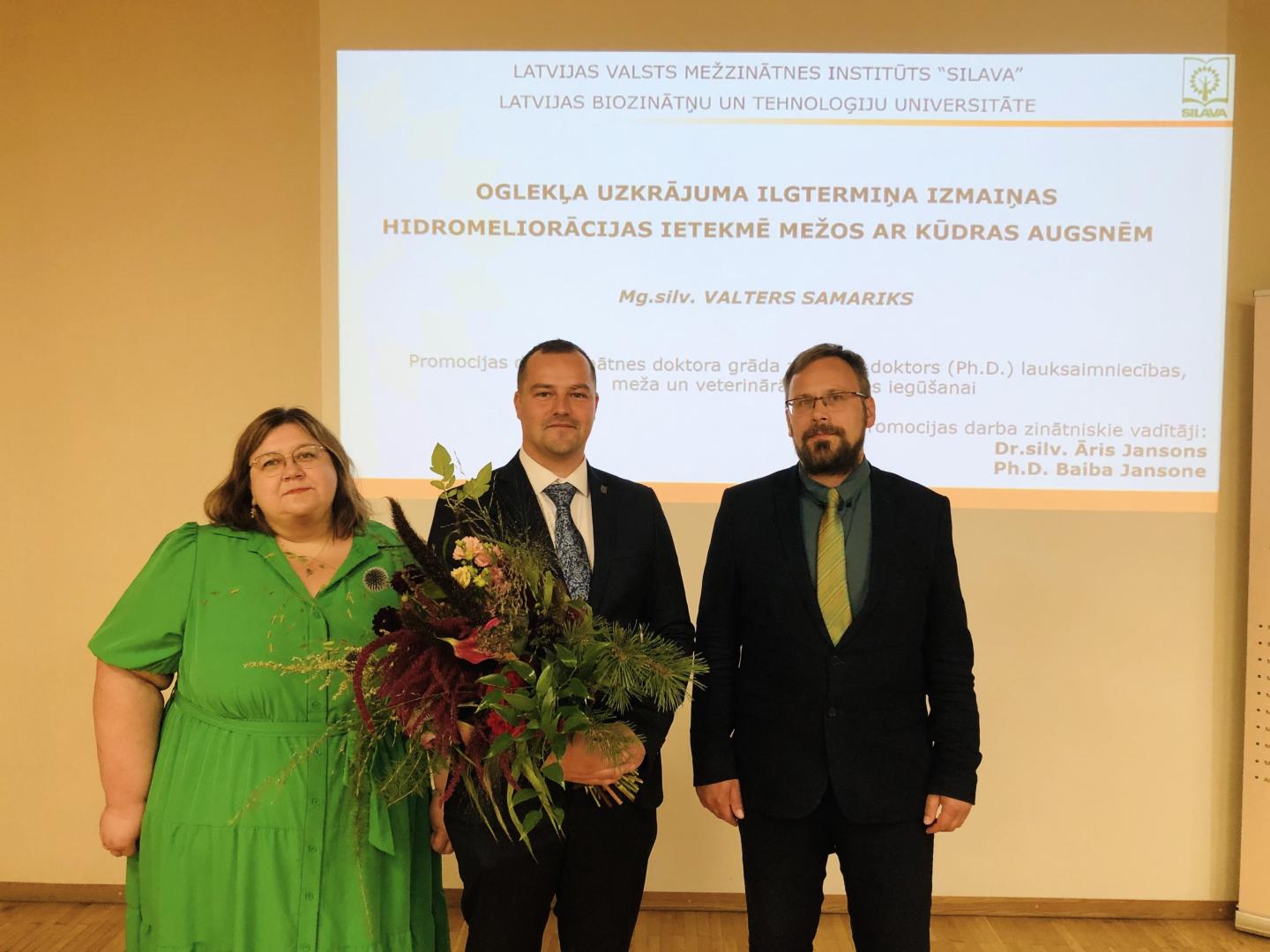
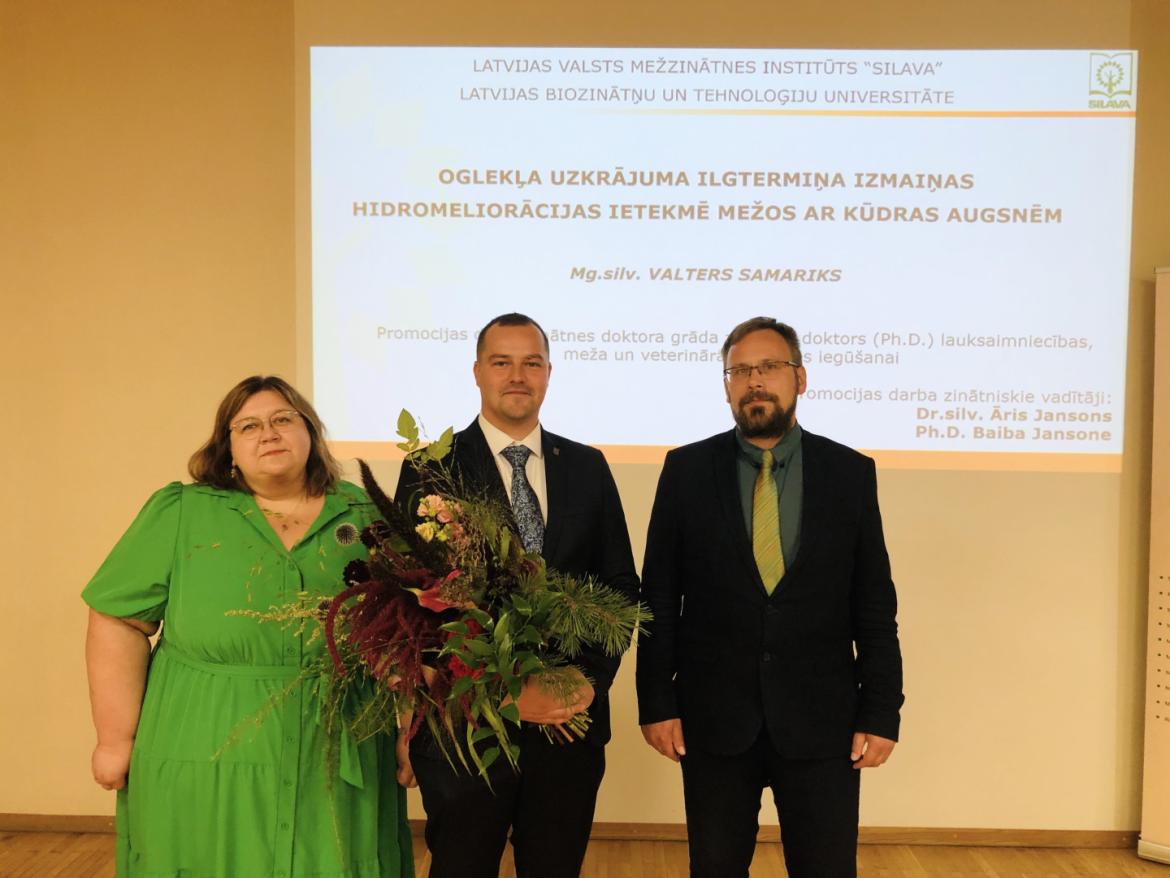
On 26 August, at the library of the Latvian State Forest Research Institute “Silava”, Valters Samariks (ORCID: 0000-0001-9953-0455) successfully defended his doctoral thesis, a thematically unified collection of scientific publications entitled “Carbon Stock Changes after Long-Term Drainage in Forests on Organic Soils” (Oglekļa uzkrājuma ilgtermiņa izmaiņas hidromeliorācijas ietekmē mežos ar kūdras augsnēm).
As a result, he was awarded the academic degree of Doctor of Science (Ph.D.) in Agricultural, Forestry and Veterinary Sciences.
The aim of the doctoral thesis was to assess the long-term effects of forest drainage on soil greenhouse gas emissions and carbon stock dynamics in the main carbon pools of mature coniferous stands growing on mesotrophic organic soils.
“Forest ecosystems are an essential component of the global carbon cycle, functioning both as significant carbon reservoirs and as dynamic regulators through carbon sequestration and the exchange of greenhouse gases (GHGs) between the biosphere and the atmosphere. In recent decades, the role of forests in climate change mitigation and biodiversity conservation has been increasingly emphasized in international and regional policy documents. The European Union has set objectives for climate change mitigation and adaptation, as well as for achieving and maintaining climate neutrality by 2050 and beyond. Quantifying forest carbon stocks at regional and national levels is crucial for the development of science-based management and policy strategies, thereby improving the accuracy of carbon accounting, promoting adaptive forest management, and supporting the achievement of biodiversity and climate goals,” explains the young researcher, Valters Samariks.
“The hemiboreal region of Northern Europe, which includes Latvia, Estonia, southern Sweden, and parts of Finland, represents a transition zone between boreal coniferous forests and temperate deciduous forests. Latvia has the largest forest area among the Baltic states, providing substantial timber resources, and demand for these resources is expected to increase in the future. Forests cover 53% of Latvia’s land area. Norway spruce (Picea abies) and Scots pine (Pinus sylvestris) are the principal forestry species, together accounting for 45% of the total forest area (NFI 2023). The interaction of a maritime climate, post-glacial topography, and high soil moisture has promoted the extensive development of organic soils and peatlands. In Latvia, 23% of forests are located on organic soils.”
To achieve the objective of the study, several research tasks were undertaken: the impact of forest drainage on carbon stocks in tree biomass and deadwood was evaluated; the effects of drainage on soil carbon stocks and greenhouse gas emissions were characterized; and the influence of drainage on carbon accumulation in ground vegetation, fine roots, and litter was assessed.
Supervisors of the doctoral thesis:
- Dr. silv. Āris Jansons (ORCID: 0000-0001-7981-4346)
- Ph.D. Baiba Jansone (ORCID: 0000-0003-4359-7882)