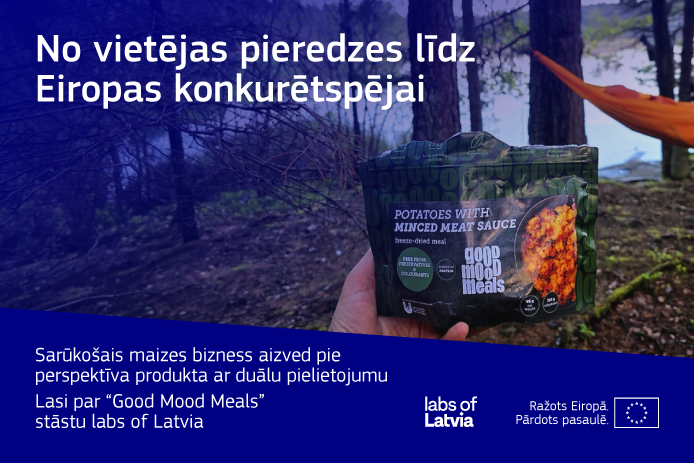
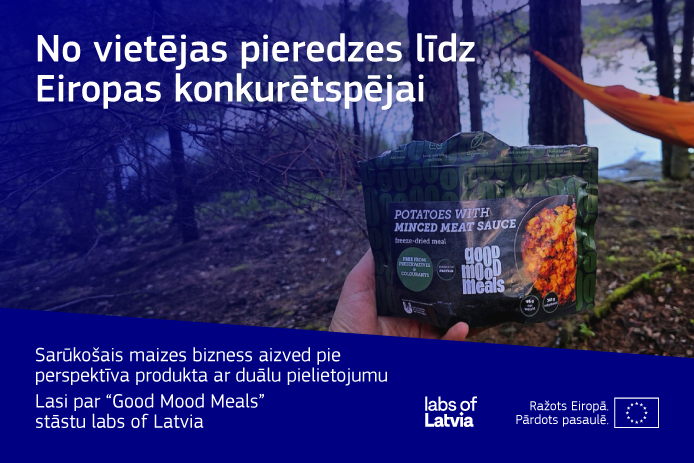
Valdis and Oņega Circeņi from Salaspils, who have experience in the bread business, noticed that with each generation the demand for traditional rye bread is declining, so they decided to look for a new, export‑oriented niche. This led to the creation of the company “Roga‑Agro” brand “Good Mood Meals” — lyophilised food, or freeze‑dried food, with a long shelf life, reports the programme “Uzrāviens”.
The European Union (EU) considers lifelong learning as one of the central pillars of its education, employment, and social policy. It is not a single specific regulation, but rather a broad strategy supported by several frameworks and initiatives. The EU defines lifelong learning as activities undertaken to improve knowledge, skills, and competences for personal, civic, social, or employment‑related purposes. And it is not only formal academic education. It is also the school of life — both knowledge acquired through self‑learning and simply through life experience.
The Circeņš family does not lack life experience. In business, they have experienced everything that a Latvian entrepreneur could encounter — starting with capital accumulation in the chaotic 1990s, which even included dealing with racketeering, to the ability to adapt to new challenges today. Realising that the rye bread market is shrinking, the entrepreneurs reoriented themselves and began producing lyophilised food.
Good Mood Meals lyophilised meals are initially prepared similarly to homemade food, after which they are frozen and dried under vacuum. When the buyer has purchased it in a store and wants to prepare it, the contents of the package must be poured over with hot water. This type of food is convenient for those for whom every gram of weight matters during travel, for example, mountaineers. It is also sometimes the case that “Good Mood Meals” are ordered for corporate events or bought to take along on skiing trips to resorts where restaurant meals are too expensive. The eight‑year shelf life of the product facilitates the sales process, as it is very attractive to retailers.
All of the above factors allow the product to be used in the dual‑use segment — these meals can also be used in the military sector and in crisis situations, where long‑term food storage is essential. The European Union considers food a strategic resource, and Europe is also striving to avoid excessive dependence on external suppliers. Therefore, locally produced products with traceable supply chains will certainly have advantages in the future.
The company has also attracted scientific support from the Latvia University of Life Sciences and Technologies for the development of its idea. For digitalisation, it used funding from the Latvian Investment and Development Agency, as in addition to production the company is also developing e‑commerce, which has become an important sales channel. Meanwhile, with support from the Rural Support Service, solar panels have been installed, for example.
More than 30 years of experience in business also allows the Circeņš family to look at their new field of entrepreneurship with a rational perspective. “If you go slower, you will go further,” says O. Circene.
V. Circenis explains that the company is growing organically: “We do not use venture capital. The development is slower, but more predictable.” The target market for “Good Mood Meals” is export, as in Latvia this niche is small and all potential clients have already been identified. “You cannot look only at your local market. Otherwise, you’ll run into trouble later,” V. Circenis is convinced.
When setting prices, the company also looks not at the Latvian price level, but at the global market.
The Circeņš family has diversified its business risks. In addition to “Good Mood Meals”, the company’s portfolio includes catering, a shop, a farm, and real estate. In theory, the family would have had enough work even without innovation in the food sector. The new business direction was initiated by O. Circene. “It’s my fault. Valdis asked — do you need this? I had the strength, and I wanted to create a good product,” she says.