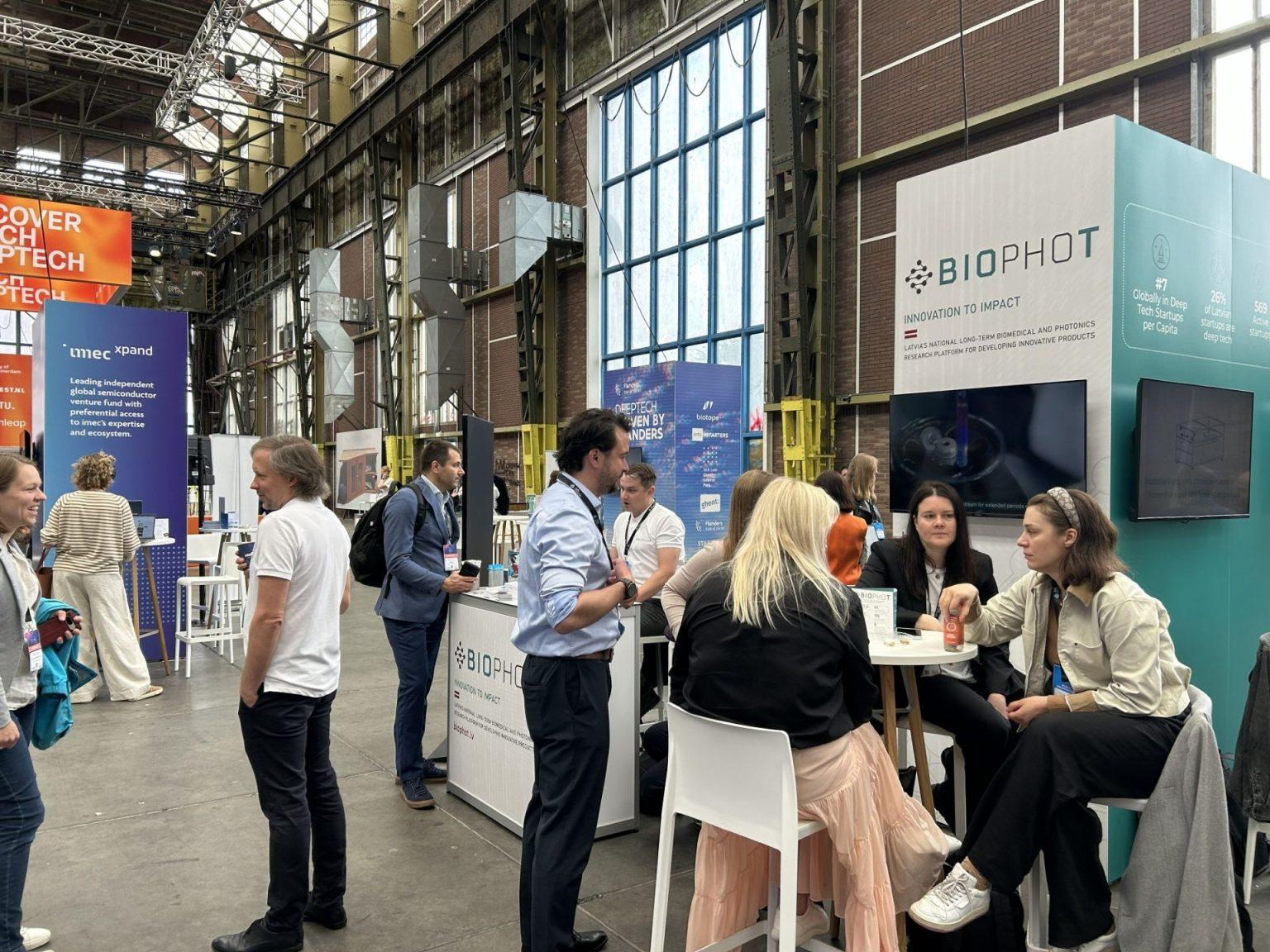
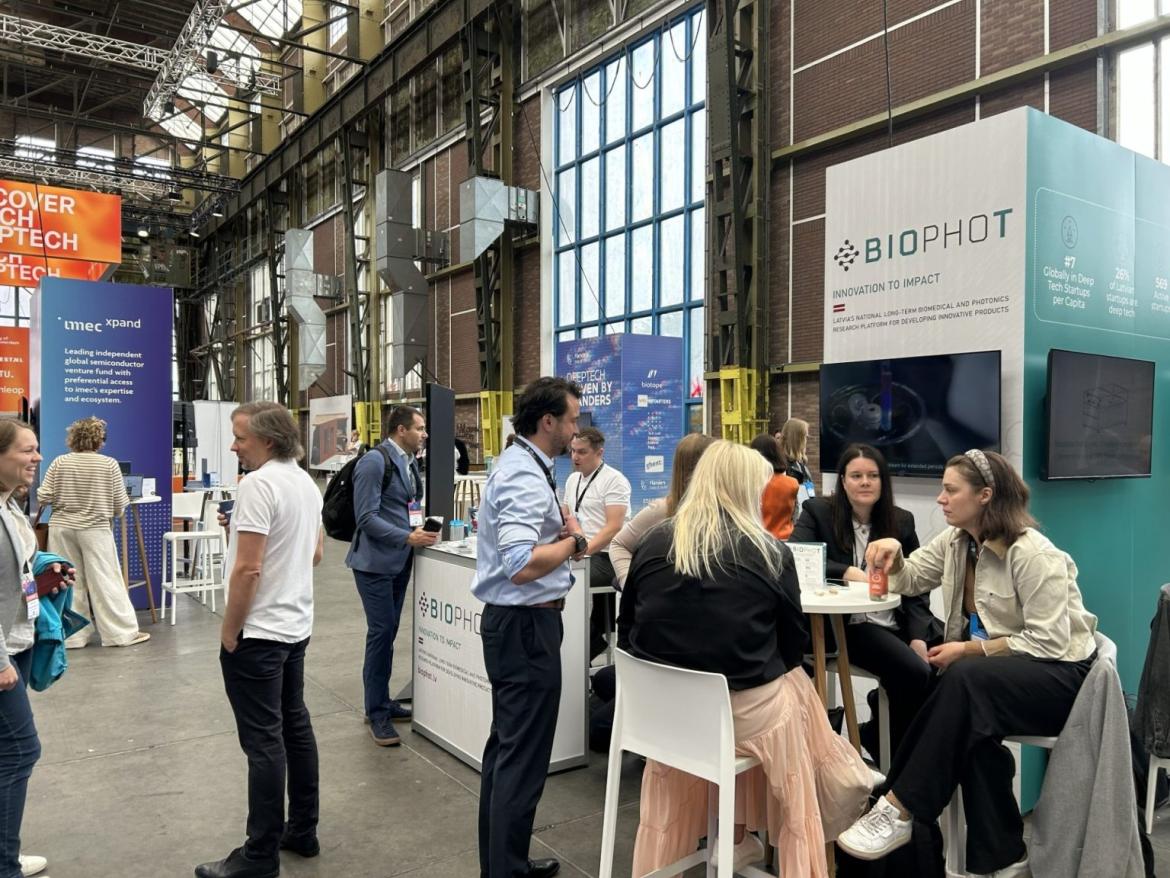
In mid-June, more than 20 innovation teams from the BioPhoT platform took part for the first time as a unified Latvian delegation in one of the world’s most important deep technology events — the Hello Tomorrow Global Summit in Amsterdam. Participation in the forum enabled Latvian researchers to strengthen their international visibility and establish direct contacts with investors, accelerating the entry of innovations into the international market.
BioPhoT Innovation Project Selection, Implementation, Monitoring and Sustainability Manager Andris Baumanis emphasises that participation in an event of this level is much more than project demonstration. It is an opportunity to test the competitiveness of Latvian innovations on a global scale, establish direct contacts with investors and industry leaders, and accelerate the path of scientific developments to the market. “The ability of Latvian teams to attract international attention confirms that the solutions created can compete with the world’s strongest deep technology projects, while also demonstrating to investors and policy makers the potential contribution of science and innovation to economic growth,” he concludes.
The importance of such international innovation forums is increasingly emerging as teamwork between researchers, business developers and mentors, who together build a bridge between science and the market. Participation in internationally significant events shows that the commercialisation of research results is no longer only a laboratory task — it requires active involvement in business development, support from experienced mentors and the ability to navigate the international investment environment. It is precisely close team cooperation that allows researchers’ ideas to turn into structured, investor-friendly and market-viable solutions, Baumanis says.
University of Latvia Leading Expert in Technology and Innovation Transfer Jurijs Jastržembskis points out that one of the most important advantages of Hello Tomorrow is its international scale: the conference was attended by more than 3,000 participants from around the world. Participation in the forum makes it possible to build relationships not only with investors, but also with universities, technology transfer organisations, innovation agencies and institutions from other countries. Such contacts are a long-term investment that may in the future become an important support network for the commercialisation and international development of research project results. Particularly significant is the forum’s ability to bring together participants from outside Europe, including from Latin American countries such as Brazil. This provides Latvian innovation teams with access to entirely new ecosystems and cooperation opportunities that are not available within the usual Baltic and Nordic cooperation circle.
A significant benefit for researchers was the experience of presenting to an international audience: at the forum, Latvian representatives introduced those present to their solutions in thematic sessions in the fields of medical technology, biomedicine and integrated technologies, as well as in the Expo area. The teams had to be able to clearly formulate what problem they are solving, what value they create and why the specific solution is needed. This kind of experience provides an opportunity to communicate effectively with investors and potential partners.
Experts emphasise that an important lesson is the need to be proactive at such events. Successful participation does not happen by passively waiting for interested parties at a presentation stand. It requires initiative, the ability to start and maintain conversations, approach potential cooperation partners and purposefully use every contact to expand one’s partner network.
Riga Technical University BioPhoT direction manager Liene Ivanova emphasises the role of research organisations in the development of deep technology innovations. In her view, international platforms once again confirm that universities and scientific institutes are the main source of knowledge-intensive innovations. “That is why the BioPhoT platform, with eight national partners and a portfolio of 66 projects, is an important driving force in the development of Latvia’s innovation ecosystem, purposefully building a bridge between academic excellence and the global market and helping scientists’ ideas become commercialisable products,” she emphasises.
A particularly valuable benefit of the forum was gaining insight into investor and market perspectives. Kaija Kurme-Jansone, Innovation Expert at the Institute of Solid State Physics, University of Latvia and BioPhoT mentor, emphasises that for many scientists this was their first experience in a real start-up environment, where ideas are assessed according to their market potential, not only their scientific quality. The teams received direct and open feedback from investors, who evaluate the scalability, impact and commercial potential of projects. This allowed researchers to validate their ideas outside the laboratory and gain an essential understanding of the requirements needed for successful technology commercialisation.
Additional value for the Latvian delegation was provided by participation in the programme for learning about the Dutch innovation ecosystem and in European Spin-off Forum events. Jānis Latvels, Commercialisation and Innovation Expert at the Institute of Solid State Physics, University of Latvia, notes that visits to innovation centres, universities and industry organisations in Eindhoven vividly demonstrated the advantages of an integrated innovation chain — from academic research to industrial implementation and investment attraction. A particularly significant conclusion is the role of early industry and investor involvement in technology development.
The discussions at the European Spin-off Forum highlighted a European trend towards developing increasingly standardised, faster and more investor-friendly models for the development of spin-off companies. Technology transfer organisations are increasingly becoming active partners in company development, rather than merely administrative intermediaries.
Participation in international innovation forums of this scale is also seen by researchers as an important step on the path from laboratory to market. As Riga Technical University Professor Kristaps Kļaviņš emphasises, the real alignment of innovations with market needs, direct feedback from investors and the building of international contacts are critically important for their further development.
The BioPhoT platform project “SwyCard”, led by Kļaviņš, faced particularly intense competition in the selection process this year. The project is developing a non-invasive, painless diagnostic platform that uses the analysis of children’s sweat to identify important clinical biomarkers. In January, it was submitted to the Hello Tomorrow 2026 Deep Tech Pioneers Challenge, in which 905 projects were selected from 4,800 applications to participate in the Deep Tech Pioneers Exhibition. Of these, only 105 projects used the opportunity to take part in the forum with a separate stand, including “SwyCard”.
Participation in the exhibition confirmed strong interest in the project’s solution. The project team actively established contacts with investors and companies that have already expressed interest in the possible implementation of a pilot project, and communication on further cooperation is currently continuing.
The SwyCard team also established contacts with representatives of international innovation ecosystems, including from Brazil and Australia, expanding the project’s visibility beyond the European market, Kļaviņš says. This experience once again confirms that participation in global innovation forums makes it possible not only to present a technology, but also to directly test its market potential and build international cooperation channels.
Latvia’s position in the global deep technology environment is also confirmed by data from the Hello Tomorrow Global Deep Tech Pioneers Radar 2026, which ranks Latvia among the world leaders in terms of the number of deep technology start-ups per capita. As Andris Baumanis emphasises, the next challenge is to turn this potential into internationally successful companies, investments and export-capable technologies. For this reason, participation in world-class platforms is a strategically important instrument for the growth of Latvia’s innovation ecosystem and the strengthening of its competitiveness.
The unified Latvian deep technology delegation for participation in the Hello Tomorrow Global Summit 2026 on 11 and 12 June was organised by the Investment and Development Agency of Latvia (LIAA), the Riga Investment and Tourism Agency (RITA) and the long-term national research programme platform BioPhoT. The delegation’s participation was supported by SIA “Skrīveru saldumi”, which also delighted the forum’s visitors.
The “Biomedicine and Photonics Research Platform for the Creation of Innovative Products” (“BioPhoT”) is implemented under the leadership of the National Research and Innovation Institute by the Institute of Electronics and Computer Science, the University of Latvia, the Institute of Solid State Physics, University of Latvia, the Latvian State Institute of Wood Chemistry, the Institute of Food Safety, Animal Health and Environment “BIOR”, Rīga Stradiņš University and Riga Technical University.
Project No. IVPP-EM-Inovācija-2024/1-0002 “Biomedicine and Photonics Research Platform for the Creation of Innovative Products (BioPhoT)” is being implemented within the framework of the long-term national research programme “Innovation Fund — Long-Term Research Programme”, funded by the Ministry of Economics.