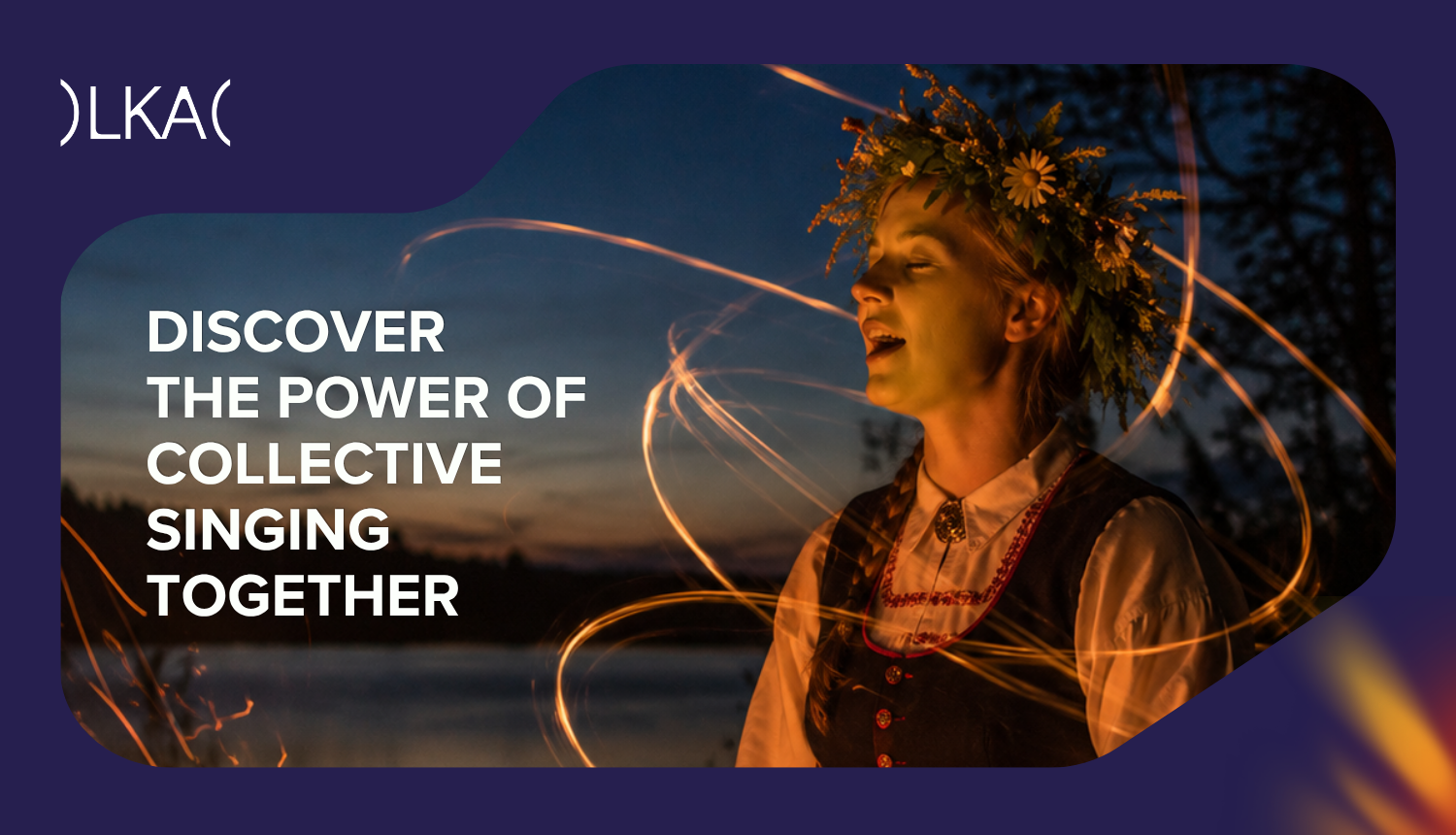
The Latvian nation is often referred to as a “singing nation.” There is a great deal of historical and contemporary cultural evidence that confirms the importance of collective singing in the formation and strengthening of the Latvian nation and state – the phenomenon of folk songs, the splendid tradition of the Song Festival and the related folk art movement, collective singing at politically and socially significant moments, the most vivid expression of which is the “Singing Revolution” accompanying the Third Awakening during the restoration of state independence.
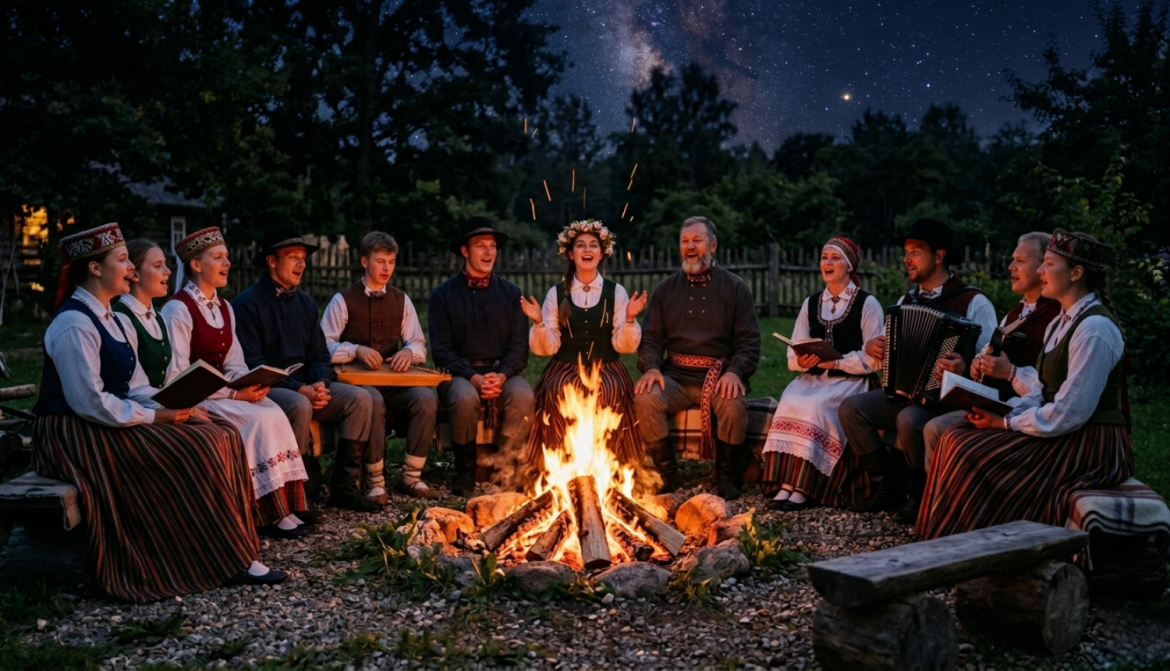
Collective singing is also an integral part of many festive rituals, as it is capable of creating a powerful emotional experience with a long-lasting impact and the strength of collective memory. Research data from the Latvian Academy of Culture show that in Latvia, among all religious and seasonal celebrations, the largest number of people—regardless of age, gender, nationality, place of residence, and income—celebrate the Līgo festival and Midsummer Day. During these celebrations, which are associated with the summer solstice, both in rural homesteads and parishes, as well as in regional centers and cities—we often make music and sing together. At present, in a geopolitically and economically unstable time, when there is concern about the future, there is an attempt to find a sense of security and emotional stability, which is not always linked only to investments measurable in monetary terms in the state defense budget. Can collective singing provide this? What do science and research data reveal?
The researchers’ answer is yes!
Researchers from the Latvian Academy of Culture are currently implementing an international research project “CRIES: Collective Singing in Times of Social Crises: Investigating Its Potential in Scandinavia and the Baltics”. In collaboration with researchers from Aarhus University in Denmark, the Institute of Lithuanian Literature and Folklore, and the University of Tartu, the project reveals and compares the diverse impact of collective singing on the behavior and resilience of different groups of people across nations and cultures during severe social crises. It is known that collective singing in different eras, from the second half of the 19th century to the present day, has served as an important tool for fostering social cohesion, emotional mobilization, and strengthening cultural identity, especially in situations of social crises. At the same time, researchers draw attention to the fact that the social and emotional power of songs sung together can be both inclusive and exclusive if a part of the population does not feel that they belong in these singing rituals. Therefore, it is important to understand how residents evaluate the experience of collective singing in today’s situation.
Within the framework of the CRIES project, not only have individual stories of residents’ experiences been collected and songs sung in various situations at different times been compiled, but in the autumn of 2025, following a unified methodology, a representative public opinion survey of residents of Latvia, Lithuania, Estonia, and Denmark was also carried out (with a total sample of 4,151 respondents) on the collective singing experience of the populations of these countries.
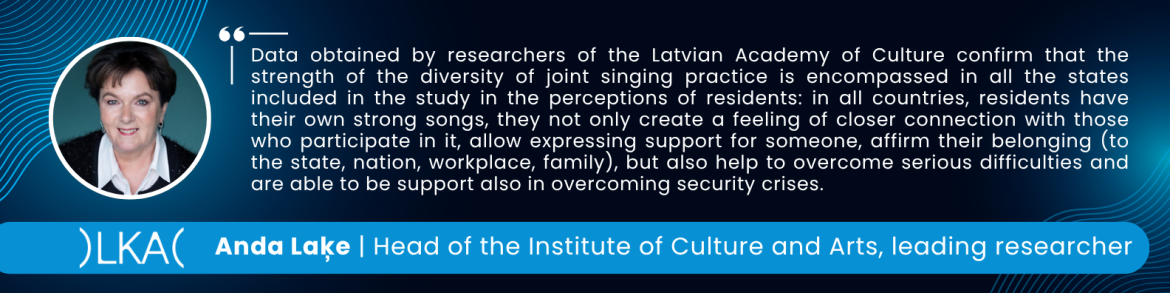
More than half of Latvia’s residents are firmly convinced that collective singing creates a stronger sense of connection with those who participate in it and allows them to affirm their belonging (to the state, nation, workplace, family), which demonstrates its significant role in fostering cohesion and strengthening identity in today’s heterogeneous Latvian society.
Comparing the opinions of residents of the four countries included in the study, it can be seen that, although 81% of Latvia’s residents acknowledge that the Latvian nation can be described as a singing nation (which is the highest indicator among the residents of all countries), in practice, the largest proportion of residents who have participated in some collective singing activity is in Denmark (94%). Meanwhile, the largest number of residents who recognize the power of the social impact of singing is in Lithuania. Although collective singing has universal benefits that are acknowledged by residents of all four countries, the actual practices of collective singing and the awareness of its benefits differ.
Summary
Foreign studies also show¹ that collective singing has an impact on people’s emotional world, providing benefits for human health; however, this is not its only strength. Collective singing is not just entertainment or simply a beautiful artistic expression and performative activity. It is a powerful social practice that helps people experience a connection with others and with their nation, feel supported, and find within themselves a value-based strength in times of security and other threats. The research data encourage a broader view of the instruments that support residents during geopolitical and security crises.
Let our songs of strength unite us, not divide us!
In the summer of 2026, from June 19 to 21, the XX Baltic States Student Song and Dance Festival “Gaudeamus” will take place in Riga, bringing together 4,000 students from Latvia, Lithuania, and Estonia. The festival events will take place at the University of Latvia (LU), Vērmanes Garden, Dailes Theatre, Riga Cathedral, Old Riga, and Freedom Square. We also invite everyone to join in a collective song during these celebrations!
Event programme: https://www.kultura.lu.lv/en/gaudeamus/gaudeamus-2026/programme/

- Kreutz G, Bongard S, Rohrmann S, et al. Effects of choir singing or listening on secretory immunoglobulin A, cortisol, and emotional state. J Behav Med, 2004.