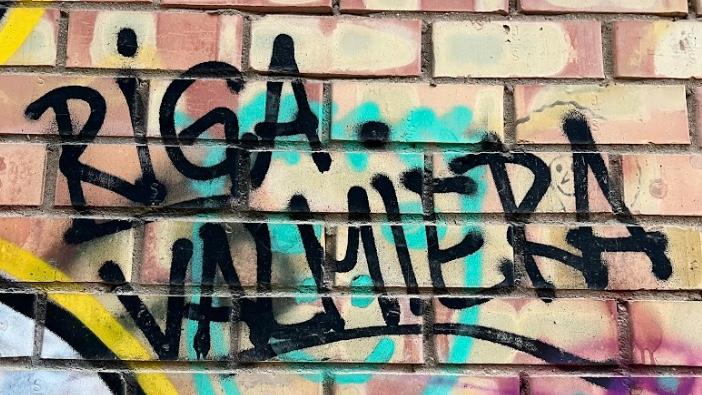
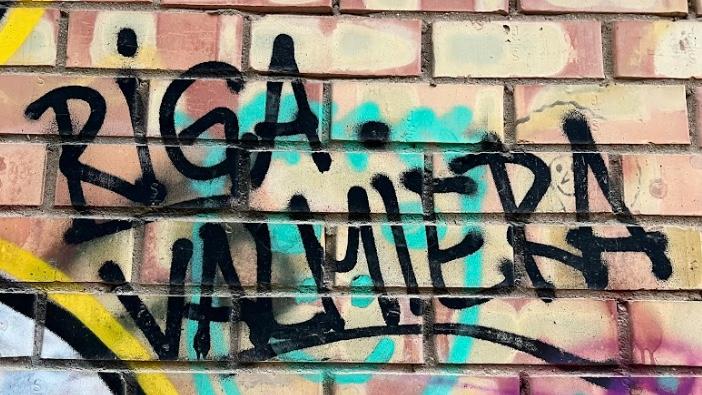
Interest in these signs visible in the urban environment formed the basis of “GraffitO!”, an interdisciplinary project by early-career researchers at the Latvian Academy of Culture (LAC), which invites us to view street writing not as damage to the urban environment, but as a living cultural phenomenon open to interpretation.
Street Writing as the Language of the Urban Environment
The project focuses on street writing – a spontaneous language of public space that develops outside official communication. It consists of words, sentences, symbols and other human-made textual or visual elements that can be read and interpreted. During the initial stage of the project, more than 400 examples of street writing were documented in the urban environment according to this criterion – the legibility of the sign and its communicative message.
These signs are most often created anonymously, temporarily and intuitively, allowing society’s mood to be seen much more directly and without filtering than in everyday communication. Their impermanence is also significant. Many inscriptions disappear after only a few days, are painted over or rewritten, yet this transience is itself part of urban life – a continuous dialogue between people and the city.
Attention is also paid to the boundary between art and vandalism. What some perceive as damage or disorder becomes, for others, a form of experience, protest or participation. It is precisely this contradiction that makes street writing an important subject of research, allowing us to discuss not only art, but also society, public space and the right to leave one’s mark.
The Desire to Express Oneself While Remaining Anonymous
Alongside other forms of street art, such as wall paintings, murals and signatures (“tags”), street writing has long been one of the most visible and controversial elements of the urban environment, regularly prompting debate.
On the one hand, it is often understood as vandalism – the deliberate damage of public or private property. On the other hand, it can be viewed as part of the city’s visual landscape and as a symptom of a socially active urban environment. It is a tool that both transforms this environment by changing its landscape and reflects the concerns of different social groups, offering insight into public sentiment, areas of tension, interests and attitudes.
It is precisely this duality, together with the factors that characterise street writing and are specific to it, such as the question of authorship, that makes it an interesting subject of research.
The inscriptions often comment on social or political processes, but just as frequently they reveal experiences, thoughts or feelings that are deeply personal to the author and which they might not otherwise express publicly in everyday life.
The question of authorship acquires particular significance in street writing – it reveals an apparent contradiction between the desire to express oneself publicly and, at the same time, to maintain a distance and perhaps protect oneself from the vulnerability created by the directness and openness of publicly expressed thoughts. Anonymity is, of course, determined not only by the author’s personal reasons, but also by entirely practical factors, such as the administrative penalty imposed for intentionally damaging public property or property belonging to others.
Little Order, Plenty of Directness
Although street writing is not part of any pre-planned urban landscape, together with other messages in public space it clearly contributes to the city’s visual environment and competes for the attention of its residents.
The urban environment of the 21st century is already relatively saturated with colours, slogans, calls to action and various brands. Against this backdrop of colour and information overload, street writing stands out for its unpredictability – it displays neither regularity nor a unified aesthetic. On the contrary, each inscription is created using the simplest means available to its author, with an individual style of handwriting and lettering.
These inscriptions contain little “order”, but plenty of directness, which makes them stand out against other messages, such as advertisements, that are based on symmetry and proportion.
Equally important is the decision itself to express one’s opinion in the urban environment, which means not only voicing an opinion publicly, but also marking one’s physical presence in public space. This gesture demonstrates that the author of street writing is more than a passive city resident. The choice to express one’s opinion in the urban environment affirms the author’s agency and ability to influence the surrounding environment beyond the boundaries of their home or courtyard.
This is particularly true of the urban environment, where any changes nowadays generally take place only after coordination with various institutions and lengthy planning procedures. The opportunity for an individual to make a tangible change to the urban environment on their own, without the permission or involvement of others, is therefore relatively rare.
Protest on Urban Surfaces
Protest in street writing can take various forms – in the message itself, in the way it is executed and in the location chosen. It may be expressed through specific words and phrases, but the place where the inscription is created is equally significant. The visibility of the inscription and the way it disrupts or complements the familiar rhythm of the urban environment can also become a form of protest.
During the project, we frequently encountered examples of street writing in which authors expressed resistance both to injustices they had personally experienced and to broader social and political processes. Many inscriptions repeatedly called for the system to be dismantled or conveyed other messages rejecting the existing order and submission to it. They often used swear words and addressed taboo subjects.
It seems that provocative language serves here not only as a means of self-expression, but also as a way to disrupt the established conventions of public communication and make the message more difficult to ignore.
The choice to protest in this public form could be viewed in a similar way. An inscription on urban surfaces already breaches an established order in itself and embodies what may be a small but direct act of defiance. This sets it apart, for example, from a social media post, where it is also possible to communicate one’s message; however, a message left in the urban environment is physical, more difficult to ignore and becomes part of that environment – it takes on a tangible form. Street writing is therefore a distinctive form of protest in which content, environment and action interact. The action may be impulsive or provocative, but it transforms the urban environment into a space for discussion.
Humour, Irony and Defiance
Street writing is not limited to expressions of protest; humour can also be found alongside protest. Humour is not merely an accidental by-product, but a deliberate strategy. It is one of the main ways in which personal commentary enters public space – through provocation, irony or ridicule.
These inscriptions most often include declarations of love, jokes and obscenities. Alongside humour, more intimate or private messages are also frequently observed.
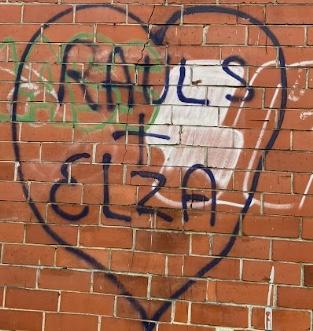
This shows that humour is a way of addressing uncomfortable and unspoken topics in a lighter form. Humour can also serve as a cover, with the humorous message acting both as a challenge to the reader and as a mask for the author.
It is precisely in the shadow of these seemingly frivolous and sometimes genuinely offensive inscriptions that uncomfortable truths about society are revealed: the joke serves as a cover, yet the message still reaches its target.
Spelling mistakes are also common. Many inscriptions contain spelling errors, which can be interpreted in two ways: either the author deliberately disregards the rules of the language, or simply does not know them.
This uncertainty as to whether an error is a deliberate gesture against established norms or the result of unintentional ignorance is part of the language of street writing, which never provides unequivocal answers. Spelling mistakes do not, however, make the message any less powerful. On the contrary, they make it a more personal and authentic form of expression in which content is more important than form.
Reflection of the Social Environment and the Search for Identity
Street writing clearly reflects various social processes and the changes they bring about in society. It can capture collective moods as well as personal feelings of insecurity related to an individual’s place in society, including uncertainty about the social position or level of prestige one is expected to have achieved by a certain age.
For example, the inscription “Already 40 – what now?” succinctly reveals the author’s uncertainty about their situation in life. In this context, street writing becomes a space in which different forms of tension emerge between society’s expectations and the individual’s relationship with those expectations.
Alongside these and similar forms of expression, street writing also reflects changes in various social habits, particularly differences in forms of communication. One of the clearest examples is the impact of technology on interpersonal communication.
In the recent past, examples of street writing might include the author’s telephone number, whereas today texts in the urban environment much more frequently feature social media usernames, profile names or other elements of digital communication.
These changes occur at different levels: the mode of communication changes, as does the very understanding of what it means to be reachable. Similarly, by providing a telephone number, the author offers more direct and personal access to themselves, whereas a social media username more often leads to a public, deliberately constructed and socially performative identity – a public “self” that reveals which part of their image the author is prepared to make public.
Street writing embodies a kind of archive of social change, reflecting both individual experiences and searches for identity, as well as broader transformations in culture and social structures. It bears witness to changes in the relationship between the individual and society, in how we relate to others and to ourselves.
The Right to the City
Similar ideas were explored by the French philosopher Henri Lefebvre in his analysis of the relationship between the urban environment and people. According to Lefebvre, city residents have relatively limited opportunities to change the urban environment, even though the city formally “belongs to everyone” who lives there. In his theoretical work, Lefebvre calls for residents to be given back their “right to the city”, which includes the right of city residents to make decisions, modify and plan an urban environment that is more closely aligned with their needs, as opposed to various standardised methods of urban planning. Lefebvre advocates the creation of multifunctional spaces and the encouragement of spontaneous encounters, thereby revitalising the public environment.
Although most modern cities have various mechanisms for supporting residents’ initiatives, and public participation is often regarded as a relatively important factor in decision-making related to the urban environment, Lefebvre’s theories help us to understand the phenomenon of street writing and its underlying causes more fully.
From the perspective of these ideas, street writing can be interpreted as a form of spontaneous “democratisation” of the urban environment – it enables any individual to make direct and unmediated changes to the cityscape.
Of course, this does not negate the legal and ethical restrictions associated with writing on public or private property. However, it is precisely this tension – between prohibition and the desire to express one’s views, between order and individual initiative – that makes street writing a significant cultural phenomenon in contemporary cities.