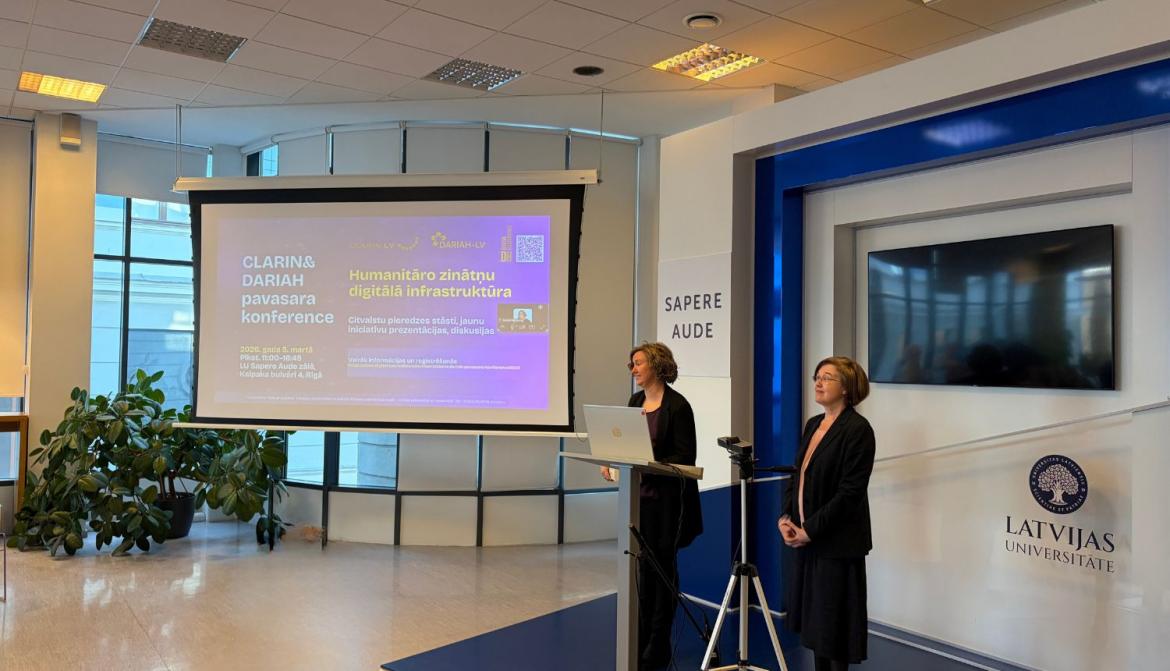
CLARIN & DARIAH Spring Conference in Riga brings together digital humanities researchers and users
March 20, 2026
On March 5, 2026, the CLARIN&DARIAH Spring Conference took place at the University of Latvia, bringing together more than sixty researchers and practitioners from the digital humanities, language technology, memory institutions and research data infrastructures. The event offered an opportunity to learn about research infrastructures and recently launched large-scale research projects. The conference was opened by Kaspars Zalāns, Senior Expert at the Department of Higher Education, Science and Innovation of the Ministry of Education and Science of the Republic of Latvia.
A central theme running through the programme was what researchers, institutions, and society expect from research infrastructures — and how artificial intelligence (AI) is reshaping humanities research and work with language resources. In the morning session, associate professor Andrius Utka from the Vytautas Magnus University introduced the CLARIN-LT research infrastructure and recent Lithuanian language resources developed for the AI era, emphasising that high-quality language data and reliable access to it are becoming critical for both the development of language technologies and research. Ahmad Kamal from Linnaeus University in Sweden then provided an insight into the activities of DARIAH-SE, offering the perspectives of the Swedish national node of DARIAH.
One of the issues particularly emphasised at the conference was open science and sustainable data management to ensure that the created digital resources and tools are available in the long term. Inguna Skadiņa, national coordinator of CLARIN-LV, presented the Latvian experience in CLARIN, looking back at the achievements, benefits and challenges of maintaining and using language resources. Sanita Reinsone, a tenured professor at the University of Latvia, in turn, outlined the next steps toward establishing a DARIAH-LV node, emphasising the need for a coordinated digital humanities infrastructure in Latvia.
The conference participants particularly valued the demonstration session, which showcased newly developed tools and resources and illustrated their practical use in research. Demonstrations covered various digital tools and language resources, including the Latvian language morpheme and word formation database, the Norma corpus and technical formatting tool, the DataverseLV research data repository, resources for digitization and analysis of folk song texts and melodies, an image search tool from the Latvian State Archives of Audiovisual Documents, LATE speech transcription tool, AI tools for book cataloguing, the Historical Dictionary of Latvian Given Names and Livonian language digital resources.
In the afternoon session, participants were introduced to several projects from the State Research Programme Letonika – Fostering a Latvian and European Society, as well as other high-impact initiatives in Latvia. Ilze Auziņa, a leading researcher at the Institute of Mathematics and Informatics of the University of Latvia, presented the project DigiLATE - Digital Resources and AI Technologies for the Sustainability of the Latvian Language, while Sanda Rapa, director of the Institute of the Latvian Language of the University of Latvia, introduced the project LaTS – The Latvian Language in Time, Space and Society. Uldis Zariņš, director of the Library of the University of Latvia (UL), introduced to the high-impact project ȬPEN - Open Knowledge Ecosystems for the Development of Social Science, underlining that open science is not only a matter of access, but also an infrastructure for data exchange, skills development and collaboration. Anda Baklāne, the head of digital research services at the National Library of Latvia, shared recent developments in bibliographic data processing and research at the Library, with a particular focus on the use of AI.
The conferences concluded with a panel discussion, “Humanities in the Age of AI: What Do We Expect from Infrastructures?” Speakers and participants highlighted practical needs, such as sustainable data storage and access to data, a shared ecosystem of tools, and closer cooperation between researchers, memory institutions and technology developers. The panel discussion clearly showed that in the AI era, the importance of research infrastructures is only increasing- enabling language resources, cultural heritage and research data to be usable, comparable and sustainable for both academia and society.