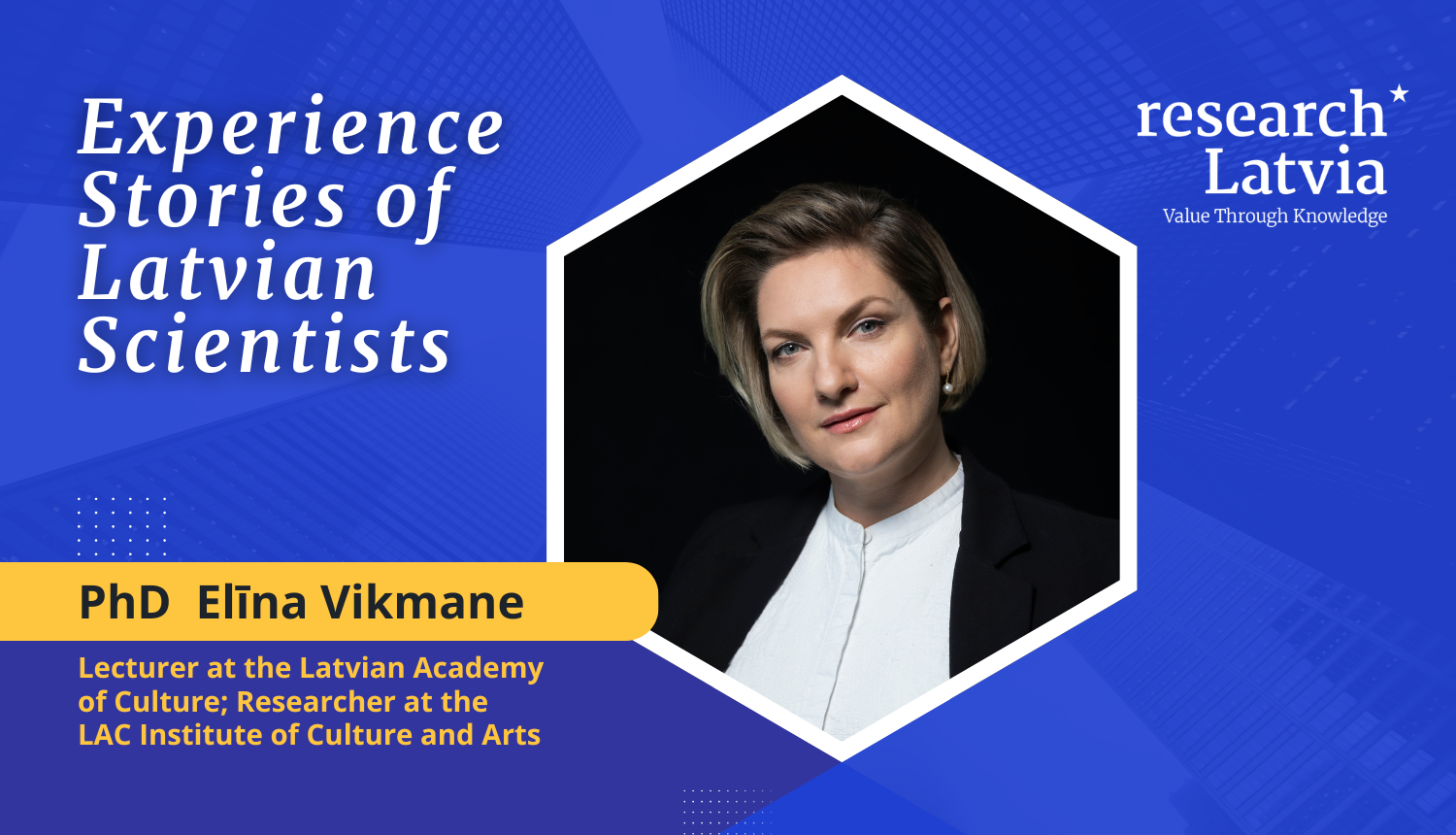
Digital innovation in the museum sector and public engagement with cultural heritage through digital platforms are the core themes of the work of PhD Elīna Vikmane, Researcher at the Institute of Culture and Arts of the Latvian Academy of Culture (LAC) and Fulbright Scholar at the Smithsonian Institution With a consistent interdisciplinary perspective, her research explores how digital technologies reshape museums and our relationship with cultural heritage. In a conversation with the science communication portal researchLatvia, Elīna Vikmane discusses the future of digital cultural heritage, the role of museums in the digital age, and her personal research path.
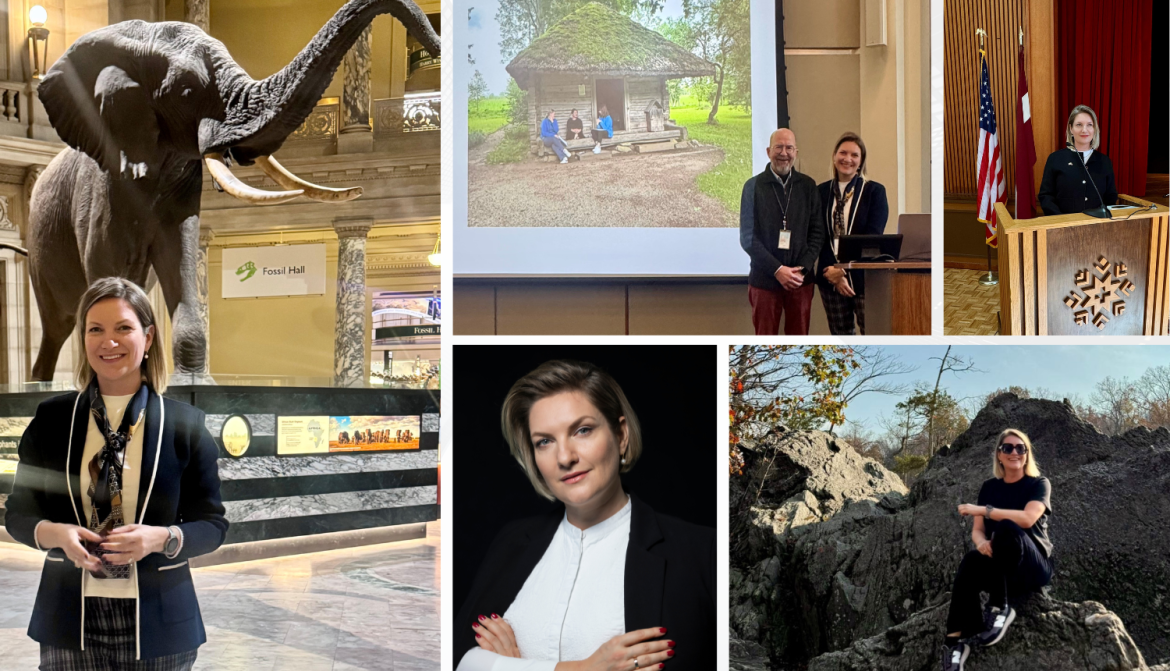
Currently, Elīna Vikmane is a visiting researcher at the Smithsonian Institution in Washington, D.C., the world’s largest museum and research complex. As part of a Fulbright Fellowship, she analyses how digital platforms and public participation are transforming museums and redefining our engagement with cultural heritage.
Interdisciplinarity as a Driver of Research
Elīna Vikmane’s professional trajectory spans mathematics, social sciences, cybermuseology research, and the development of the concept for the Latvian Museum of Contemporary Art. It was through this diverse experience that she realised her desire to pursue research in a systematic and in-depth way. “I am deeply interested in interdisciplinarity and in the productive frictions it creates. At times, this places me in a unique position – sometimes highly valued, sometimes misunderstood. But this is a field I have consciously chosen,” says Vikmane.
Her doctoral dissertation (2023) focuses on cybermuseology and the diffusion of digital innovation in the museum sector, examining how technologies transform ways of thinking about museums, modes of experiencing them, and the formation of digital cultural heritage.
Her research interests centre on participatory dynamics in cultural heritage and the diffusion of digital innovation, with particular attention to how these processes affect both institutional museum practices and public experience in the digital age.
Notably, cooperation with the Smithsonian Institution began well before the Fulbright application process: “In research, an award essentially means securing funding to be able to work. Before applying for Fulbright, a great deal of preparatory work was required – developing a research proposal that could spark interest at the Smithsonian, ultimately resulting in an invitation to collaborate. I am very pleased that this effort was successful.” Vikmane emphasises that Latvian researchers have broad opportunities to collaborate with leading international institutions. The key factors, she notes, are courage and confidence in one’s professional abilities: “What moves us forward is our own determination and willingness to act. Latvian researchers have every opportunity to work with any institution in the world.”
What Is Changing in Museums? A Future Perspective on Digital Cultural Heritage
Change is already underway, fundamentally reshaping both the role of museums and that of society. As Director of the LAC master’s programme Cultural Heritage Management and Communication, Vikmane often poses a question to students that captures the scale of forthcoming changes: “What form will your cultural heritage take? Beyond paintings or books, it is the digital materials you create today – photos, correspondence, documents. Where will these materials ultimately reside, and who will ensure their preservation?"
The COVID-19 pandemic marked a clear turning point for museums, forcing a rapid shift towards digital environments. For Vikmane’s research, this period offered a rare opportunity to observe the diffusion of innovation in real time.
In her view, digital heritage is becoming increasingly significant for two main reasons: the rapid development of technology and the enormous volumes of data generated by individuals on a daily basis.
“Change is inevitable. We can move blindly into the future, or we can try to understand what is changing and how and prepare accordingly.” These transformations affect not only museum practices but the broader cultural ecosystem, from data preservation to the interpretation of digital traces in the future.
Digital Platforms as a New Layer of Museum Practice
One of Vikmane’s research concerns is how digital platforms are reshaping relationships between cultural heritage institutions and the public. On the one hand, on-site museum spaces are no longer the sole sites of engagement with cultural heritage. On the other hand, digital platforms enable the public to become active contributors rather than passive observers. “It is possible that we have never physically visited a museum yet are deeply engaged in its activities. This represents a significant shift in museum practice.”
Community participation in museums’ digital platforms plays a crucial role in her research, as it can fundamentally transform institutional behaviours. Individuals contribute by enriching data, identifying, transcribing, or annotating objects, participating in heritage preservation and interpretation processes, and becoming co-creators of its communication. “Public engagement in museum work might fundamentally change the museums themselves, as participatory approaches require sharing power and involving communities in decision-making”
In the digital age, museums’ responsibilities become more diverse: they preserve and present collections, coordinate processes, engage communities, and create trusted digital environments for co-creation.
Vikmane also notes that much of what people once recorded on paper is now stored digitally: “Nearly our entire lives are gradually migrating into digital platforms and folders – emails, documents, poetry, and digitally recorded moments of lived experience.”
This raises fundamentally new questions: Where will they be preserved after we are gone? Who will be responsible for their long-term safeguarding? The researcher points out that commercial and non-governmental platforms already exist that treat, for example, digital photo collections as legacy, enabling users to specify posthumous ownership and stewardship. However, public awareness and discussion of these issues remain very limited.
The Research Process and Moments of Insight
Research requires patience: much of the work takes place through thinking, searching, and identifying connections that are not immediately visible. At times, weeks may pass before something that previously seemed incompatible suddenly becomes clear. “For weeks, it feels like something does not quite fit. The direction seems right, but internally I sense that something is still missing. Then I go for long walks, and suddenly everything comes together,” says Elīna. Walking has become her way of organising thoughts. This rhythm – movement, silence, and distance from everyday work – allows ideas to settle and take shape. “There is even a book, The Philosophy of Walking, about the role of walking in thinking. For me as well, solutions most often emerge while walking or jogging,” she adds. “When I run, I record audio notes for myself so that the moment of insight is not lost.”
These “aha” moments often mark turning points in research – moments when earlier uncertainty gain structure and clarity for the next steps. Research work is therefore not only about analysis and data processing, but also about a deep cognitive process in which uninterrupted time is essential for ideas to crystallise.
Participatory Research and Science Communication
Public engagement in research is particularly important to Elīna Vikmane. “Citizen science offers enormous benefits – knowledge, a sense of belonging, and self-confidence. But it also requires researchers to relinquish part of their power,” she emphasises. At the centre of her professional interests is participatory research, in which people contribute data and take part in co-creating initiatives; researchers and members of the public work together; and ethical considerations, power relations, and the scientific quality of data are continuously reflected upon. This approach is demanding, yet highly productive – it transforms both the research itself and the relationships between researchers and participants. “In my view, this is also the path of science communication – to conduct research together with people, in order to reveal the complexity of science, rather than trying to oversimplify research results.” She sees citizen science and participatory research not as isolated approaches, but as complementary practices that contribute to a more open, comprehensible, and inclusive science.
Elīna also stresses that society can understand science far more deeply than is often assumed: “I think simplifying science is a well-intentioned road to hell. In today’s complex world, people cannot be equally interested in everything. But when there is a genuine interest in a topic, it is precisely nuance that captivates.” It is therefore important not to shy away from explaining complex issues. Breaking down stereotypes and fostering a more open dialogue on scientific topics is essential.
In her view, one of the most effective tools of science communication is storytelling and the use of metaphors, as these help connect complex ideas to experiences that are already familiar to audiences.
Elīna also stresses that society can understand science far more deeply than is often assumed: “I think simplifying science is a well-intentioned road to hell. In today’s complex world, people cannot be equally interested in everything. But when there is a genuine interest in a topic, it is precisely nuance that captivates.” It is therefore important not to shy away from explaining complex issues. Breaking down stereotypes and fostering a more open dialogue on scientific topics is essential.
In her view, one of the most effective tools of science communication is storytelling and the use of metaphors, as these help connect complex ideas to experiences that are already familiar to audiences.
Research as a Way of Life
Research can become a way of life, one that requires the ability to maintain balance. “Researchers must be able to separate their professional and personal lives, as the risk of burnout is very high. It is essential to learn to set boundaries,” Vikmane emphasises. “I am fortunate that a safe and collegial environment has developed at the Latvian Academy of Culture. This is extremely important for researchers.”
Elīna encourages students not to hesitate to take their first steps in research already at the bachelor’s level. In her view, only by actively engaging in the research process can one truly understand whether it is the right direction and a suitable professional path. At the same time, she notes that doctoral studies represent the greatest challenge – a marathon in which one must find a sustainable research rhythm and maintain clear and long-term motivation.
The work of PhD Elīna Vikmane demonstrates that contemporary science is shaped through collaboration and open dialogue with society. Her research in digital museology highlights how technology's participatory approaches, and changes in museums help create a more accessible and meaningful understanding of cultural heritage.
----
About the Article Series Stories of Latvian Scientists’ Experiences
This series, developed by the Ministry of Education and Science’s communication platform researchLatvia, provides insight into the work of Latvian researchers, fostering a deeper understanding of the role of science in society and creating a dialogue between scientists and the broader public.
These stories invite both current and future researchers, as well as society, to explore Latvia’s scientific achievements and draw inspiration and motivation from the experiences of those who have dedicated their careers to scientific work. The interviews are conducted within the framework of project No. 1.1.1.1/1/24/I/001, “More Efficient Implementation and Management of Latvia‘s Science Policy”.