ELIXIR Tools Platform: A Guide to Accessible Bioinformatics Software
February 25, 2026
As life science research becomes increasingly data-intensive, it not only generates vast volumes of data but also requires modern analytical approaches that depend on high-quality, reproducible, and sustainable software. At the center of this transformation is the European life-science information infrastructure ELIXIR - a decentralized intergovernmental organization that brings together national nodes and is built on five complementary platforms: Data, Tools, Compute, Interoperability, and Training.
This article focuses specifically on the Tools Platform, which promotes scientific discovery and ensures secure access to reliable software for the life sciences.
The ELIXIR Tools Platform acts as a central driving force within the ecosystem of biological data tools, helping researchers not only to locate appropriate software tools but also to assess their quality, integrate them into scientific workflows, and develop good software development practices.
From tool search to reproducible analyses
Software tools are an integral part of bioinformatics research; however, their diversity and rapid development can create obstacles in selection, installation, configuration, and comparison. The ELIXIR Tools Platform not only aggregates tools in one place but also provides a systematic approach to their discoverability and quality.
The platform maintains several core service collections used by researchers:
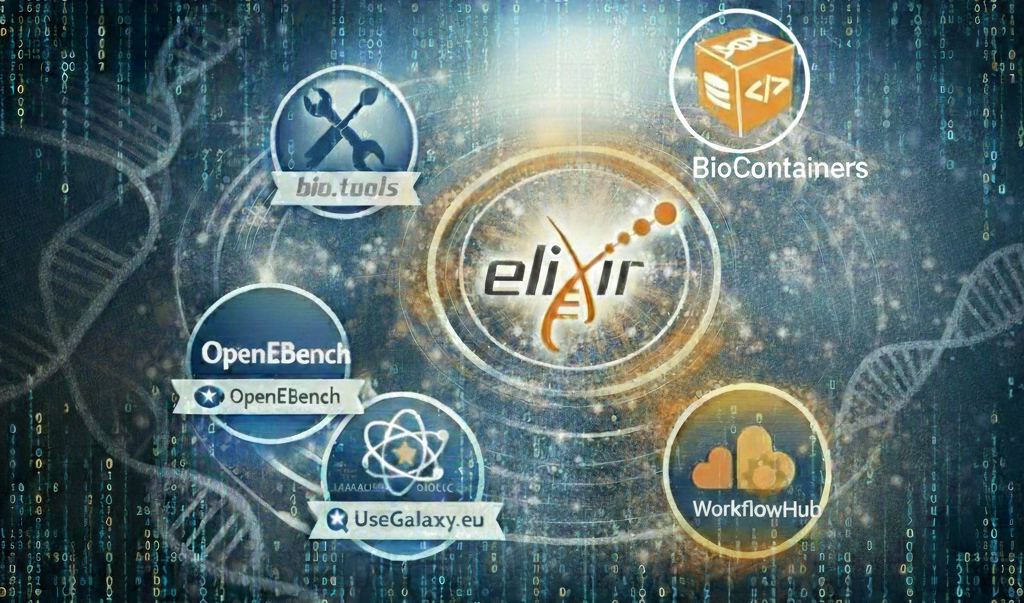
- bio.tools - a registry for searching biological and bioinformatics software tools and data resources.
- BioContainers - a collection of containerized software versions that facilitate tool deployment and reproducibility across different computing environments.
- OpenEBench - a platform for tool comparison and performance benchmarking.
- UseGalaxy.eu- an environment with thousands of tools, visualizations, and reference genomes that enables direct data analysis.
- WorkflowHub.eu - a registry for sharing and publishing scientific analysis workflows.
characterizing bioinformatics and the life sciences, and the ELIXIR logo (https://elixir-europe.org/).
Together, these services form a functional and complementary ecosystem in which researchers can quickly find, test, and use software tools best suited to their research needs.
Platform activities are structured into several mutually coordinated work streams that support both technical development and community - oriented engagement.
One of the main priorities is the ELIXIR Research Software Ecosystem, whose goal is to develop a cross-border approach to federated access to and management of software metadata. This includes the development of new user interfaces and collaboration with international initiatives to improve software descriptions and their use in a broader research context.
Another important area is software governance and standards, which develop guidelines and best practices to make tools compliant with FAIR principles. Benchmarking approaches - tool comparison and evaluation - are also promoted so that researchers can select the most suitable solutions for their data and tasks.
The ELIXIR Tools Platform works closely with other ELIXIR platforms - especially the Data and Compute platforms - to ensure that tools are easily connected to the data and infrastructure used in analysis. The tools are also linked to training resources that enable researchers to learn best practices in software development and use.
In addition to technical activities, the Tools Platform participates in international initiatives such as the European Open Science Cloud (EOSC) and other global collaborations to ensure the long term sustainability of software resources and their integration into the wider scientific infrastructure.
The ELIXIR Tools Platform forms a foundation for modern bioinformatics research by providing research software that is accessible, well described, and structured for reuse, reproducibility, and high quality. It simplifies researchers’ work - from simple tool search to the development and sharing of complex analytical workflows.
The platform is led by Salvador Capella (ELIXIR Spain), Björn Grüning (ELIXIR Germany), and Hervé Ménager (ELIXIR France), with coordination provided by Jonathan Tedds and Mihail Anton from the ELIXIR Central Hub.
Although Latvia is not yet an ELIXIR Member State, its research institutions - especially high performance computing (HPC) service providers - can already engage in ELIXIR platform activities through several channels. Latvian organizations can participate in EU funded collaborative projects, such as those related to the European Open Science Cloud (EOSC) or the Genomics Data Infrastructure (GDI), where ELIXIR is a key partner. It is also possible to provide technical expertise in ELIXIR commissioned services, participate in open workshops, or collaborate informally with existing ELIXIR nodes. However, full and strategic engagement in ELIXIR platforms - including participation in decision - making, service provision, and direct access to platform coordination - will only become possible once Latvia officially becomes an ELIXIR member state.
As previously reported, on June 1, 2025, Rīga Stradiņš University (RSU) launched the project “RSU Participation in the Horizon Europe Programme” (Project No. 1.1.1.5/3/25/I/014), which will also implement one of Latvia’s new ESFRI/ERIC national partnership and action plans - Latvia’s integration into ELIXIR. One of the main objectives of this project is to ensure Latvia’s full membership in ELIXIR, thereby opening opportunities for national research infrastructure developers to contribute to the development of the Tools Platform, create joint workflows, and integrate Latvia’s digital infrastructure into the European life science data ecosystem.