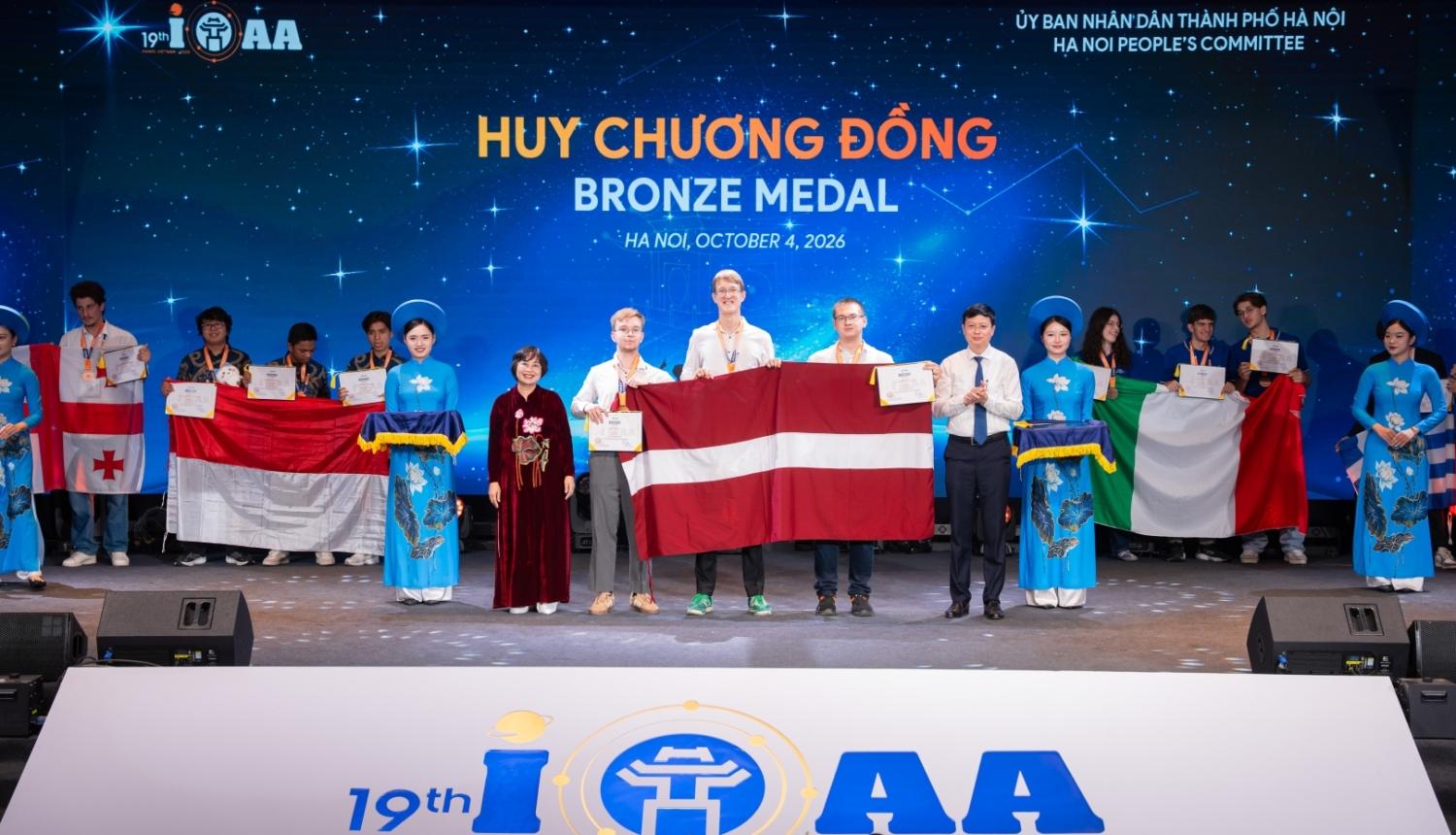
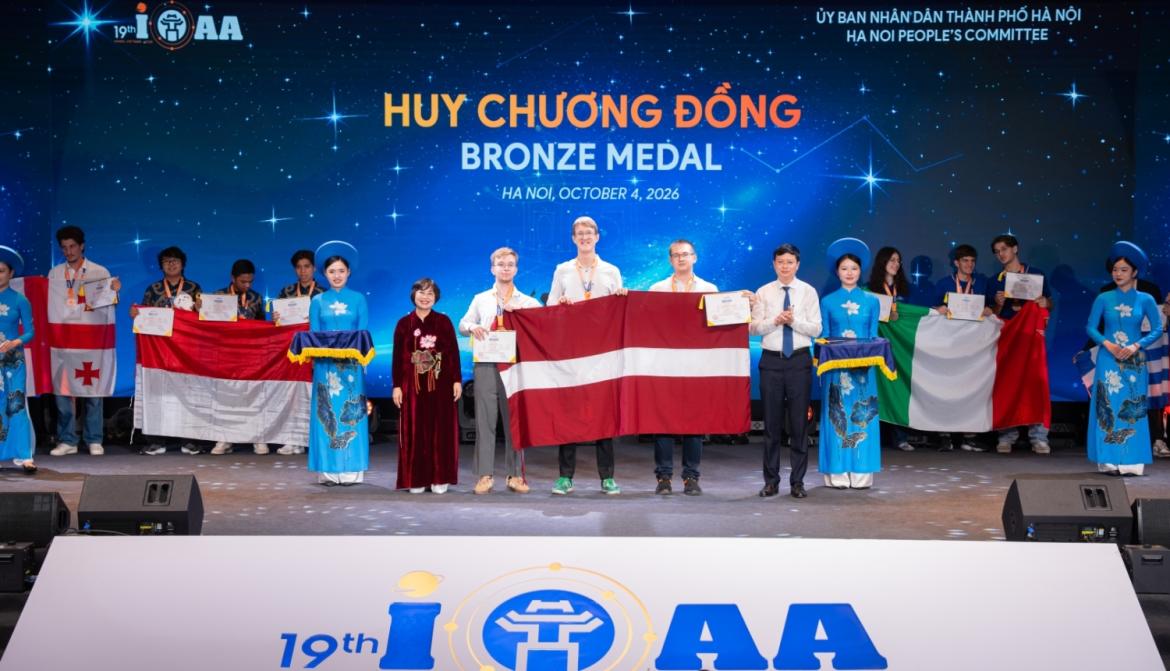
Aleksandrs Jesiļevskis, a 12th-grade student at RTU Engineering High School, explores the Universe not only through books – he observes the sky through a telescope himself and attempts to calculate the orbit of an asteroid from the data obtained. He has been fascinated by astronomy for at least ten years. This autumn, Aleksandrs was one of five young people from Latvia who earned the opportunity to travel to distant Vietnam through selection competitions. The International Olympiad on Astronomy and Astrophysics (IOAA) took place in its capital, Hanoi, from 26 September to 4 October, where 320 students from around the world tested their knowledge and skills. Aleksandrs returned home with a bronze medal – for the second consecutive year.
“In my free time, I mostly engage in amateur astronomy. I have been doing this for at least ten years. As a child, I started with popular science books, but later my family got me my own telescope, and I began making observations,” says Aleksandrs.
Sometimes he observes the sky for his own enjoyment, seeing through the telescope things that are invisible to the naked eye. At other times, Aleksandrs uses the observations he has obtained for calculations – for example, attempting to determine the orbit of an asteroid.
Alongside astronomy, Aleksandrs is also passionate about electronics. Both the experience gained at international Olympiads and his studies at RTU Engineering High School, where young people study STEM subjects in depth, will be useful for his further education.
Aleksandrs describes his admission to this school as a coincidence. He learned about the particular educational institution only about a week before the application deadline for the entrance examination and decided to give it a try. Although he did not really have time to prepare, he passed the examination successfully and was admitted to the school. Now Aleksandrs is completing his final year of high school and considering his options for further studies.
Aleksandrs has also demonstrated his knowledge of astronomy at Olympiads. The path to joining the Latvian team usually begins with the Open Astronomy Olympiad, which consists of online and in-person rounds. After that, five participants and two reserves are selected through selection competitions. Young people with previous IOAA experience, as Aleksandrs already had this year, can also participate in the selection round.
This year's International Olympiad on Astronomy and Astrophysics in Hanoi took place over nine days and brought together young people from 66 countries and territories. It was Aleksandrs' second participation in the competition – last year, he travelled to Mumbai, India, as part of the Latvian team.
At the Olympiad, participants had to solve theoretical problems, analyse data and make observations using a telescope, as well as complete tasks in a planetarium. These disciplines test both knowledge of astronomy and astrophysics and the ability to apply it in practice. Each participant works individually, and medals are awarded based on the total points earned across the different rounds. Between the competition rounds, team members can study and discuss tasks together.
Latvia's team of five students won three bronze medals this year. One of them was awarded to Aleksandrs, who, as he himself admits with regret, fell just three points short of a silver medal. He had also won a bronze medal last year.
“At the Olympiad, I met many new people and also saw participants I knew from last year's competition. It was very interesting! This year, however, there were fewer excursions, so we spent some of our free time together, relaxing and studying. But we also managed to visit the centre of Hanoi and a traditional pottery workshop, where everyone had the opportunity to make a ceramic item with their own hands,” says Aleksandrs.
After high school, Aleksandrs is considering studying electrical power engineering or high-power electrical systems. He is interested in the design of high-voltage and high-power electrical grids, including how to integrate solar panel systems into the existing power grid. This work requires an understanding of how to connect electricity generation and consumption and ensure that systems operate in accordance with technical requirements. Aleksandrs sees this as an appealing opportunity to apply his technical interests to solving practical problems.
When evaluating study options, the young man is also considering employment opportunities after graduating from university. He has not yet chosen a specific place to study – he is considering both Latvia and nearby countries, such as Estonia or Lithuania. His achievements at international Olympiads may therefore prove to be an additional advantage when applying to study abroad.
“In Latvia, when applying, for example, to study physics at the University of Latvia, results from both national and international Olympiads are useful, and there is not such a big difference between them. However, abroad, achievements at international Olympiads may carry greater weight – very high results, such as a gold medal, can be a fairly certain ticket to a prestigious university,” explains Aleksandrs.
Participation in the Olympiad was supported within the framework of the ESF+ project No. 4.2.2.3/1/24/I/001 “Development of a Professional Support System for Teachers”, implemented by the State Education Development Agency.