The Institute of Literature, Folklore, and Art of the University of Latvia (ILFA UL) is an agency of the University of Latvia and an organization dedicated to scientific research and the preservation of cultural heritage. In June 2026, the Institute celebrates its 80th anniversary.
The Institute has existed in its current status as a public legal entity since 2006. The Archives of Latvian Folklore, which is part of the Institute, was founded as early as 1924. During the Soviet occupation, the Institute’s departments developed as part of various research institutes under the Academy of Sciences of the Latvian SSR. In 1992, the A. Upīts Institute of Language and Literature of the Academy of Sciences was reorganized, and the ILFA UL began operating under its current name as part of the University of Latvia. The main research areas of the ILFA UL are literary studies, folklore, music and performing arts, and digital and environmental humanities.
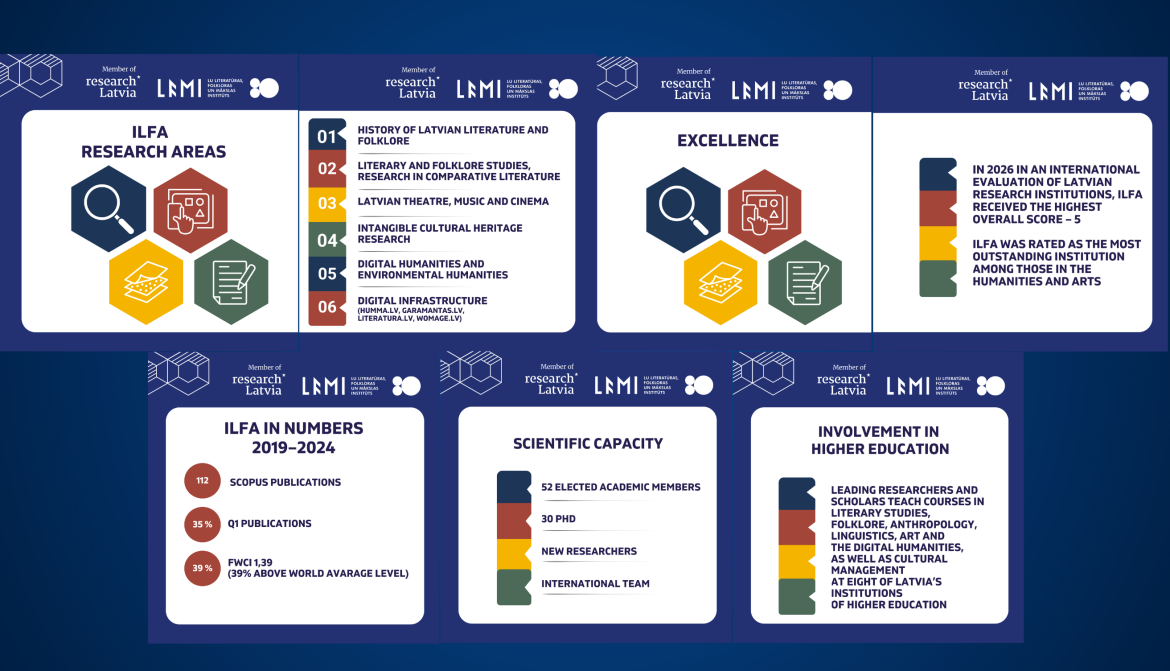
The ILFA UL oversees one of the symbols of national culture and one of the largest collections of folklore materials in the world – the Archives of Latvian Folklore. Since 2021, the institute’s director has been senior researcher Dr. philol. Eva Eglāja-Kristsone. In 2026, in an international evaluation of Latvian research institutions, the ILFA UL received the highest overall score – 5 – and was thus once again recognized as the most outstanding institution in the humanities and arts.
Research Areas at the ILFA UL
The basic structure of the ILFA UL consists of four departments: the Archives of Latvian Folklore, the Department of Literature, the Department of Art Studies, and the Department of Cultural, Social, and Environmental Studies. Representatives from these departments are also part of the Digital Humanities Group, which is responsible for the development of the ILFA digital resources and scientific research. Since 2025, the ILFA Scientific Council has been chaired by Dr. philol. Ieva Garda-Rozenberga.
Main areas of research in recent years: development of the digital infrastructure at the ILFA UL (the digital platform for the humanities and arts humma.lv; the digital archive of the Archives of Latvian Folklore garamantas.lv; including the Collection of Autobiographies, the digital platform for literature literatura.lv, the digital resource on women’s history womage.lv, and the initiation of the creation of a data platform for the performing arts sector), as well as the development of digital and environmental humanities, research on intangible cultural heritage, the preparation of the final volumes of the academic edition of Latvian folk songs, research into the history of Latvian literature and folklore, research into Latvian theatre, music, dance, and performance, and research in literary and folklore theory and comparative literature.
The ILFA UL participation in various national and international research projects illustrates how the study of historical traditions is balanced with solutions to contemporary problems, highlighting aspects of both cultural heritage preservation and societal development and responsibility.
From 2019 to 2024, ILFA UL research was published in 112 Scopus-indexed publications, 35 % of which appeared in Q1 journals. 39 % of these publications are cited at a rate above the global average (FWCI 1.39). Monographs and collective monographs by ILFA UL researchers are published regularly.
Team of ILFA UL
The ILFA UL employs 52 elected academic members and administrative staff, 30 of whom hold a Ph.D. Our team places special emphasis on engaging young scholars and international researchers. ILFA UL leading researchers and researchers teach courses in literary studies, folklore, anthropology, linguistics, art, and the digital humanities, as well as cultural management, at eight higher education institutions in Latvia: the Faculty of Humanities at the University of Latvia, the Faculty of Education, Psychology, and Art at the University of Latvia, the Faculty of Economics and Social Sciences at the University of Latvia, the Jāzeps Vītols Latvian Academy of Music, the Latvian Academy of Culture, the Latvian Academy of Art, Riga Technical University, the RTU Liepāja Academy, the RTU Riga Business School, and Riga Stradiņš University. ILFA researchers also participate in an educational program organized by the Competence Training Centre of the National Library of Latvia.
Publishing
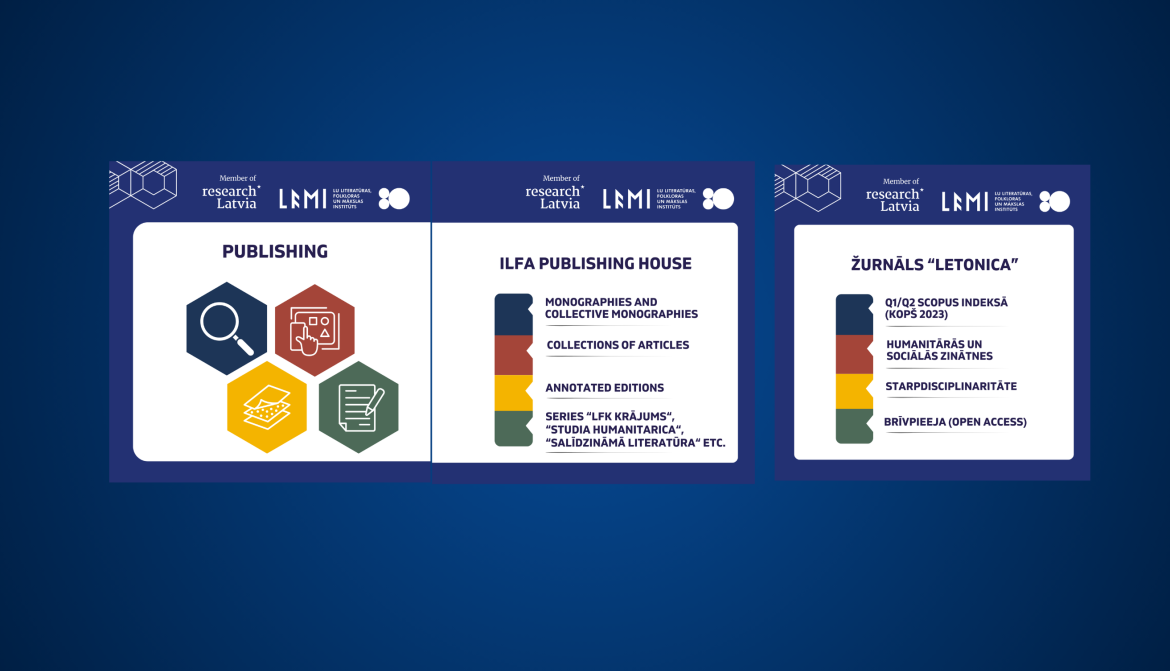
The ILFA UL Publishing House has been in operation since 2008, publishing monographs and collections of articles prepared by the institute’s researchers, the journal “Letonica”, and other publications that are regularly nominated for and win awards in competitions such as the “Latvian Literature Annual Award”, “Zelta ābele” book art competition and others. The director of the publishing house is Dace Krecere-Vule.
Since 1998, the ILFA UL has been publishing the interdisciplinary academic journal “Letonica”, which features articles in the humanities and social sciences – original, previously unpublished research based on scholarly investigation. All articles published in the journal undergo anonymous peer review. In the “Scopus” database the journal is indexed in five fields – literature and literary theory (Q1); visual arts and performing arts (Q1); history (Q1); music (Q1) and cultural studies (Q2) – thus covering the broadest range of topics among Latvian academic journals. The journal is also indexed in the ERIH PLUS and EBSCO databases. The journal’s editor-in-chief is Dr. philol. Jānis Oga, a researcher at the ILFA UL.
Knowledge transfer at the ILFA UL also takes place through dialogue with the broader public, using a variety of communication forms and tools – popular science publications, conferences, seminars, public lectures and discussions, consultations, social media, websites, and other informational resources, as well as by engaging in current cultural events and participating in public educational activities.
Also watch the video story dedicated to the June personality of the researchLatvia science calendar – PhD Jānis Ozoliņš, leading researcher at the Institute of Literature, Folklore and Art of the University of Latvia – about his research.