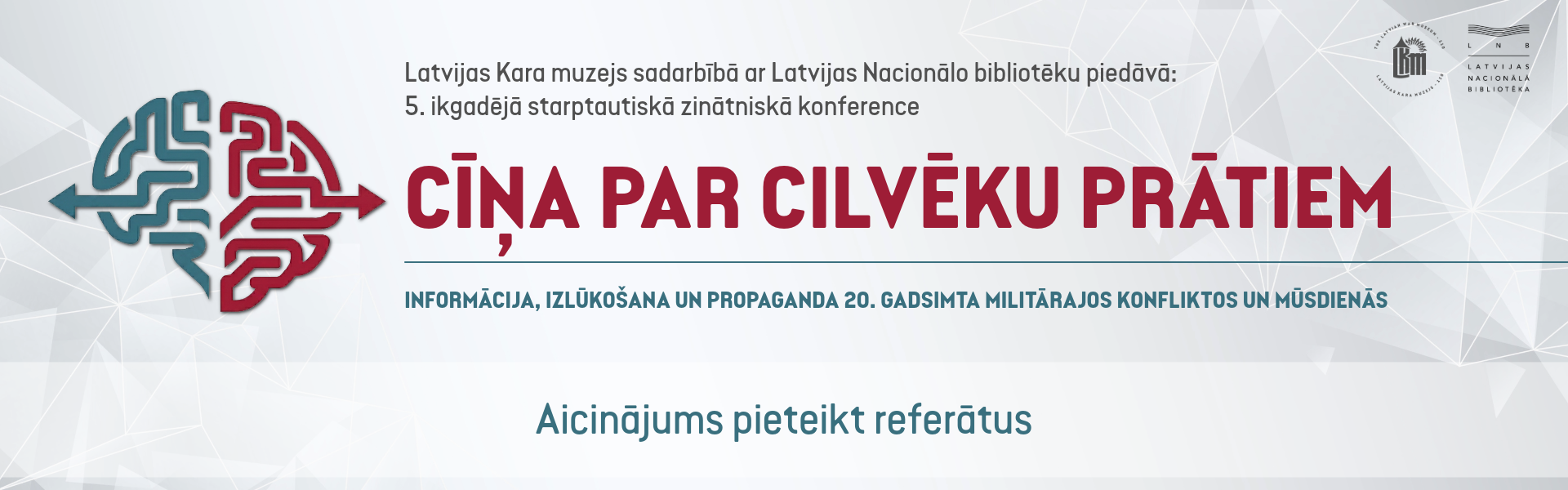
The Latvian War Museum, in cooperation with the National Library of Latvia, announces the call for papers for the international scientific conference “Struggle for human minds. Information, intelligence and propaganda in 20th century military conflicts and today”. The conference will take place on October 14–15, 2026 in Riga, in the Ziedonis Hall of the National Library of Latvia.
In today’s world, information is both a weapon and a target of war. Information is critically important not only for the conduct of military operations, but also in the struggle for human minds, that is, in shaping public opinion. The term “information warfare” has been known since the 1970s, but today its significance has increased to such an extent that it is rightly called “the new face of war” – an integral and often decisive component of it. Meanwhile, the evaluation of the credibility of information is no longer only the field of work of military analysts. It has become important for every member of society, if we do not want, without noticing it ourselves, to become manipulable.
Manipulation of information in the context of war is as old as wars themselves, and obtaining information about the opponent’s forces has always been at the core of strategies of attack and defence. Equally old is the sowing of confusion in the enemy’s ranks through rumors, or, conversely, boosting the morale of one’s own troops. However, over the course of the 20th century, with the modernization of society characteristic of this period, and the rapid development of war and technology, information acquired an unprecedentedly significant place in military conflicts.
The First World War marked the beginning of a new reality in the history of military conflicts, in which not only armies but also civilians – the entire enemy nation – became a strategic target. One of the strategies of “total war” became the breaking of civilian morale, thereby forcing the enemy nation to withdraw from the war. The direct attacks on civilians characteristic of the first half of the century were gradually replaced by methods in which manipulation of information was the central element. In the 21st century, the struggle for human minds continues, and we now speak of “hybrid warfare” – a type of war in which manipulation of information plays one of the central roles and even the boundaries between peace and war are no longer clearly definable.
At the 5th annual international conference of the Latvian War Museum, we aim to analyse the significance of information and its manipulation in warfare in the Baltic region in its various aspects – both by looking back at the history of the 20th century and by assessing the current situation. We invite speakers to address the following topics in the history of the Baltic region and Europe:
The use of propaganda for the purposes of war, including war propaganda in art and literature in the 20th century;
- The activities and role of intelligence services in wartime, in preparation for war or in preventing potential conflicts in the 20th century;
- Propaganda after the Second World War as an instrument for integrating the societies and minorities of occupied states and territories;
- The diplomatic service and its functions in collecting and analysing information in the history of 20th-century military conflicts;
- The development of mass media (the press – television – the internet, social media) and their impact on the circulation of information and the dissemination of propaganda in the context of military conflicts;
- The distortion and falsification of information in public mass media in the Baltic region in the 21st century in the context of Russia’s war of aggression against Ukraine;
The role of cultural institutions in strengthening information resilience today: exhibitions, research and the highlighting of historical evidence as tools for fostering public understanding, critical thinking and resistance to manipulation.
Conference working languages: Latvian and English.
Applications: kristine.bekere@karamuzejs.lv by 1 August 2026. The application must include: first name, surname, academic degree, place of work and position, the topic of the presentation, and a brief abstract of the presentation (250–300 words).Applicants will be informed whether their presentation has been included in the conference programme by 15 August 2026.
Contact: kristine.bekere@karamuzejs.lv