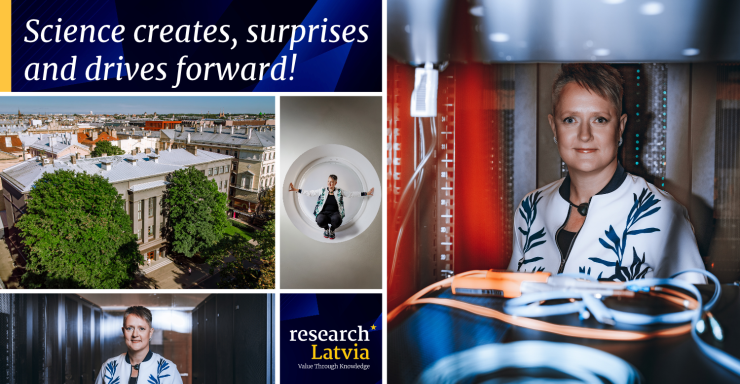
From artificial intelligence and language technologies to cybersecurity, bioinformatics and autonomous systems, the Institute of Mathematics and Computer Science, University of Latvia, combines world-class scientific research with technological development to create solutions that deliver value to society and the economy.

The development of modern society is increasingly driven by knowledge, data and technology. Artificial intelligence, cybersecurity, biomedical data analysis and autonomous systems are opening up new opportunities while also presenting complex scientific and technological challenges. Addressing these challenges requires interdisciplinary research that brings together mathematics, computer science and other scientific disciplines.
In Latvia, the Institute of Mathematics and Computer Science, University of Latvia (IMCS UL), makes a significant contribution to the development of these fields. It is a research institution with more than 65 years of experience in fundamental and applied research, as well as in the development of research-based technological solutions.
More than 65 Years of Advancing Science and Technology
The IMCS UL was established in 1959 as the Computing Centre of the University of Latvia, with a strong focus on research. Its establishment marked an important milestone in the development of computer science and computing technologies in Latvia. Over the decades, the Institute has expanded its activities, developed new research expertise and become involved in addressing an increasingly broad range of interdisciplinary scientific and technological challenges.
Today, the IMCS UL operates as an independent research institute within the University of Latvia's research ecosystem. Its activities encompass fundamental and applied research, as well as the development and provision of technological solutions that serve societal needs. The practical application of scientific expertise in cybersecurity, computer networking and language technologies is particularly important.
Five Strategic Research Areas
The research activities of the IMCS UL focus on five complementary areas, bringing together expertise in computer science, mathematics and interdisciplinary technologies.
Artificial Intelligence
Research in this area encompasses language technologies, deep learning and knowledge engineering. Particular emphasis is placed on natural language processing, speech technologies and artificial intelligence solutions for the Latvian language, supporting its full integration into the digital environment.
Cybersecurity
This research area combines expertise in quantum communications, cybersecurity and computer networking technologies. The Institute's capabilities also include CERT operations and the provision of network solutions, making a practical contribution to the security and resilience of Latvia's digital infrastructure.
Bioinformatics and Biomedical Informatics
Research focuses on applying computational and information technologies to the analysis of biological and medical data. This area supports the development of new methods and tools for life sciences research and healthcare.
Mathematical Methods and Technologies
Research covers mathematical modelling, optimisation, numerical methods and algorithms. These provide a fundamental basis for addressing complex scientific and technological problems, while also supporting the development of the Institute's other research areas.
Real-Time and Autonomous Systems
Research focuses on embedded, real-time and autonomous systems, their modelling and software technologies. The main emphasis is on developing reliable systems capable of independently sensing information and responding to changing conditions.
From Scientific Research to Solutions for Society
One of the defining features of the IMCS UL is the close connection between scientific research and its practical application. The Institute's aim is not only to generate new knowledge but also to translate it into technologies and services that address the needs of society and the economy.
This approach is particularly evident in the fields of cybersecurity, computer networking and language technologies. In these areas, research expertise is applied to the development and provision of practical solutions that contribute to a secure digital environment and broaden access to technology.
Knowledge transfer, higher education and cooperation with industry also play an important role. Collaboration with businesses, public institutions and other research organisations makes it possible to combine academic expertise with practical needs, fostering innovation and the adoption of new technologies.
Mission – Creating Knowledge That Delivers Value
The activities of the IMCS UL are guided by three interconnected mission objectives:
- To conduct world-class, targeted fundamental and applied research, promoting scientific excellence and the creation of new knowledge.
- To facilitate knowledge transfer to the economy through higher education and cooperation with industry.
- To develop research-based technological solutions that generate added value through their everyday application.
This mission reflects the Institute's belief that the value of science lies both in generating new knowledge and in its ability to solve real-world problems and improve people's lives.
Contributing to the Future of Science and Technology in Latvia
Over more than 65 years, the IMCS UL has become an important contributor to the development of science and technology in Latvia. Today, the Institute continues to advance its research expertise in areas of strategic importance to the digital and economic development of both Latvia and Europe.
By combining fundamental science, interdisciplinary research, cooperation with industry and practical technological development, the IMCS UL promotes knowledge transfer and innovation. Its contribution helps strengthen Latvia's scientific capacity, digital security and technological competitiveness while laying the foundations for future solutions.