Researchers in cognitive science in Latvia focus on a wide range of questions, from human fatigue and cognitive load to health and perception. Thanks to financial support from the University of Latvia Foundation, the laboratory studies phenomena such as human eye movements, while researchers are also exploring how changes in pupil size may be linked to stress, overload, and emotions. These studies are conducted in collaboration with leading research centres around the world.
The findings on how we interpret other people's emotions are equally surprising. “There is a common belief that the eyes are the window to the soul. In reality, when we conduct systematic experiments, we find that the mouth is actually critical for reading emotions,” says Professor Šķilters. The team, which includes talented students and researchers, experimentally demonstrates how strongly the expression of emotions in the eyes is influenced by the shape of the mouth and how facial features trigger stereotypical responses.
An important theme in contemporary science, including in Latvia, is that human senses do not operate independently. The brain combines vision, hearing, taste, smell, and touch into a single perceptual experience. This interaction is studied in so-called cross-modal perception research. “Round shapes are perceived as sweet. Angular shapes seem sour or salty. Similarly, rounded forms are typically associated with pleasant sensations and emotions, while sharp forms are linked to unpleasant ones,” explains Professor Šķilters, offering one of the simplest examples.
Forty years ago, we did not really know that changes in sound frequency, for example, could influence our sense of taste. Today, scientists study cross-modal perception, which investigates the connections between different senses. These discoveries are transforming not only culinary experiences but also expanding our understanding that all senses interact. There is no situation in which we only hear or only smell.
This knowledge can also have very practical applications. For instance, changing the colour of a beverage can influence how sweet it is perceived to be without adding more sugar. In this way, perception research can help identify better solutions in public health as well. Many studies also show that higher-frequency sounds can slightly enhance the perception of sweetness. Music and lighting in a restaurant can likewise affect taste perception. And when people enjoy the taste, they are more likely to return, leading to higher revenues for the restaurant.
A similar interaction between the senses can be observed between sound and vision. “When the pitch of a sound changes, the position of our gaze changes as well,” says Professor Šķilters, referring to one of the effects observed in research. This means that changes in sound alone can influence where a person's attention is directed. Such an effect may be useful in military applications or other situations requiring extremely rapid reactions. The implementation of these studies also highlights the important involvement of talented students in high-level research teams.
A Few Seconds of Eye Movements Can Reveal a Surprising Amount
However, the interaction between taste and other senses is only one aspect of what researchers are trying to uncover about human perception. Šķilters explains that over approximately the last 20 years, Latvian cognitive scientists have achieved several significant results. One of the most striking examples relates to the study of eye movements.
By recording a person's eye movements for just five to ten seconds, researchers can detect differences between a healthy individual and a patient in the early stages of Parkinson’s disease. “This is truly a major discovery, and by no means an obvious one,” he adds, noting that international colleagues have also expressed great appreciation for the findings.
The Smarter the Person, the Harder They Are to Manipulate
Cognitive science investigates how people perceive information and what captures their attention. If human perception is so easily influenced, what can be done to make us less susceptible to manipulation?
“The smarter people are, the more difficult it is to manipulate them,” says Professor Šķilters, emphasising that this is not only about knowledge of individual senses or specific disciplines. What matters is an educated society as a whole: the ability not only to critically evaluate information but also to accept that one’s own opinion or belief may be mistaken. This reduces susceptibility to manipulation, fosters caution toward different viewpoints and their generalisations, and increases resilience against misleading messages.
The discussion of manipulation naturally leads to the question of attention and the role of technology in our daily lives. Speaking about technology's influence on attention, Šķilters recommends reading as one way to train it. Forty-five minutes of uninterrupted book reading strengthens both attentional endurance and precision. The professor advises choosing a printed book and placing the phone in another room while switching off other devices. Writing by hand on paper is equally important. These activities engage both vision and touch, whereas touch is not stimulated in the same way when using touchscreen devices.
How Is Artificial Intelligence Changing the Way We Think?
Artificial intelligence (AI) tools are playing an increasingly significant role in our daily thinking processes. Šķilters does not deny their advantages, as they allow many tasks to be completed more quickly and easily. At the same time, however, he points to the risks that regular use of such tools may pose to our own cognitive processes.
The professor associates this with changes in metacognitive performance, namely the ability not only to perform a task or understand something but also to evaluate the quality of one’s own thinking and performance. By relying on AI, we may lose the ability to objectively assess how well we are performing a task ourselves, and our understanding of our own abilities may gradually diminish.
According to the researcher, another challenge concerns understanding and evaluating cause-and-effect relationships. AI also has no intrinsic reference point for distinguishing truth from falsehood. Humans possess the ability to separate truth from lies and misinformation, but as we increasingly rely on AI, will we be able to preserve that ability?
“What matters is not only learning how to understand or calculate something, but also understanding how well we calculate, how well we think, and how well we perform a given process. Otherwise, people may not even notice that they have relied on an AI decision that is potentially inaccurate or flawed.”
Jurģis Šķilters
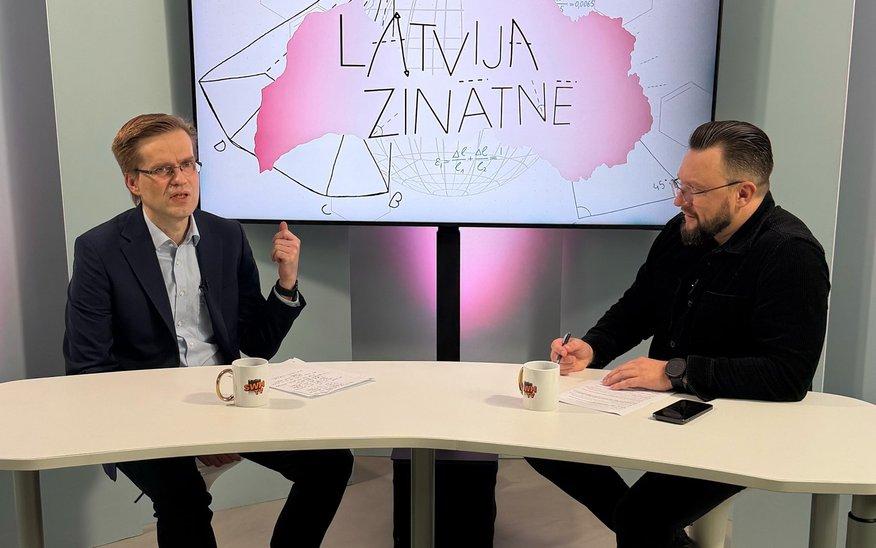
The Radio SWH TV programme “Latvia in Science” introduces Latvian scientists, researchers, and innovators whose ideas and achievements are shaping future technologies and solutions, while revealing science as an exciting and deeply human endeavour. The conversations with scientists are produced in cooperation with “Rietumu Banka” under the motto “Excellence Is Never Accidental.” The scientists are supported by the University of Latvia Foundation.
The programme airs on Radio SWH TV on Thursdays at 20:00, with repeat broadcasts on Sundays at 15:00.