Born in Belgium, he spent more than 20 years working at Delft University of Technology in the Netherlands. Today, his work is associated with a Swiss company, while he continues to collaborate with several universities. Everywhere he goes, he seeks out biochemists, geneticists, and other scientists, passionate and driven individuals who are willing to embrace his vision for DNA technology and help advance it further.
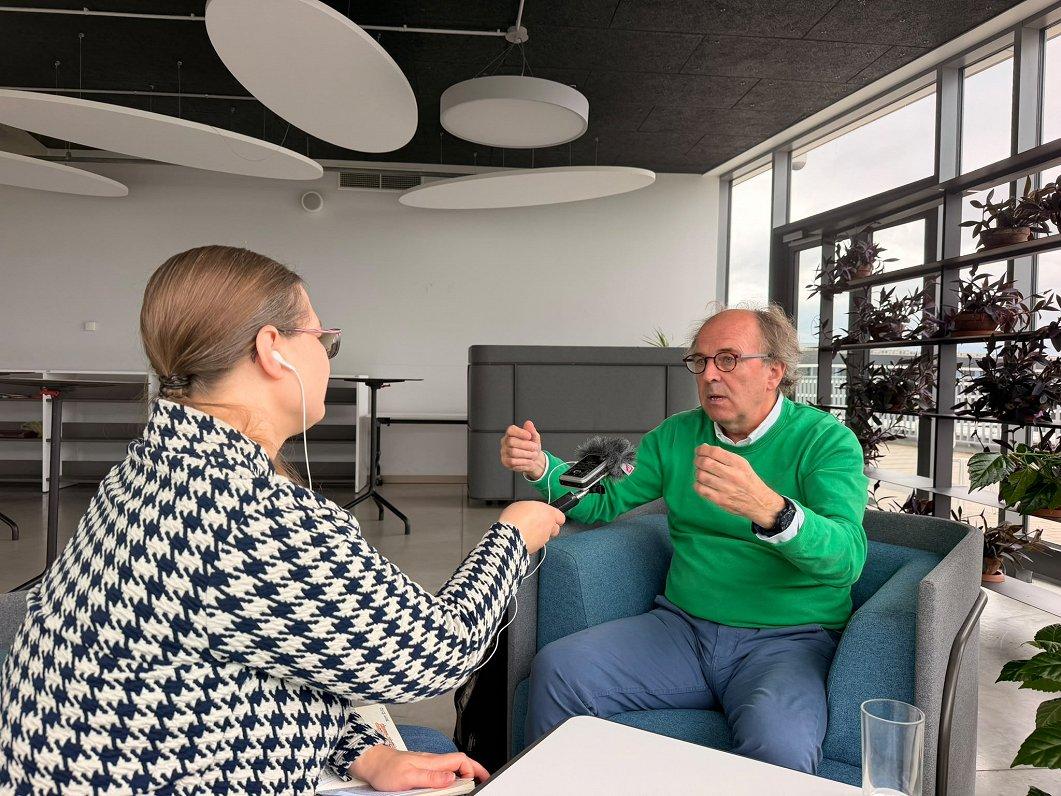
Professor Bertels recently spoke with Latvian Radio's science programme Known in the Unknown. If this conversation sounds futuristic, that's perfectly fitting, as Bertels is often described as a true man of the future.
"Perhaps I am not the only one, but I am quite unique in the sense that I always like to look 10 to 15 years ahead. Where are we now? What are our limits? And what do we need to change today in order to be ready 10 to 15 years from now? The transistors we use in mobile phones and supercomputers are already only two nanometres in size. Scientists have discovered that once we go below one nanometre, transistors begin to behave probabilistically and with uncertainty. That means the same data could produce completely different outputs. That is why, as early as 1986, the physics genius Richard Feynman argued: why not build a computer based on the principles of quantum mechanics? This idea launched the global fields of quantum computing, quantum communication, and quantum sensing.
But I am focusing specifically on quantum computing. What concerns me most is that physicists, and I have nothing against physics or physicists because they are very smart, tend to focus only on the layer of quantum physics itself. Yet when you build a computer, you must consider many other layers as well.
Let me give you an example. It is not an anecdote; it is reality. Intel, whose processors power computers around the world, visited Stanford, MIT, Princeton, Cambridge, Oxford, and many other leading universities asking a simple question: ‘What is a quantum computer?’ When they came to Delft, my colleagues in physics said, ‘Coen, you should explain it to Intel, because you are the one who builds computers. We are just physicists.’
So I explained that a quantum computer requires many layers: chip design, architecture, operating systems, programming languages, applications, and quantum circuits. Intel responded, ‘This is the first place where we have actually heard what it means to build a quantum computer.’ That was the beginning of my career in quantum computing.
Mariona Baltkalne, Latvian Radio: Our programme has often covered quantum physics, quantum technologies, and quantum computing, yet for many people these concepts still seem somewhat abstract. How would you explain where quantum technologies appear in our everyday lives? We certainly use them already. But how and where?
Coen Bertels: I can give a very simple answer. Every one of us experiences quantum effects because they exist at the subatomic level. We do not consciously perceive this quantum behaviour, yet it is everywhere, including within our own bodies.
I would also like to say something about DNA. I enjoy challenging people to think differently, and a few years ago I decided to start exploring DNA for computation. But even more importantly, I wanted to address a question that humanity has largely overlooked: how will we store the enormous and ever-growing volumes of data we continue to generate? Fortunately, a solution already exists.
The pharmaceutical industry has developed DNA-based data storage systems for preserving genetic information used in the development of medicines and vaccines. The technology already works. However, nobody is connecting this field with quantum computing. Companies such as IBM and Microsoft are exploring DNA data storage while also investing heavily in quantum computing, but these remain separate worlds. I am the crazy person trying to connect them.
I should also thank Korea University for inviting me. There I met a young professor of genetics who had built a DNA storage system for his research. At the same time, I was already working on quantum computing. We connected, collaborated, and published a scientific paper together. Unexpected connections, the kinds nobody anticipates, are where real innovation can emerge.
I am convinced that DNA computing and DNA data storage are not a question of if, but when. Whether it happens in five, ten, or fifteen years, I cannot say. That is why I am looking for younger people to continue pushing these ideas forward. I am 64 now. I want to inspire the next generation to look further into the future and say, ‘Yes, I will go in that direction.’ That is one of the main reasons I am here in Riga. I want to speak with young people, with industry, and with science students. Think about it. It could become a major turning point in your lives.
Mariona Baltkalne: Let's return to your “crazy idea” in a moment. But staying with quantum technologies and quantum computing: scientists devote tremendous effort to these fields even though most of us do not notice their effects in everyday life. Could you give some examples where quantum technologies and quantum computing already have, or will have, a tangible impact?
Coen Bertels: A clear example comes from chemistry. Much of modern industry relies on chemical processes. Today, chemical companies simplify their models to manageable numbers of atoms and electrons because those systems can be simulated on classical computers. However, as soon as additional electrons or atoms are added, the complexity quickly becomes unmanageable.
In fact, around 90 to 95 percent of everything produced by the chemical industry is first designed and modelled using computers. When practical quantum computers become available, this complexity barrier will disappear. We will be able to model vastly more complicated molecular systems. All of this still needs to be demonstrated experimentally, but it has the potential to transform chemistry and therefore nearly every aspect of our lives.
Perhaps the most important applications will be in medicine and pharmaceuticals. Because I work on DNA for quantum computing and data storage, we are already exploring medical applications. One of my PhD students from China has begun working on a cancer vaccine concept.
I often frame my work in the context of future missions to Mars. If humanity sends people to Mars, we must be able to support them medically for years, perhaps for their entire lives. That includes women astronauts. Take breast cancer as one example. We will need the ability to diagnose and treat such conditions on Mars itself. A return trip from Mars to Earth takes many months. Patients could not simply be transported back home. This is why I believe the future of quantum technologies extends far beyond political boundaries and geographical limitations.
One issue that the quantum-computing community largely overlooks is data storage. I became interested in DNA data storage after reading an interview with Michael Dell, founder of Dell Technologies. He suggested that the world may require a hundred times more data centres over the next decade. When I calculated what that would mean in terms of space, it simply did not seem feasible.
Companies such as IBM and Microsoft are separately investigating quantum computing and DNA data storage, but they do not combine the two. As a small company, we have more freedom to pursue unconventional ideas. That is why I focus on creating a bridge between data storage, computation, DNA technologies, and quantum concepts. We have already started down that path. This work is not for one individual; it is for humanity as a whole.
Mariona Baltkalne: This seems like the right moment to explain that connection in more detail. DNA data storage still sounds almost impossible to many people. DNA is the basis of our genetics. How can DNA be combined with quantum technologies?
Coen Bertels: First, let me explain DNA itself. It consists of four nucleotide bases that pair in a very specific way: adenine with thymine, and cytosine with guanine. Those pairings have existed for millions of years. Dinosaurs used them. Humans use them. It is already a proven natural technology.
Today, pharmaceutical companies already use DNA storage methods. Any kind of digital information, including this interview, can be translated into DNA. You simply need a compiler: software that converts one data format into another. In this case, it converts digital data into DNA sequences.
At Delft, we developed such a compiler ourselves, so the concept already exists. However, scaling it up remains challenging. Compilers are among the most sophisticated forms of software ever created.
To give an illustration, all of the information humanity has produced over roughly the last 10,000 years could theoretically fit into about five cubic metres of DNA storage. The challenge is not storing the data but efficiently finding and retrieving specific pieces of information. That is where future software development will play a crucial role. Once these challenges are solved, DNA-based quantum computation and DNA data storage could be integrated.
Mariona Baltkalne: But many people will still ask: does this mean using DNA taken from humans or other living organisms to store information?
Coen Bertels: That is a very good question. No, we use synthetic DNA. One of my colleagues in South Korea experimented with DNA from a microorganism, but that is not the approach we want to take. Our work has nothing to do with using human DNA or DNA from living bacteria. It is artificially created DNA designed specifically for technological purposes.