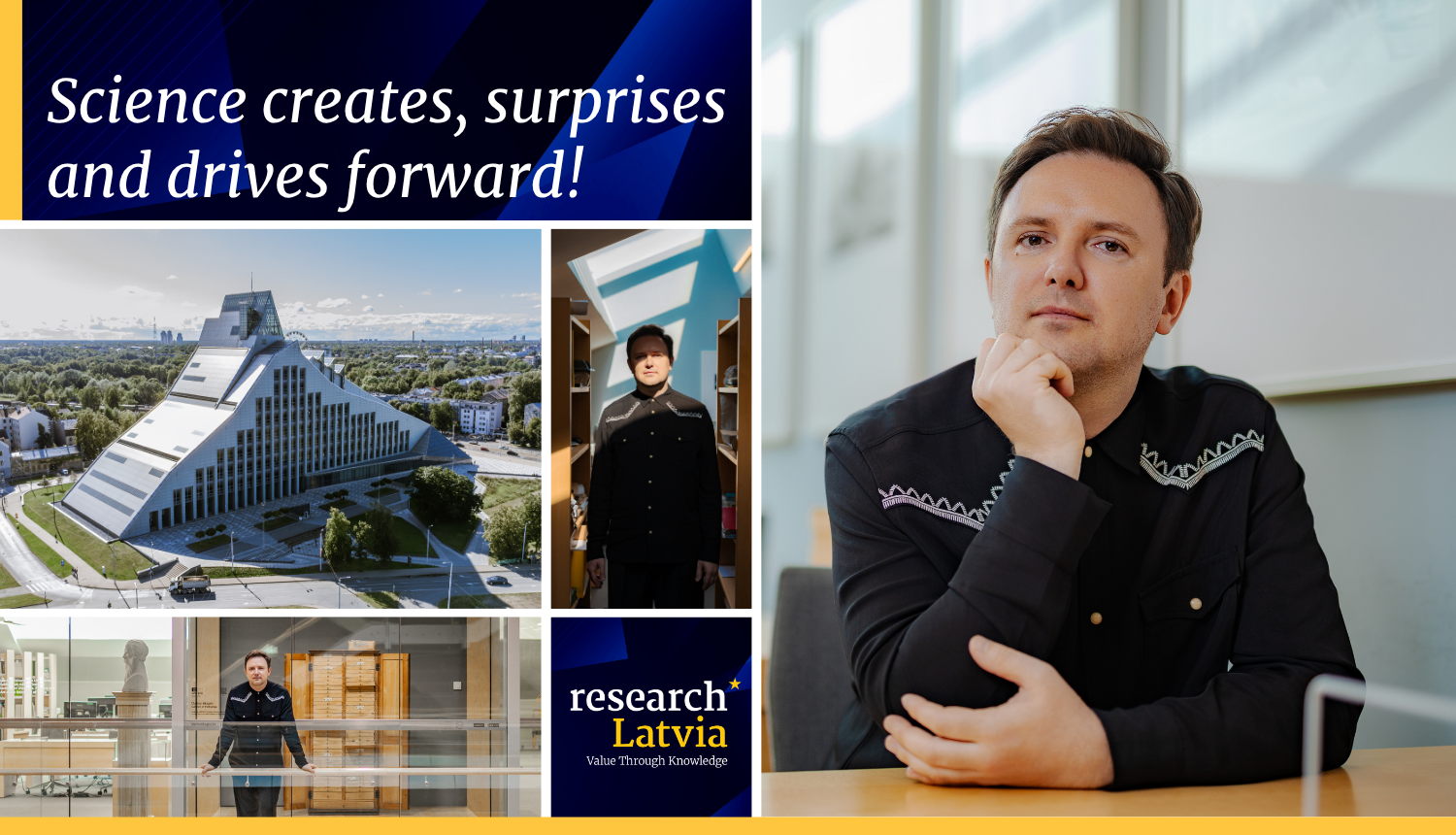
As a leading researcher at the Institute of Literature, Folklore and Art of the University of Latvia (UL ILFA), PhD Jānis Ozoliņš also serves on the Institute’s Scientific Council, contributes to international research organisations, and teaches at the Art Academy of Latvia as a lecturer and doctoral thesis supervisor. His academic profile reflects a deep engagement with contemporary cultural processes and the role of the humanities in understanding society.
“At a time when society faces war, misinformation and deliberate polarisation, it is the humanities that help protect and interpret the fundamental values embedded in language, culture and identity. Without the humanities, not only science, but Latvia as a country, cannot exist.”
UL ILFA is one of the most influential humanities research centres in the Baltic region. Approaching its 80th anniversary in 2026, the Institute conducts high-level cultural and comparative research in the fields of literature, folklore, music and performing arts, cultural and gender studies, as well as digital and environmental humanities. Its work combines long-standing academic traditions with contemporary critical theories, interdisciplinary perspectives and global academic dialogue.
Jānis’ research interests are grounded in critical theory and cultural studies, shaping the interdisciplinary nature of his projects. His scientific work examines how identity is represented across different artistic forms – including literature, film and contemporary art. He has contributed to research on gender and sexuality, queer studies, masculinity, narratology, affect theory and disability studies. His teaching and supervision roles support the development of new scholars and the strengthening of humanities education in Latvia.
The humanities play an essential role in defining identity, culture and values at individual, national and universal levels. They form the intellectual foundation of education systems and are vital for cultivating critical thinking – a prerequisite for maintaining democratic societies. By studying cultural and artistic processes, researchers help societies understand themselves, their history and the forces shaping the present.
One of Jānis’ current projects focuses on how populism and far-right political discourse manifests in the public sphere and literature. The research examines how political rhetoric evolves in response to economic and political changes, and how societies are influenced through specific narrative tools. As populist movements differ across regions and historical moments, it is crucial to understand their local particularities, as well as their potential to polarise society and undermine democratic norms.
The aim of this research is not only academic but also public-facing: to promote broader understanding of how political strategies shape public opinion. By uncovering how “sensitive topics” are used in political communication, the project helps explain the mechanisms through which public attitudes are influenced and social tensions created.
Jānis’ work highlights the essential contribution of the humanities in an era marked by information overload, societal fragmentation and rapid cultural change. His research strengthens Latvia’s intellectual landscape and helps ensure that democratic and cultural values remain protected and understood.
The science calendar “Research Latvia 2026” and the researcher descriptions were developed within the ERDF-funded project No. http://1.1.1.1/1/24/I/001 “More Efficient Implementation and Management of Latvia‘s Science Policy”, implemented by the Ministry of Education and Science.