Can clothing help people better understand their movements? Researchers at Rīga Stradiņš University (RSU), in cooperation with Riga Technical University (RTU) and Vidzeme University of Applied Sciences (ViA), are developing smart textile solutions that make it possible to obtain information about body movements and use it to improve exercise performance. As the three-year research project approaches its conclusion, the technology has already been tested outside the laboratory, involving young football players. The researchers' aim was to determine how such solutions could help prevent injuries in the future.
In sports, it is important not only how much a person trains, but also how they move. When running, jumping, landing or performing squats, the load on the feet and control of leg joint movements play a significant role. People cannot always feel whether a movement is being performed in the desired way, and even a specialist cannot accurately assess all the characteristics of movement through visual observation alone.
To address this problem, the researchers explored ways to use sensors embedded in clothing for movement assessment and training.
“These tools provide us with information about what we cannot assess or see ourselves,” explained project leader, RSU leading researcher and physiotherapist Guna Semjonova, speaking about the work carried out within the project at RSU Innovation Day.
Fabric Becomes a Motion Sensor
Smart textiles are fabrics with electrically conductive threads embedded in them. When the fabric is stretched or compressed, its electrical resistance changes. These changes can be recorded and converted into data about movement or load.
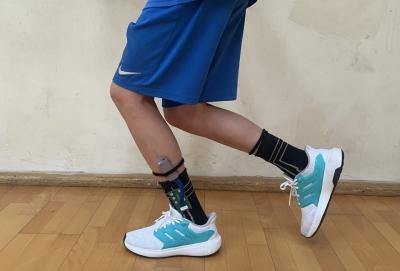
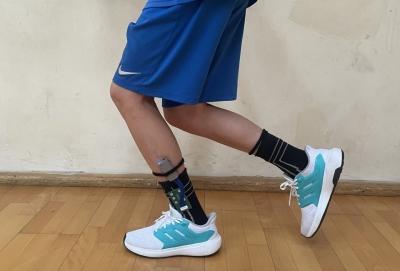
One of the solutions used by the researchers is the DAid® smart sock system. The sensors embedded in it help assess how pressure on different parts of the foot changes during movement. Unlike measurements that require a specialised platform, wearable sensors offer the possibility of obtaining information outside the laboratory as well.
However, the essence of the project is not just measuring movements. The researchers worked to make the collected data useful to the individuals themselves. This is where biofeedback plays an important role – an approach in which a person receives information about their body's functioning and uses it to consciously adjust their movements. For example, if the foot is loaded in an undesirable way during an exercise, the system can help detect this, allowing the person to adjust the execution of the movement and the position of the foot.
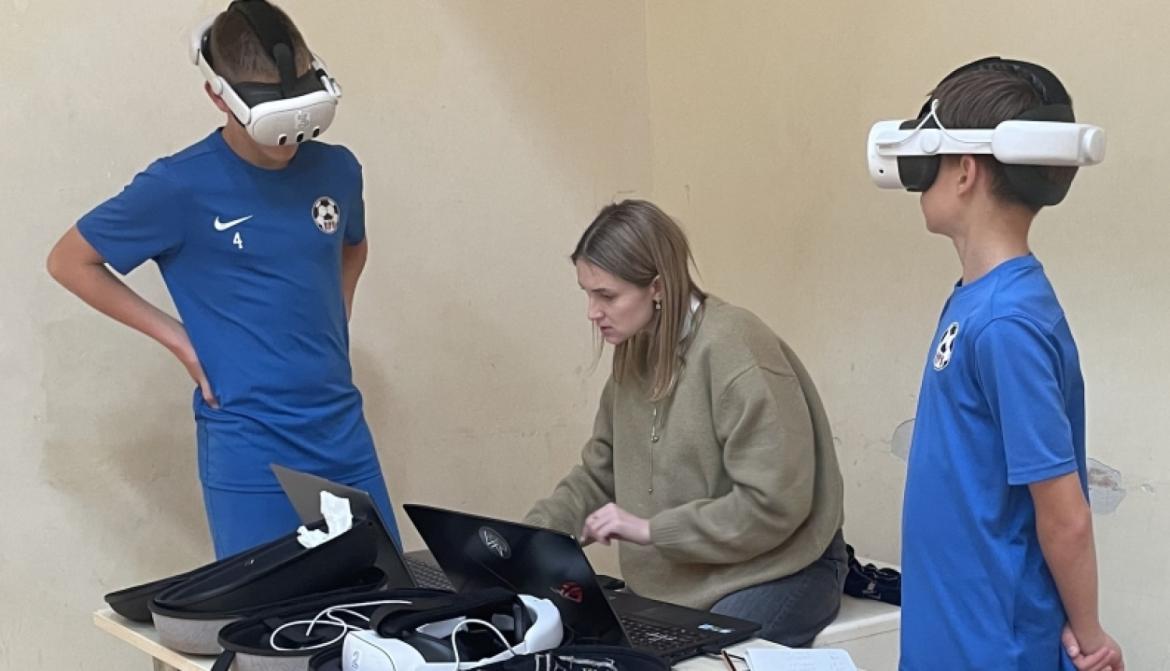
The project combines the capabilities of smart textiles with digital solutions and a mixed reality approach. The aim is to ensure that movement assessment is not merely a specialist's analysis of data, but also a process of learning exercises that is understandable and useful to the athlete.
Technology Tested Outside the Laboratory
The project has paid particular attention to players in the Latvian Youth Football League. Football often involves running, rapidly changing direction, jumping and landing, which subjects the legs to repeated strain. Under such conditions, movement control and the correct performance of injury prevention exercises are particularly important.
As project leader Guna Semjonova explains, the researchers have not only developed the technology and conducted initial measurements in the laboratory, but also tested its potential use in conditions closer to athletes' everyday activities. In a study involving 32 young football players, several wireless sensor systems were used to analyse foot loading, leg joint movements and muscle activity. The researchers identified a relationship between foot loading, knee and hip joint movements, and muscle activity. These results are described in one of the scientific publications produced during the project, published in the international journal JMIR Formative Research. The knowledge gained helps provide a better understanding of the interrelationships between movements of different parts of the leg and may be useful in developing technologies that provide athletes with feedback on exercise performance.
The technology has currently reached Technology Readiness Level 6 (TRL 6). This means that the prototype has been demonstrated in relevant conditions, but is not yet ready for widespread commercial use. Going forward, it is important for the researchers to improve the way the collected data is converted into feedback that athletes can understand and to integrate such systems into training or rehabilitation processes.
Could Smart Clothing Also Help in Rehabilitation in the Future?
Although the current project focuses on young football players, the potential applications of smart textiles extend beyond sports. Guna Semjonova, who also works as a physiotherapist in her daily practice, sees potential for using such technologies in rehabilitation, for example, helping people relearn how to walk after injuries or illnesses, as well as in amateur sports and professional dance.
The researcher explains that, before this project, she and her colleagues also studied the use of sensors embedded in T-shirts to assess the movements of violinists and ballet dancers, while RTU researchers have focused on smart textile solutions for measuring breathing and other body movements.
For such technologies to become more widely used, they must be comfortable and accessible. As Guna Semjonova recalls, early prototypes required larger electronic units and numerous wires, but it is now possible to develop increasingly compact solutions. Further development of the technologies created by Latvian researchers will require additional investment and cooperation partners. However, it is important to remember – the value of such research is not measured solely by whether a fully market-ready product has been developed by the end of the project. Such studies make it possible to test new ideas, gain knowledge and develop technologies whose practical applications may be much broader than originally intended. Today, researchers are looking for ways to help young football players better control their movements, but in the future, this knowledge may also be useful in rehabilitation and other fields.
About the Project
In the Fundamental and Applied Research Project “Smart Textile Solutions as a Biofeedback Method for Injury Prevention among Latvian Youth Football League Players” (No. lzp-2023/1-0027), Rīga Stradiņš University cooperates with Riga Technical University and Vidzeme University of Applied Sciences. The project is funded by the Latvian Council of Science. Guna Semjonova presented the research and the potential applications of smart textiles at RSU Innovation Day on 5 November 2026.