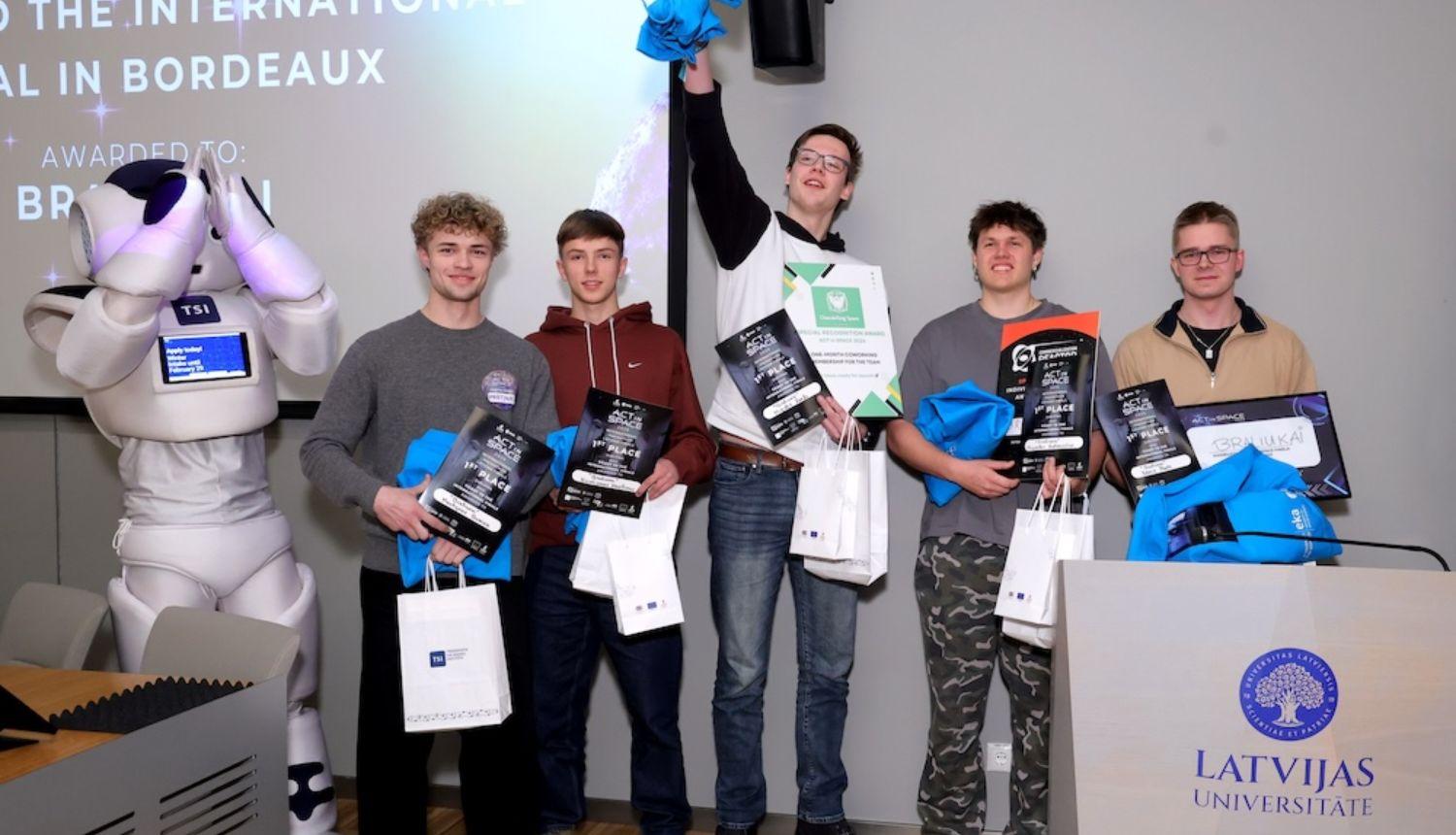
The winner of the Latvian edition of the international innovation hackathon Act In Space is the team Braliukai, which proposed a modular and compositional satellite solution called Hexsat. The concept aims to reduce the high costs, long development timelines, and limited upgrade possibilities typical of traditional space missions. As the winner of the Latvian hackathon, the team will represent Latvia at the Act In Space international final in Bordeaux, France, competing against the best teams from around the world.
The Braliukai concept envisions launching the satellite as a compact block of vertically stacked modules, maximising the use of the rocket’s payload volume. Once in orbit, the modules would automatically deploy and connect into a unified structure. The system would allow the satellite to be reconfigured and expanded even after launch. The Hexsat solution is intended to provide flexibility for various missions and to promote the development of more sustainable space infrastructure.
17 Teams, 24 Hours
A total of 17 teams participated in this year’s Act In Space hackathon, working for 24 hours to address challenges across space, defence, sustainability, and data utilisation. Participants tackled topics including defence in and from space, modular and compositional satellite design, private space stations, orbital data centres, artificial intelligence solutions for vegetation monitoring, and Earth protection and sustainable resource management using Airbus Earth Observation data.
Second place was awarded to the team T.S.I.S.C., which proposed a modular, compositional satellite design focused on developing flexible, adaptable space systems. Third place went to the team Space Psy, which presented an idea for practical forest-warning systems from space, offering solutions for early identification of environmental risks.
A Safe Environment for Experimentation
The global innovation hackathon Act In Space has been jointly organised by the French National Centre for Space Studies (CNES) and the European Space Agency since 2014. Its goal is to discover, develop, and promote the commercialisation of ideas based on space technologies, satellite data, and related solutions. In Latvia, the event was organised this year by the European Space Agency Business Incubation Centre in Latvia (ESA BIC Latvia) in cooperation with the Latvian Space Industry Association. The University of Latvia, Transport and Telecommunication Institute, Riga Technical University, EKA University of Applied Sciences, the Ministry of Education and Science, Accenture Latvia, and the Environmental Solutions Institute supported this year’s event.
“The organisation of the Act In Space hackathon in Latvia is a significant contribution to fostering young people’s interest in the space sector, as well as strengthening Latvia’s space ecosystem at the international level. Latvia’s status as an associated member state of the European Space Agency opens up opportunities for students and startups to develop skills and ideas by participating in programs, training courses, conferences, and project calls,” says Ilze Stikāne, Senior Expert at the Ministry of Education and Science.
Nikolajs Adamovičs, Coordinator of ESA BIC Latvia and Head of the Commercialisation Reactor, notes that Act In Space demonstrates that space technologies in Latvia are not a vision of the future; they are already becoming commercially viable solutions today.
“It was a pleasure to host the European Space Agency’s travelling hackathon Act In Space 2026 at the University of Latvia. In such events, it is particularly important to involve students and researchers with deep sector-specific expertise, as their knowledge enables real challenges to be addressed alongside industry and innovative ideas to be developed. In the space sector, hackathons confirm the university’s role as a safe environment for experimentation, where solutions are developed with applications both in space and on Earth,” emphasises Enno Ence, Vice-Rector for Development at the University of Latvia.
Among the Top Five
The hackathon takes place every two years in more than 50 countries worldwide, bringing together thousands of participants. In Latvia, the Act In Space hackathon was held for the fourth time. Latvian teams achieved strong results in 2023, with the Crispy team placing among the top five in the Airbus challenge at the international Act In Space final, as reported by Labs of Latvia.
“It is fantastic that our students have reached such a high level! This is a powerful achievement. It gives Latvia excellent visibility internationally and opens up opportunities for further cooperation,” said Diāna Lapkis, Member of the Board of the Latvian Space Industry Association and organiser of Act In Space 2022 in Latvia, at the time.