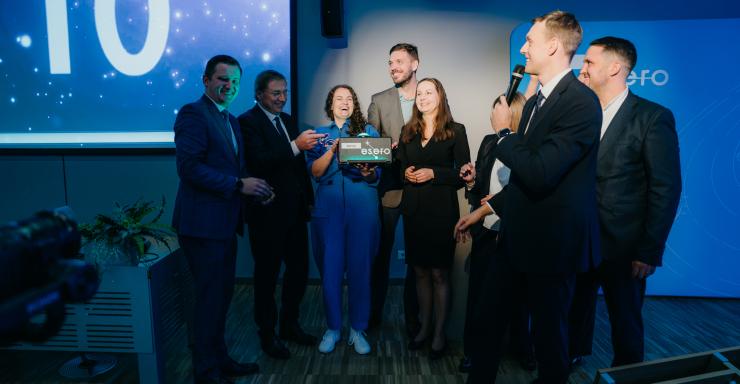
Latvia has taken another step forward in the field of space – during a visit to the headquarters of the National Aeronautics and Space Administration (NASA) in Washington, United States, Minister of Education and Science Dace Melbārde and NASA Administrator Jared Isaacman signed an agreement on Monday, April 20, joining the international Artemis Accords initiative. This agreement marks a significant milestone for Latvia within the global space exploration community and opens new opportunities for both science and business.
“Joining the Artemis Accords is an investment in the future – in our students, researchers, and innovators. It strengthens Latvia’s role as a reliable partner in the international space community and creates new opportunities to advance science, technology, and education,” said Minister of Education and Science Dace Melbārde.
In her address, the Minister particularly emphasised the importance of international cooperation and highlighted a breakthrough in space exploration with the successful implementation of the Artemis II mission, noting that it represents an important step toward humanity’s return to the Moon and a clear example of what can be achieved through close international collaboration.
The Artemis Accords are an international agreement on peaceful and sustainable space exploration, whose core principles define how countries cooperate in space exploration and technology development, based on transparency, responsibility, and sustainability. This step marks a significant milestone in Latvia’s continued involvement in international space cooperation, while opening new opportunities for Latvian students and researchers and fostering the development of science and innovation.
The agreement was developed by the U.S. government and NASA in 2020, and by 2025, it had been signed by more than 50 countries, including the largest EU Member States, the United Kingdom, Australia, Brazil, Japan, Canada, Lithuania, Estonia, and others.
The Cabinet of Ministers supported joining the Artemis Accords on October 7, 2025, authorising the Minister of Education and Science to sign the agreement. Latvia’s accession to the Artemis Accords will provide opportunities to expand bilateral cooperation with the United States in space policy and industry collaboration, integrate Latvia’s industry and research into global value chains, and strategically strengthen the country’s international visibility in the space sector.
Latvia is already active in the space sector. Since joining the European Space Agency in 2020, more than 120 projects have been implemented in Latvia, involving companies, research institutions, and universities, and developing high-value-added technologies for the international market.
Latvian companies also participate in global space missions, including lunar exploration projects, developing innovative navigation, data processing, and technological solutions in cooperation with international partners. At the same time, space technologies are already being applied in practice in Latvia – in environmental monitoring, agriculture, infrastructure management, and other fields, providing direct benefits to both the national economy and society as a whole.
Minister of Education and Science Dace Melbārde, together with representatives of Latvia’s leading universities, is on a working visit to the United States from April 18 to 26. The main objectives of the visit are the signing of an important cooperation agreement with NASA, meetings with global technology companies in the field of artificial intelligence (AI), and the establishment of partnerships with several of the world’s most prestigious universities.
The Latvian delegation also includes representatives from the University of Latvia (UL) and Riga Technical University (RTU), aiming to promote direct academic cooperation between the two countries.