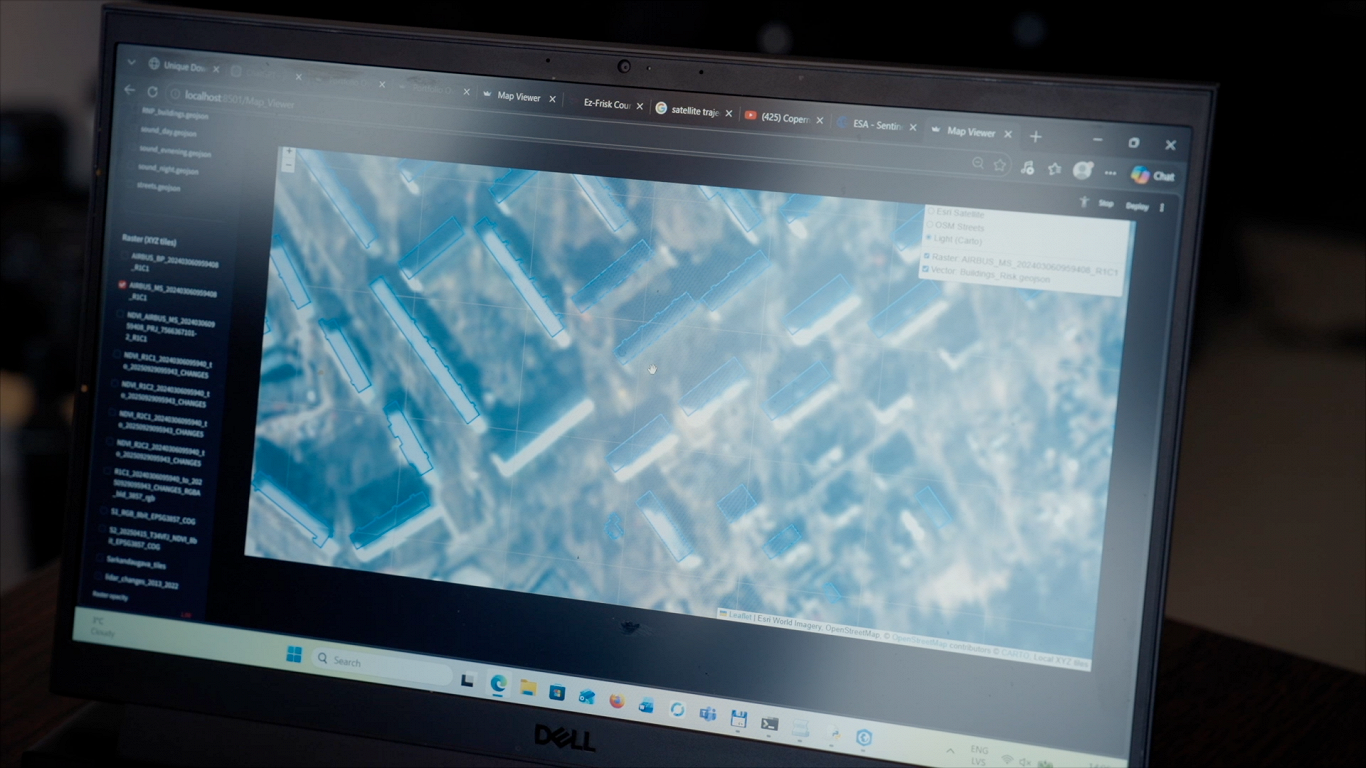
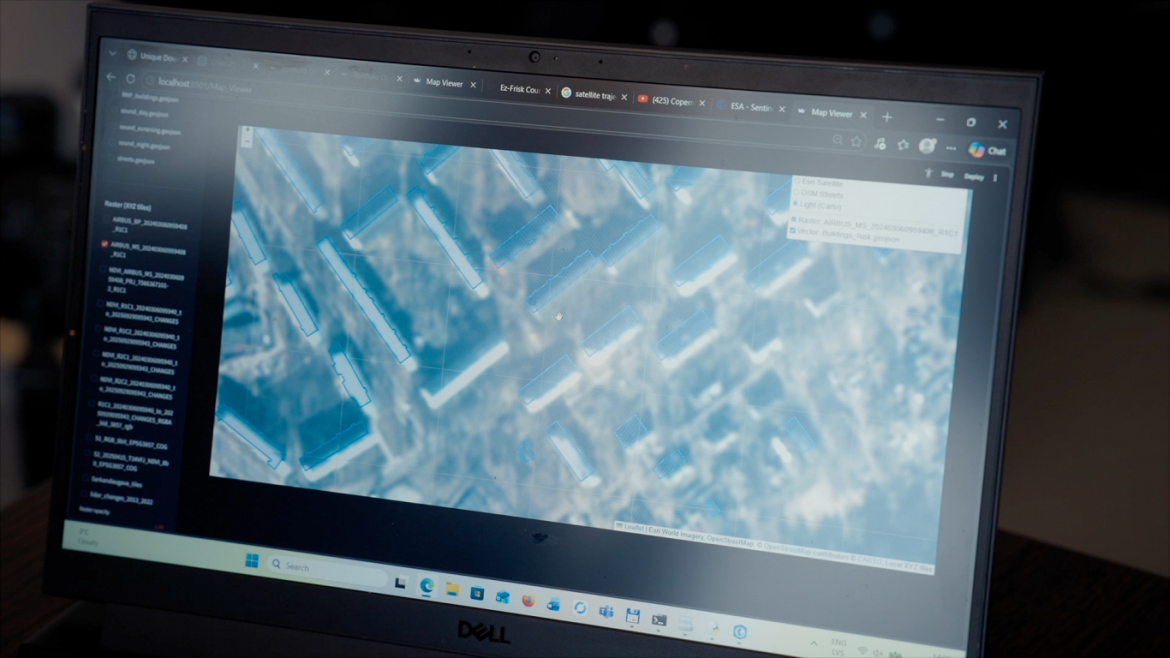
Every third day, a satellite passes over our heads, collecting an enormous volume of data about the Earth. NRG Solutions uses a small fraction of this information and transforms it into an understandable and marketable product. By leveraging space‑based data, the company analyses the condition of real estate, enabling comparisons of building‑related information over the past ten years. The next step is to use artificial intelligence to model future risks.
In Brief:
- Scientific expertise combined with the translation of complex data into an accessible format
- Focus on analysing buildings in the urban environment
- Clients in the B2B sector
- Next step: modelling future scenarios
- The first Latvian company admitted to the European Space Agency’s Business Incubation Centre in Latvia (ESA BIC Latvia)
In the context of today’s security challenges, space is becoming an increasingly important part of critical infrastructure, integrated into national defence and security systems. Space technologies, in turn, are becoming essential tools for ensuring safety. The ability to develop such technologies and harness the advantages provided by space is a key strategic capability for the European Union as a space power — one that must be rapidly strengthened.
PROFILE
In 2025, NRG Solutions reported a turnover of 0 euros and a profit of 30,996 euros. The company has one employee. It was founded in September 2024, and its paid‑up share capital is 2,800 euros.
NRG Solutions is owned by Jānis Sēlis and Linda Sēle, holding 65% and 35% of the shares respectively.
Secured Funding:
- European Space Agency Business Incubation Centre (ESA BIC) – 60,000 euros
- European Space Agency, “Requesting Party Activity Latvia” – 148,000 euros
Source: NRG Solutions, Lursoft
The EU is aligning its objectives and launching the implementation of a new pilot mission. This mission will be a decisive step toward an inclusive and dynamic future space ecosystem and will pave the way for the development of services tailored to Europe’s infrastructure needs. Space technologies already play a crucial role in the functioning of civil protection, transport, energy and infrastructure management systems.
Latvia is developing its space technology capabilities in close cooperation with the European Space Agency (ESA) and EU partners. Latvia became an Associate Member of ESA in 2020 and has already carried out more than 120 projects with a total value of 22.6 million euros. A total of 34 Latvian organisations — including companies, research institutions and universities — have participated. Funding has also been available for smaller initiatives. For example, the CASSINI Hackathon has taken place in Latvia as part of the broader CASSINI programme — a European Commission initiative designed to support entrepreneurs, startups and SMEs in the space sector.
At the end of 2024, Latvia joined the European Space Agency’s Business Incubation Centre network through the establishment of ESA BIC Latvia. The first company accepted into this incubation programme is NRG Solutions, which has also received financial support. Funding opportunities remain available to encourage the creation of new companies developing products based on ESA-provided data. The incubator aims to support 15 promising companies by 2030.
Space‑Based Business
To work in the space sector, one does not need to build rockets or launch satellites — it is also possible by using ESA data collected every third day. Satellites gather an enormous amount of information, part of which is used, for example, in military intelligence, while a significant portion remains untapped and not yet transformed into practical applications.
NRG Solutions is at the very beginning of its journey, seeking investors and identifying the next research points on the map.
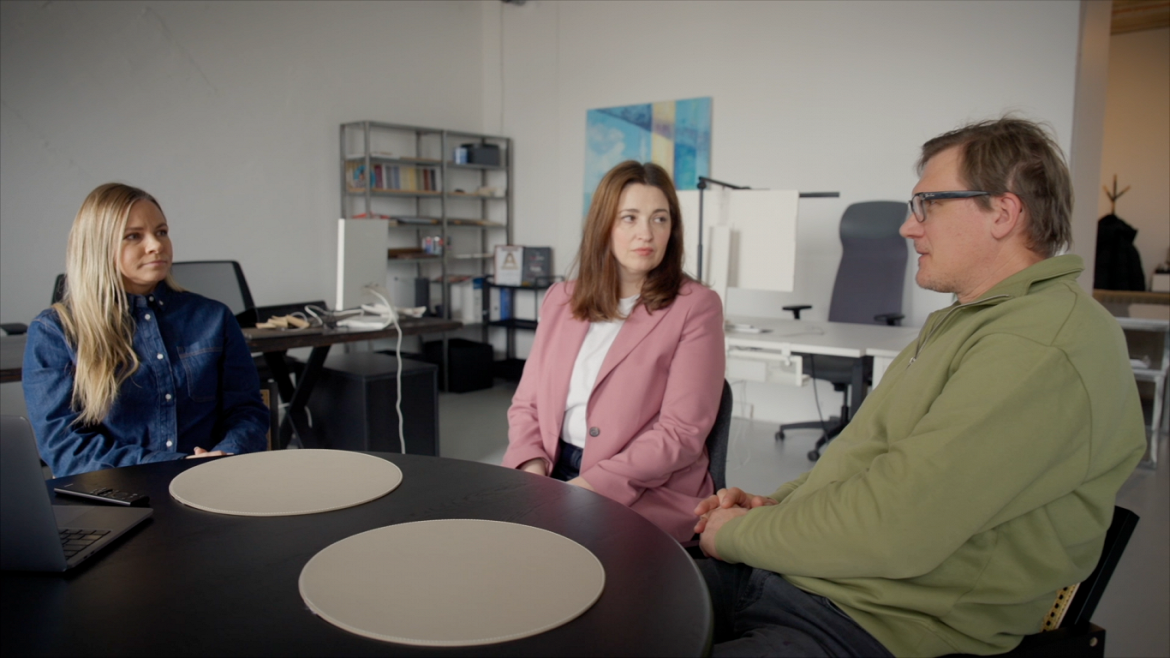
The company has attracted Māris Kaļinka, Associate Professor at Riga Technical University (RTU), as its Technical Director — his expertise in data analysis and research is invaluable.
“Our product helps make the urban environment more understandable by analysing images we receive from space,” Kaļinka explains.
These interpreted data can reveal areas that may be prone to flooding in the future — long before such risks become visible to the human eye — by detecting rising soil moisture levels. They can show how quickly a city heats up or cools down. They can even be used to remotely identify roof damage. Such data can serve many purposes. Other companies use similar methods to study, for example, water quality. NRG Solutions has chosen to focus on the urban environment.
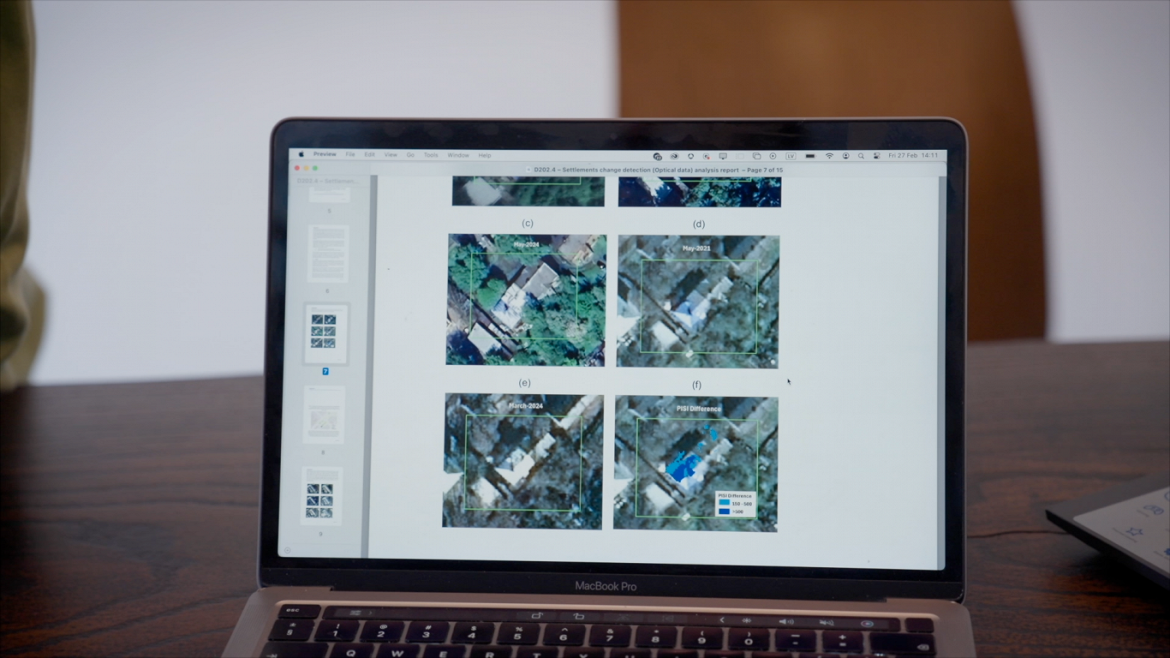
NRG Solutions will offer insights into weather‑related risks.
“We can take a specific building in Riga and examine how various environmental factors have affected it over a ten‑year period — subsidence, settling, deformation. We can see both vertical and horizontal displacement from the originally recorded point,” explains company co‑founder Linda Sēle. This helps identify issues early, long before they become serious and costly problems.
Data — the new oil
Linda Sēle herself is neither a space researcher, nor an engineer, nor a scientist, and when starting the business she had to learn new terminology and new information from scratch.
The founders of NRG Solutions, Linda Sēle and Jānis Sēlis, previously worked in a different field — web development, design and software‑as‑a‑service (SaaS).
“At first, entering a new industry where I couldn’t even speak the language of the field was extremely uncomfortable,” Sēle recalls. “But at the same time, I could clearly see what was missing — simplicity, the ability to make this understandable to an ordinary person. And who can do that better than me — an ordinary person?”
The idea for such a service came to Linda and her partner — both in life and in business — when they were searching for real estate abroad. How could one remotely obtain reliable information about a property’s condition? In a pilot study with Rīgas namu pārvaldnieks, NRG Solutions began testing cooperation with a client whose portfolio includes around three thousand buildings. The project runs until October this year.
For the research, the municipal company provides data on 200 wooden buildings and their underground utilities, and will also test the algorithms and prototypes developed during the project.
Space in climate change solutions
In the future, NRG Solutions clients will continue to be large property managers rather than individual owners. It is possible that, further down the line, such building‑history data could be attached to property sale listings. A logical next step in development will be future scenario projections, Sēle notes: “Since we have collected data for ten years, we can project future risks using artificial intelligence.”
This year’s goal is to validate the NRG Solutions product outside Latvia.
“We would like to carry out a pilot project in a southern country where the effects of climate change are felt much more strongly,” Sēle explains, noting that changes in Latvia are currently not as pronounced as, for example, in Spain.
Although the company was founded only in 2024, this short period has completely reshaped Sēle’s perspective: “Being part of this community of space‑sector companies, I realise that space is far more present in our daily lives than I ever imagined.”