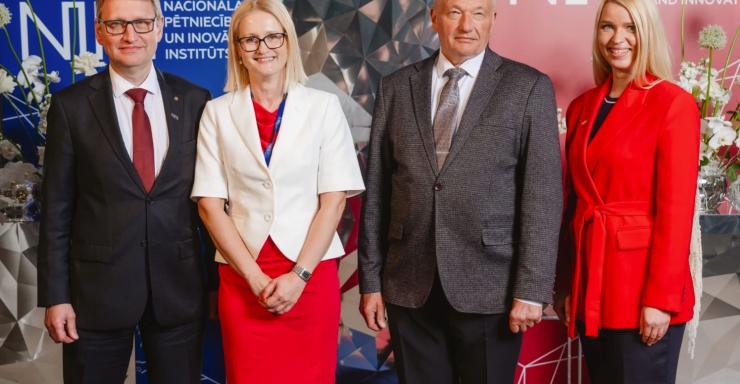
The evaluation of applications submitted to the Latvian Academy of Sciences’ competition for the most significant scientific achievements in Latvia in 2025 has been completed. In total, fifty-five applications were assessed: 25 in the natural sciences, engineering and technology, and medical and health sciences; 26 in the humanities and social sciences; and 4 in the agricultural sciences. Twelve works representing these fields have been named competition winners by the Academy.
Commentary by Ivars Kalviņš, President of the Latvian Academy of Sciences:
“The results of the evaluation conducted by the Latvian Academy of Sciences of the best scientific achievements of Latvia in 2025 show that Latvian science is increasingly integrating into the EU and global scientific ecosystem, demonstrating high-level research both in theoretical or fundamental science and in the search for opportunities to develop new technologies and materials, as well as through research in the humanities and social sciences.
Traditionally, researchers from the University of Latvia stand out among the twelve best scientific achievements with an impressive performance. Their research in quantum electronics has produced conceptually new mathematical models for the characterization of multi-electron transistors with potential applications in quantum computing; modeling of collective bacterial cooperation, which provides insights into bacterial collaboration and ‘wars’ and their possible role in the origin of diseases; as well as research in Baltic studies, revealing the role of Jānis Endzelīns in the formation of the Latvian literary language. Overall, scientists from the University of Latvia have produced one quarter of the studies recognized as the best this year.
Among the laureates are also scientists from the Latvian Institute of Organic Synthesis, who have discovered a new candidate compound with strong prospects of becoming an effective and safe medication for the treatment of diabetes and obesity, and who have developed a new methodology for obtaining halogen-containing molecules (chlorine, fluorine, etc.) to enable the safe and efficient production of medicines and other chemical products.
Meanwhile, the Latvian Biomedical Research and Study Centre has developed new approaches for creating effective vaccines against Lyme disease, while the scientific institute BIOR has developed the scientific basis and introduced recommendations for more effective control of African swine fever.
Scientists from Riga Technical University have developed and, together with engineers from electricity generation and distribution network companies, implemented effective methods to ensure the stability of electricity generation and supply under conditions of significant system threats.
Researchers from the Latvia University of Life Sciences and Technologies have compiled a monograph offering a deep and multidimensional perspective on the course of Latvia’s most recent agrarian reform, one of the most significant processes in the history of Latvia’s restored independence.
The National Library of Latvia is also among the 2025 laureates with a monograph by LAS academician Pauls Daija, dedicated to the little-known role of Baltic Germans in Latvian literature in the first half of the 19th century.
A special achievement this year is also the monograph by LAS academician Ineta Ziemele (Riga Graduate School of Law), a unique work of legal research in international law that reflects the doctrine of state continuity and the resolution of nationality issues in the Baltic States historically, highlighting the relevance of these issues today and outlining future perspectives.
Scientists from the Latvian State Institute of Wood Chemistry have distinguished themselves with an industrially implemented process in which suberinic acids obtained from the depolymerization of suberin extracted from birch bark are used as environmentally safe substitutes for synthetic binders in the production of moisture-resistant plywood, wood surface coatings, and particle boards.
Overall, we can state with satisfaction that the competition organized by the Latvian Academy of Sciences once again gives Latvian society the opportunity to witness the excellent performance of Latvian scientists.”
MOST SIGNIFICANT SCIENTIFIC ACHIEVEMENTS OF 2025
THEORETICAL SCIENCE – FUNDAMENTAL RESEARCH
- Laying the Foundations of Quantum Electronics Theory // Theory of Multi-Electron Transistors
Authors: Mg. phys. Elīna Pavlovska, Mg. math. Mārtiņš Kokainis, Bc. phys. Ralfs Šuba, Ph.D. Ģirts Barinovs, LAS full member Vjačeslavs Kaščejevs.
Scientific institution: Faculty of Exact Sciences and Technologies, University of Latvia.
- Theoretical Models and New Research Methods for Controllable Active Matter Ensembles // Controllable Active Matter Ensembles and Their Models
Authors: LAS full member Andrejs Cēbers, Ph.D. Mihails Birjukovs, Mg. phys. Māra Šmite, Ph.D. Bhagyashri Dada Shinde, Dr. phys. Guntars Kitenbergs, Dr. Damien Faivre, Dr. Andrejs Tatuļčenkovs, Dr. phys. Rūdolfs Livanovičs.
Scientific institution: Laboratory of Magnetic Soft Materials, University of Latvia (LU MMML).
- A Fundamentally New Method for Photochemically Induced Radical Generation in Halogen Atom Transfer Reactions
Authors: Ph.D. Nagarajan Ram Kumar, MSc. Anete Patrīcija Raiskuma, Dr. chem. Larisa Baumane, Dr. chem. Sergejs Beljakovs, Dr. chem. Kaspars Traskovskis, LAS corresponding member Jānis Veliks.
Scientific institution: Latvian Institute of Organic Synthesis.
- Ziemele, I. State Continuity and Nationality: The Baltic States and Russia. Past, Present and Future as Defined by International Law. 2nd revised ed. De Gruyter Brill, 2025.
Author: LAS full member Ineta Ziemele, Dr. iur.
Scientific institution: Riga Graduate School of Law.
- Daija, P. Agents of the Enlightenment: Baltic German Pastors in Latvian Literature, 1815–1848. Riga: National Library of Latvia, 2025. 390 pp.
Author: LAS full member Pauls Daija, Dr. philol.
Scientific institution: National Library of Latvia.
- Kļaviņa, S. The Cornerstones of Baltic Studies Created by Jānis Endzelīns. Riga: Zinātne, 2025. 320 pp.
Author: LAS honorary doctor Sarma Kļaviņa, Dr. philol.
Scientific institution: University of Latvia.
- Agrarian Reform: The Revival of Farmers and the Development of Agriculture in Latvia. Jelgava: Latvia University of Life Sciences and Technologies, 2025. 552 pp.
Authors: Editor-in-chief LAS full member Irina Pilvere; Ilze Būmane, Mārtiņš Cimermanis, Dainis Ģēģeris, Anda Jankava, Agnese Krieviņa [and 8 additional authors].
Scientific institution: Latvia University of Life Sciences and Technologies (LBTU).
APPLIED RESEARCH
- Innovative Methods and Tools for the Stable and Secure Operation of the Baltic Energy System
Authors: LAS corresponding member Antans Sauhats, Dr. sc. ing. Andrejs Utāns, Ph.D. Ivars Zālītis, Dr. sc. ing. Aleksandrs Dolgicers, Dr. sc. ing. Jevgeņijs Kozadajevs, Ph.D. Zane Broka, Ph.D. Kārlis Baltputnis, Dr. sc. ing. Romāns Petričenko, Dr. sc. ing. Gatis Junghāns, Ph.D. Dmitrijs Guzs, Dr. sc. ing. Diāna Žalostība, Mg. sc. ing. Gunārs Cingels.
Scientific institution: Institute of Industrial Electronics, Electrical Engineering and Energy (IEEEI), Riga Technical University.
- The Drug Candidate ATR-258 for the Treatment of Diabetes and Obesity Has Successfully Completed Phase I Clinical Trials
Authors: Dr. chem. Ilga Mutule, LAS full member Edgars Sūna, Ph.D. Linda Supe, Dr. chem. Jana Spura, Krista Jaunsleine, Vadims Kovada, Mārtiņš Priede.
Scientific institution: Latvian Institute of Organic Synthesis.
- Structural Vaccinology Against Lyme Disease: A New Step Toward the Development of a Safer and More Durable Vaccine
Authors: Ph.D. Kalvis Brangulis, Ph.D. Dagnija Tupiņa.
Scientific institution: Latvian Biomedical Research and Study Centre (BMC).
- Studies of the African Swine Fever (ASF) Virus and Epidemiology in the Context of Surveillance and Control Strategies
Authors: Dr. med. vet. Ph.D. Edvīns Oļševskis, Mg. med. vet. Kristīne Lamberga, Mg. med. vet. Svetlana Cvetkova, Mg. biol. Žanete Šteingolde, Mg. med. vet. Mārtiņš Seržants, Santa Ansonska, Mg. med. vet. Māra Užule, Mg. biol. Laura Krivko, Mg. sc. ing. Daina Pūle, LAS full member Aivars Bērziņš.
Scientific institution: Institute of Food Safety, Animal Health and Environment “BIOR”.
- From Birch Bark to Sustainable Wood Materials: Innovations in Suberinic Acids for the Circular Bioeconomy
Authors: LAS corresponding member Jānis Rižikovs, Dr. sc. ing. Aigars Pāže, Ph.D. Daniela Godiņa, MSc. Rūdolfs Bērziņš, MSc. Kalvis Liepiņš, MSc. Guntis Sosins, Ainārs Bobulis, Artūrs Raimonds Feldmanis, and Ketrina Plantus (both from AS “Latvijas Finieris”).
Scientific institution: Latvian State Institute of Wood Chemistry (LSIWC).
About the Competition
The Latvian Academy of Sciences began compiling and evaluating annual achievements across all scientific fields in 2002. In 2025, the now well-established competition for the most significant scientific achievements of the year was held for the twenty-fourth time. Since 2011, the LAS has organized a ceremonial event to honor the laureates, which has become a notable occasion in Latvia’s scientific life. To promote Latvian science internationally, last year the LAS prepared and, with the support of the Ministry of Education and the Boris and Ināra Teterev Foundation, published the printed yearbook Latvian Academy of Sciences Yearbook 2025, based on expanded descriptions of the scientific achievements of 2024.