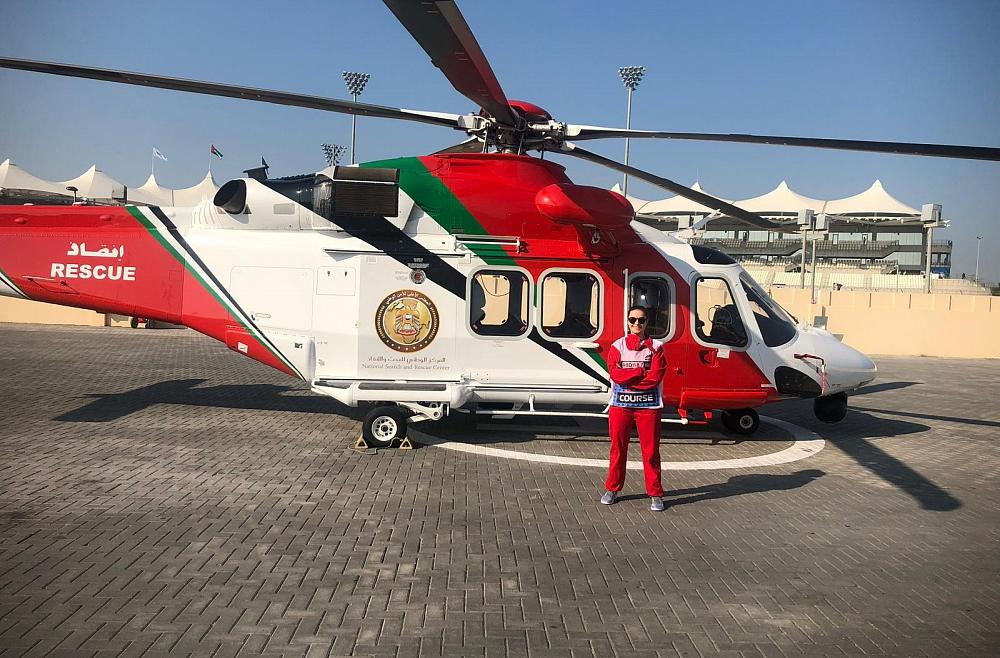
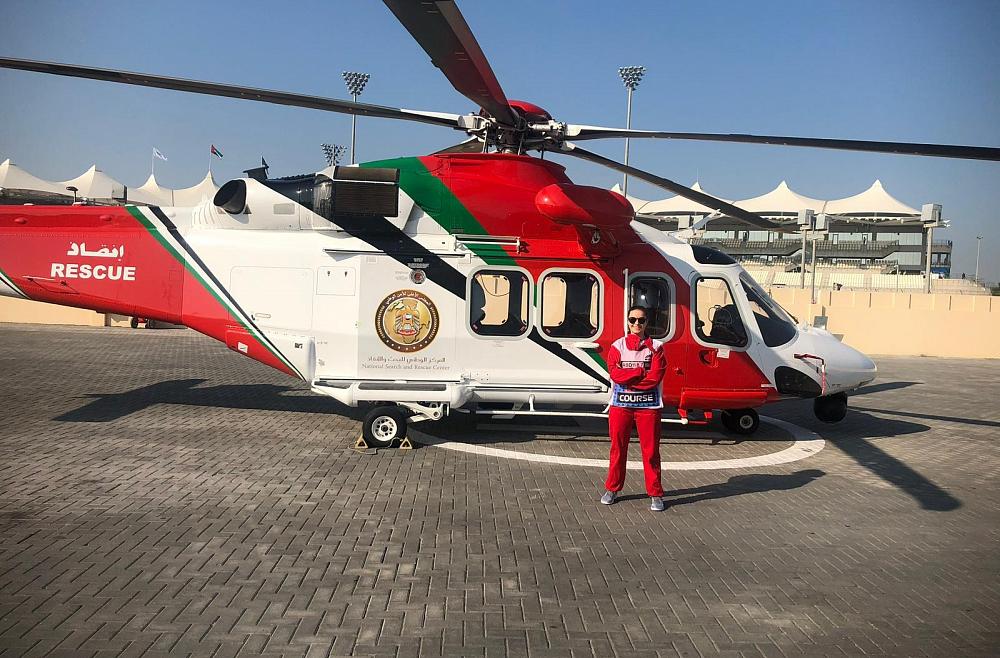
The girl who wants to work in space — that is what she was once called during her student years, and indeed, Veronika will soon go on a research mission to Antarctica related to space exploration, during which she will have to spend nine months in harsh conditions at a polar station with no possibility of evacuation, she revealed on the Latvian Radio programme “The Known in the Unknown”.
Motorsport, aviation, space medicine
Her career, like a puzzle, consists of many different pieces, but they are all united by one motif — medicine. “My basic speciality is family medicine — it is the foundation to which everything else is added. Somehow, in my life, it happened that at several stages I chose a more scenic route, which took me into motorsport, aviation and space medicine. Somehow, I have collected these puzzle pieces over the course of my life and continue to collect them,” Veronika said.
As a doctor, she graduated from the University of Latvia in 2016. Latvia had given her a very strong foundation from which to build, but Veronika wanted to see the world, so she went to the United Kingdom. There, she had to build her path anew — in a completely different language, culture and system — but this gave her valuable experience that proved useful in her next adventures, Veronika revealed: “Although it was very difficult at the time, it taught me to adapt and work in a team, because later I worked in various international and multilingual teams, and in fact it was a very good foundation for that. But at the beginning it was very difficult
Taking care of astronauts’ health
To cope with the mental strain, she resumed skydiving, which she had already started doing in Latvia. This passion led her to a deeper interest in aeronautics and space, which, thanks to various interesting coincidences and Veronika’s ability to dare and not be afraid, in turn opened many new doors for her in motorsport and later also in F1.
Although she has not yet managed to become an astronaut herself, at least for now, Veronika is currently a member of the European Space Agency’s Medical Board and helps ensure that astronauts’ health is not endangered during missions and various studies. “In general, we are currently in a very exciting period, because within about two years we will be back on the Moon, and already the main task of the Artemis III mission, which will still be in orbit, will be to test landing modules. One of the astronauts on this mission is from Europe — the Italian astronaut Luca Parmitano — which is why the European Space Agency is very involved in the Moon missions,” she said.
Latvia’s name in the space industry
Travelling to the Moon also requires space medicine specialists to solve entirely new problems, including evaluating the new spacesuits, their safety, comfort and suitability.
Veronika emphasised that she is very pleased that Latvia, as a member state of the European Space Agency, can participate in these processes, because on this international medical board she does not represent the United Kingdom or any other country — Veronika represents Latvia.
“It has opened many doors for me, because we see, review and take part in the most important and most exciting science projects happening in our time. For example, we are currently receiving Artemis mission projects, and it gives me great joy that we, as such a small country, have our own say and can express ourselves,” she said.
Expedition in Antarctica
However, Veronika is not ready to stop yet. Very soon, she will go on a long-term study to Antarctica, for which she has applied for the third time. Although her application was not accepted the first two times, Veronika did not give up, and now her participation in this European Space Agency study has been approved.
“The polar station I will go to is an Italian–French station called Concordia. It is located in the interior of Antarctica, on the continent, at quite a high altitude — about 3,200 metres. Since the atmosphere there is quite thin, the pressure is equivalent to an altitude of about 3.5 kilometres. As a result, there is also a risk of altitude sickness, and overall the conditions there are such that they make the environment very, very extreme,” she said.
There, polar night and day can be observed — for half the year it is light, while for the other half it is dark. In summer, the temperature ranges from −20 to −30 degrees, while in winter it can drop as low as −70 and −80 degrees.
There is extreme dryness, and static electricity also creates challenges in everyday life.
“Despite this, during the summer period there are quite a few scientists there, engaged in climate studies, glaciology and other research, but during the winter period only 12 or 13 of us will remain — researchers — and for nine months we will have no possibility of evacuation; we will be completely isolated,” Veronika revealed.
An analogue for Moon and Mars studies
This is precisely where her task as a biomedical researcher begins — Veronika will not conduct her own individual studies at the polar station, but will implement the European Space Agency’s research programme, the aim of which is to study the effect of isolation on humans.
“The Concordia base is used as an analogue for Moon and Mars studies. The studies are both physiological, for example, how our immune system changes when we are in isolation for a very long time, as well as at the bacterial level and the psychological level. In total, I will have to carry out five studies from various European universities, in which I will be both a laboratory assistant and a research subject,” she explained.
Veronika admitted that this incredible and somewhat frightening fact — that she will have to live in Antarctica for nine months with no possibility of evacuation — creates many different emotions, all of which she has to experience at the same time.
On the one hand, it is natural to feel anxious; on the other hand, Veronika also feels immense satisfaction and excitement about this unique opportunity: “It is quite a rare job that only very few people have the opportunity to do — not only to go to Antarctica, but to overwinter there, and in such unique conditions. For me personally, it is the closest thing I could find to feeling like an astronaut without being an astronaut, because the work is essentially quite similar — you are in an isolated place and carry out other people’s studies both on yourself and on others. So for me it is a great satisfaction and honour to fulfil this role.”