On 27 July 2020, Latvia became an associate member of the European Space Agency (ESA). Over the past five years, this status has laid a solid foundation for the development of Latvia’s space sector, opening doors to international cooperation, scientific growth, technological innovation, and the development of human capital.
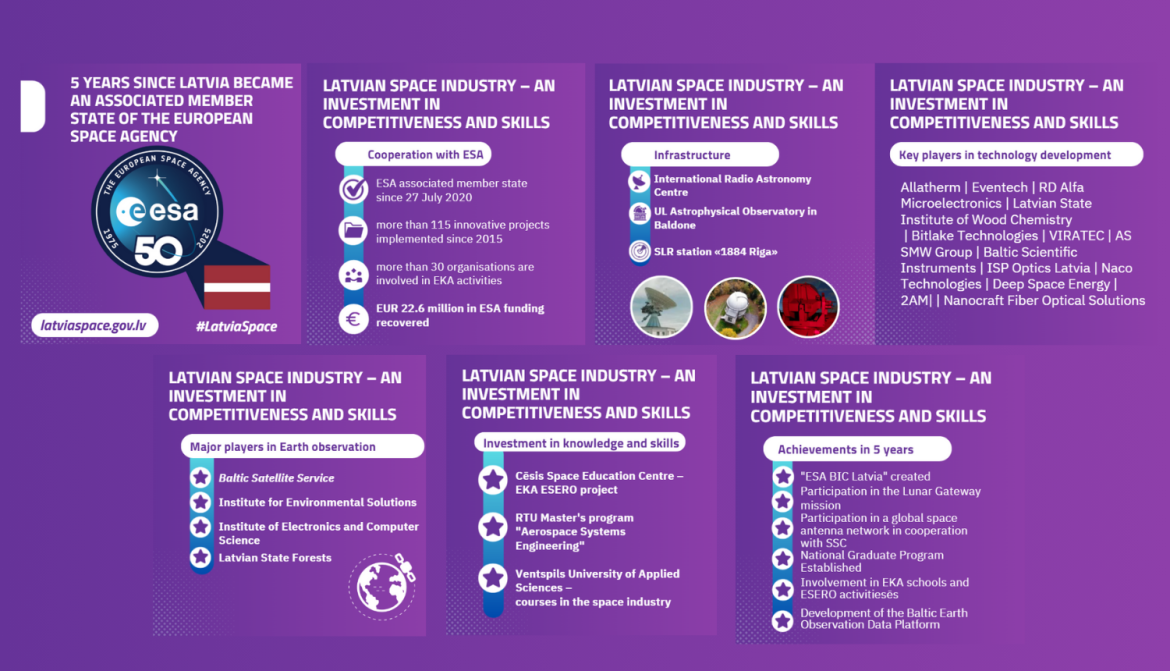
The 2024 ESA report about the first four membership years shows that Latvia’s financial contribution to space programmes has been strategically valuable and effectively utilised. These figures highlight not only the efficient use of funds but also the growing capacity of Latvian institutions and companies to compete in the European space sector. Being an associate ESA member allows Latvia to receive support for various projects, creating additional value across other industries. Since the beginning of this cooperation:
- Latvia has invested at least €23 million in ESA programs, resulting in over 100 successfully implemented projects in research, education, and technological development. Thanks to this collaboration, the company Allatherm is currently developing a xenon pump that will provide fuel for the planned Lunar Gateway space station. Additionally, as part of the national program last year, 10 projects were approved, with a total funding of €1.58 million. Among these, satellite data will be utilized to combat illegal construction in Latvia.
- More than 30 organizations, including companies, universities, and research institutions, are involved in these projects. A complete catalogue of space-related Latvian companies, research institutions, and organizations is available at latviaspace.gov.lv, which has become the central platform for Latvia’s space ecosystem.
Latvia’s status as an associate ESA member ensures annual training opportunities for industry professionals, researchers, and teachers, as well as the development of higher education programs. Latvian students are also taking advantage of internships at ESA institutions. Notable examples include Riga Technical University, which launched a master’s program in Aerospace Systems Engineering (accredited in 2022), and Ventspils University of Applied Sciences, where a second student has now earned a spot in a highly competitive ESA internship — an opportunity offered only to the most talented young professionals worldwide. Over the past two years, 22 Latvian teachers have also participated in ESA-organized workshops and training sessions designed to successfully integrate space-related topics into their curriculum.
Latvia’s participation in ESA lead to new partnerships, strengthened institutional and international collaborations, built connections with industry, and enhanced export capabilities. Since 2022, the Baltic region’s largest science-driven technology event Deep Tech Atelier has placed special focus also on the space sector and its development. In 2023, as part of the World Congress of Latvian Scientists organized by the Ministry of Education and Science, the Baltic Copernicus Day was held to raise awareness about the Earth observation program Copernicus and its benefits for scientists, entrepreneurs, and public authorities. That same year, the Space Exploration Center opened in Cēsis, with the mission of sparking children's interest in science, engineering, technology, and mathematics by explaining the relevance of these fields through the lens of space exploration. In 2024, the ESA Business Incubation Centre (ESA BIC Latvia) was launched, aiming to support at least 15 space startups.
Next year, Latvia plans to establish an ESA ESERO (European Space Education Resource Office) center, focusing on space education and the development of STEAM (Science, Technology, Engineering, Arts, and Mathematics) skills in schools. Additionally, this autumn, Latvia will host the international conference Big Data from Space, organized in cooperation with ESA, the European Commission’s Joint Research Centre, and the European Union Satellite Centre.
Latvia’s partnership with ESA, guided by the Latvian Space Strategy 2021–2027, has delivered measurable benefits in education, innovation, and research. Over the past five years, Latvia has not only joined European space initiatives but also established itself as an active contributor, driving both national growth and advancements within the European space community.