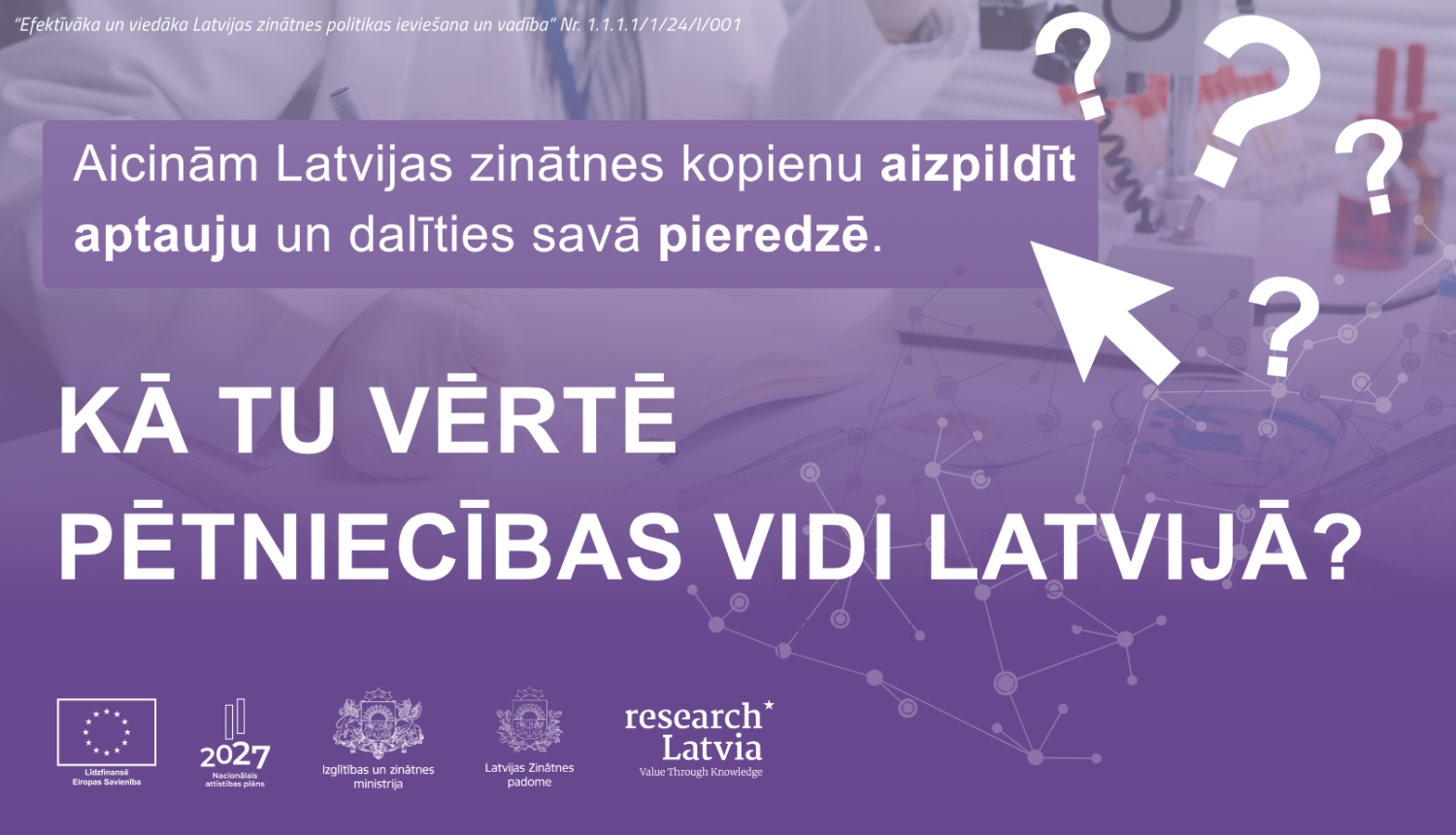
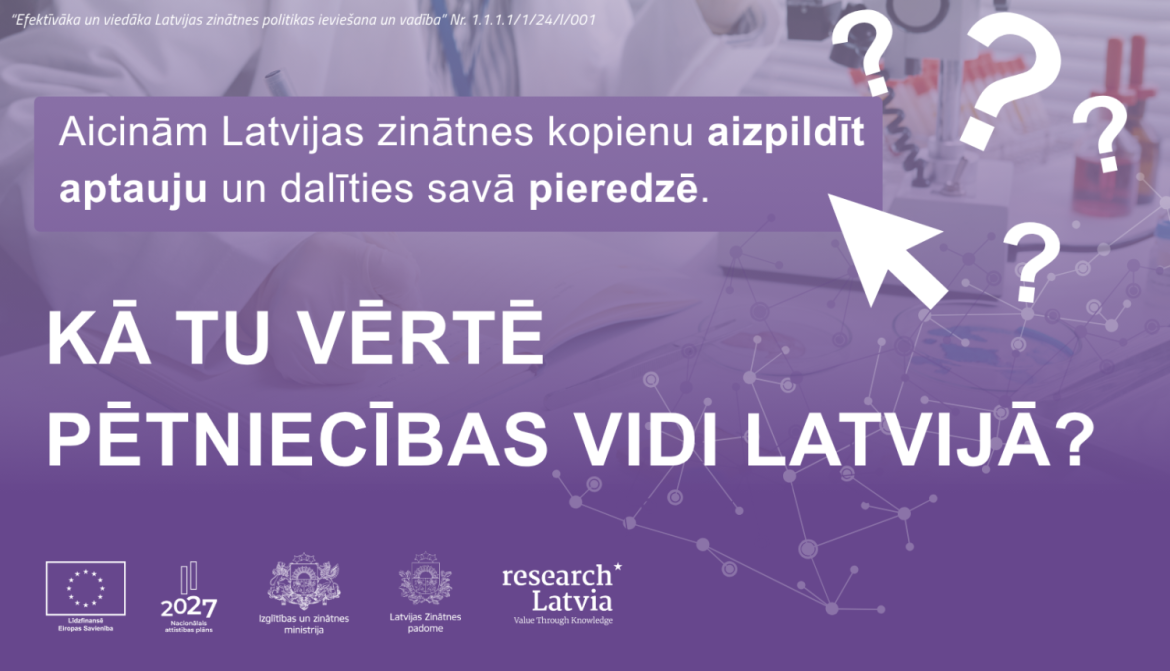
How does the scientific community assess the working environment in Latvia, what challenges does it face in its daily work and professional development, and what improvements are needed? To gain a broader understanding of the situation from the perspective of those working in it, the Latvian Council of Science, in cooperation with the Ministry of Education and Science, invites representatives of the scientific community to take part in a survey.
The survey covers various aspects of research work, ranging from infrastructure and the availability of necessary resources to working conditions, career development and administrative processes. It also includes questions about international cooperation, the practical application of research results, open science and science communication.
“The more broadly the scientific community becomes involved, the more complete a picture we will be able to gain of the situation across different scientific fields and institutions. We invite you to share your experience so that it can become an important basis for decision-making and practical improvements in the research environment,” says Elita Zondaka, Acting Director of the Latvian Council of Science.
A separate section of the survey is dedicated to the European Research Area. Respondents are invited to assess which of its policy areas are most important to them, such as researchers’ career and mobility opportunities, modern research infrastructure, open science, international cooperation, knowledge transfer and public engagement in research.
The survey also aims to identify the scientific community’s views on the work of the Latvian Council of Science. Participants will be able to indicate which of the Council’s priorities should receive greater attention over the next three years, as well as suggest specific improvements in cooperation. The areas to be assessed include reducing the administrative burden, providing practical consultations on attracting funding, improving the quality of scientific project evaluation, science communication, and developing support for knowledge and technology transfer.
Completing the survey takes approximately 20–25 minutes, and responses can be submitted until 18 October 2026.
Participation is anonymous. Responses will be analysed in aggregated form, with measures in place to prevent the identification of respondents. The names of institutions and the ages of respondents will not be indicated in published datasets or research reports.
The survey is being carried out within the framework of the EU funds project “More Effective and Smarter Implementation and Management of Latvia’s Science Policy”
No. 1.1.1.1/1/24/I/001.