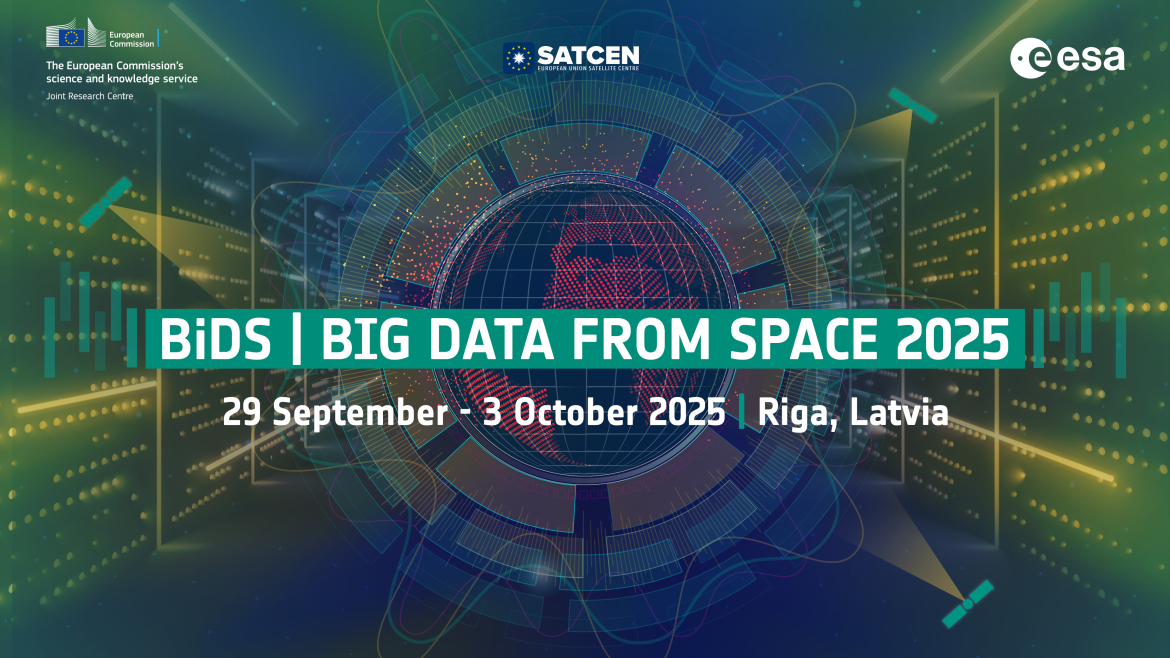
The Big Data from Space (BiDS) 2025 conference will be held from 29th September to 3rd October in Riga, Latvia, bringing together experts in science, policy, industry, and society for the seventh time. The conference aims to foster collaboration and idea exchange to address global challenges such as climate change, sustainability, and security.
Space data collected from satellites is one of the main tools through which space technologies contribute to the economy. Satellite navigation, Earth Observation, telecommunications, and other areas complement each other and connect with other digital technologies like the Internet of Things (IoT), big data analytics, 5G, artificial intelligence, high-performance computing, and more.
The conference is organized by the European Space Agency (ESA), the European Union Satellite Centre (EU SatCen), and the European Commission's Joint Research Centre (JRC) in collaboration with the Ministry of Education and Science of the Republic of Latvia and Research Latvia. It is held every two years, and this year, its location in Riga offers an excellent opportunity to showcase Latvia's achievements in the space sector and promote local contributions to international space and science communities.
Stefanie Lumnitz, ESA Chair Representative, Horizon Europe Earth Observation Scientist at ESA, emphasizes:
“Big data from space provides opportunities to explore and create innovative solutions to global problems. BiDS 2025 will be a great platform for exchanging ideas that could improve our future, and I am excited that we can meet in Riga this year”.
The first two days of the conference will take place at the University of Latvia Academic Centre and will be dedicated to satellite events—interactive workshops and sessions to enhance learning and networking. From 1st October to 3, the National Library of Latvia will host panel discussions, poster presentations, an industrial exhibition, a demonstration zone, a B2B event, and other activities. Such a large-scale conference will allow Latvian scientists to share their discoveries with the international scientific and industrial communities. At the same time, companies will have the chance to present their innovative solutions to space industry professionals.
BiDS 2025’s main themes will focus on the role of big data in addressing climate change and sustainable development and its significance in European and global politics. The conference will highlight how big data can advance data science, inspire the creation of new digital technologies, and promote open and FAIR data principles. This conference will provide a unique opportunity to engage in discussions that will help shape our future and create international collaboration. We invite everyone working with space data or interested in these fields to attend the conference and share their ideas.
The call for papers and satellite events is now open! Don’t miss the chance to present your ideas at this important event: bigdatafromspace2025.org.
Stay updated on the latest information on the BiDS website, as well as Latvia Space and Research Latvia portals.
The conference is organized within the framework of the ERAF project No. 1.1.1.1/1/24/I/001 “More Efficient Implementation and Management of Latvia's Science Policy”.