
New Horizon Europe project at ISSP UL for sustainable battery recycling

Author
University of Latvia

August 21, 2026

research natural sciences

The Institute of Solid State Physics, University of Latvia (ISSP UL), has become part of the new Horizon Europe project CIRCULOOP (High-Throughput Circular Closed-Loop Direct Recycling for Low-Value Battery Chemistries in European Gigafactories). With the support of the BATT4EU partnership, a three-year effort is being launched to develop a direct battery recycling platform.

Mašīnas, kas pārstrādā baterijas
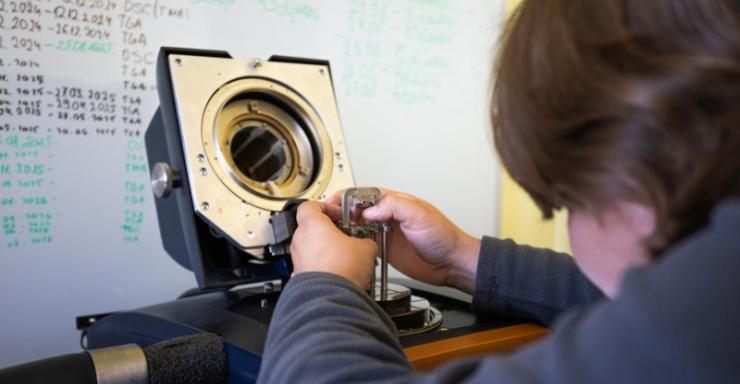
Illustrative image

As Europe rapidly expands battery production capacity in gigafactories, up to 10% of the produced volume can become manufacturing scrap and rejects. Traditional pyrometallurgical and hydrometallurgical recycling methods consume too much energy and are economically unviable for battery chemistries with low material value, such as lithium iron phosphate (LFP) and lithium manganese iron phosphate (LMFP).

CIRCULOOP aims to preserve the structure of the cathode material, recover more than 90% of cathode materials, and restore their electrochemical properties to nearly their original level. The technological framework will combine cold-gas delamination, separation using environmentally friendly solvents, and redox regeneration.

Once integrated into factory workflows, this platform will reduce energy consumption, preserve material value worth tens of millions of euros each year, and strengthen Europe’s strategic autonomy in raw materials.

The project consortium is coordinated by the Spanish research centre EURECAT and brings together 8 partners from Spain, Germany, Portugal, Belgium, the United Kingdom, and Latvia.

ISSP UL will provide research support for electrode delamination, solvent-based separation, and cathode material regeneration tasks. The institute also leads two work packages in which, together with partners, it is developing a sustainability assessment for industrial implementation. Under the leadership of Ginta Kučinska, Head of the Laboratory of Energy Materials, the ISSP UL team will develop 10–15 practical design rules for battery manufacturers for direct battery recycling (Design for Direct Recycling – DfDR), fully compliant with the EU Battery Regulation 2023/1542.

Recommended articles

natural sciences achievements

Latvian Birch Bark Innovation Nominated for the Prestigious “RegioStars 2026” Award

 For the third year in a row, a European Union (EU) funds project implemented in Latvia has been selected as a finalist in the European Commission’s prestigious “RegioStars” competition. This year, the competition jury has nominated the Latvian State Institute of Wood Chemistry project “Treasu…

Ministry of Finance Republic of Latvia

September 8, 2026

atvērtā zinātne research

Opportunity for doctoral students to apply for free online courses within the OpenEU project

The OpenEU Alliance invites doctoral students studying at OpenEU universities to apply for participation in free online courses. Available Online CoursesIntroduction to Open Science – offered by Open Universiteit (OU)Search and Management of Scientific Information for the PhD – offered by Univ…

Daugavpils University

September 7, 2026

science communication natural sciences humanities and arts

European Researchers’ Night 2026 will take place across Latvia on 25 September

At European Researchers’ Night events, everyone will have the opportunity to discover science up close. In a single evening, more than 35 locations across Latvia will offer the chance to meet researchers, get a glimpse into the everyday world of science, and take part in experiments, workshops, dem…

Latvian Council of Science/Research Latvia

September 4, 2026

public health natural sciences

Systemic sclerosis may be more common in Latvia than statistics suggest; study also reveals a frequent risk of nerve damage

Systemic sclerosis is one of the most severe autoimmune rheumatic diseases. In people with this condition, mortality is approximately 3.5 times higher than among healthy people of the same age. Despite the seriousness of the disease, it remains relatively understudied, particularly with regard…

Rīga Stradiņš University

September 2, 2026