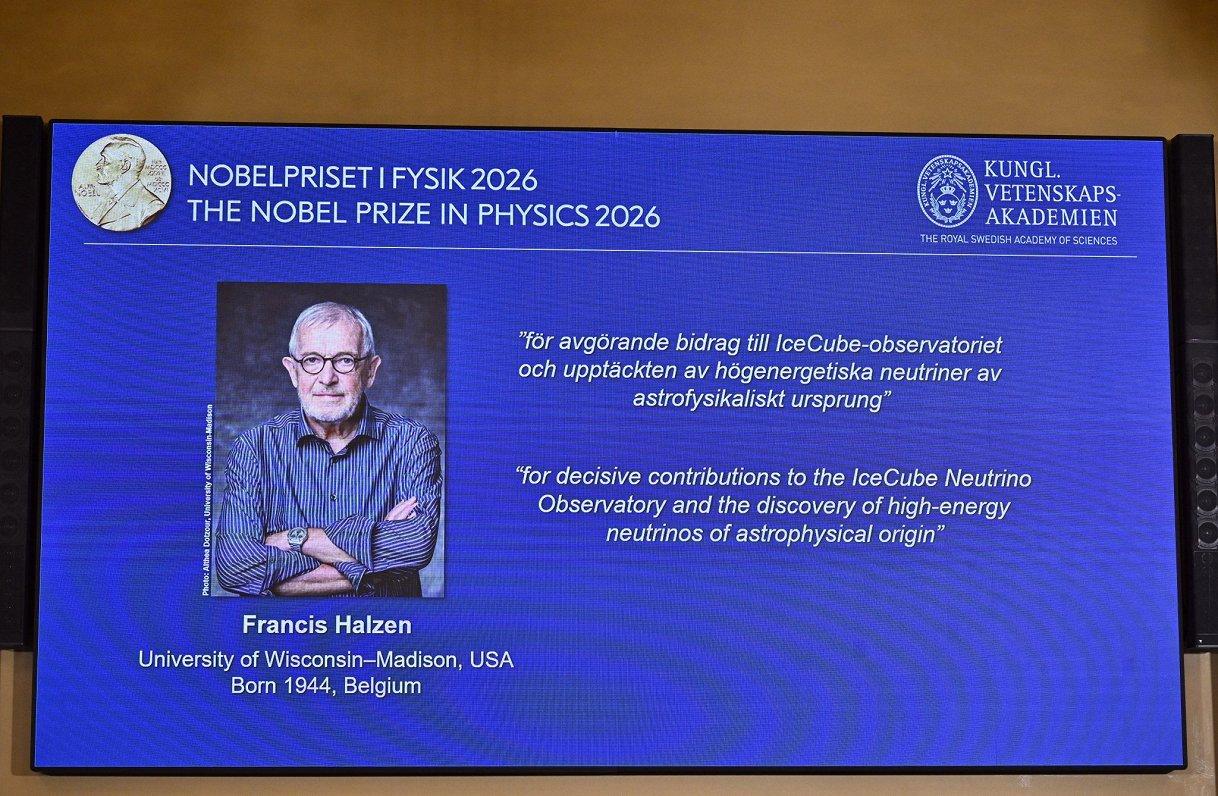
This year’s Nobel Prize in Physics has been awarded to Belgian-born American scientist Francis Halzen for his contribution to neutrino research and the establishment of the “IceCube” observatory at the South Pole. Thanks to Halzen’s ideas, scientists succeeded in discovering a new type of neutrino of astrophysical origin.
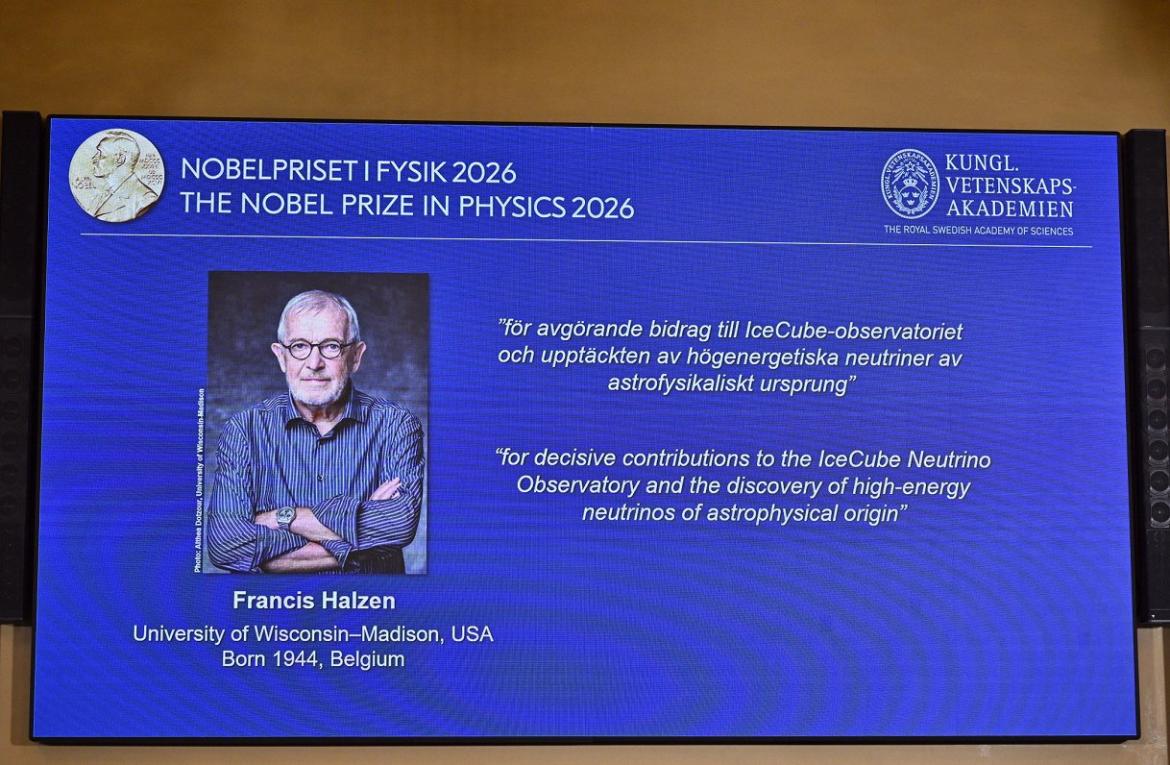
The 82-year-old Halzen was born in Belgium and studied at KU Leuven, but has lived in the United States for more than half a century, where he is a professor at the University of Wisconsin–Madison.
Halzen’s scientific work has largely been devoted to neutrino research. Neutrinos are electrically neutral elementary particles that are produced, for example, in the decay of elementary particles. They interact with ordinary matter extremely rarely. The study of neutrinos has made it possible to solve important fundamental problems in nuclear physics.
Neutrinos are everywhere; billions of these mysterious particles pass through every person’s body every second. However, individual neutrinos very rarely interact with an atomic nucleus.
Scientists have long known that there are natural particle accelerators in the Universe that emit particles with energies up to a million times greater than those that can be achieved in laboratories on Earth. Extremely high-energy neutrinos are produced in the same environments where other types of particles are also generated. However, unlike other particles, neutrinos reach us without changing direction or losing energy. This means that they can provide information that would otherwise be unavailable.
Francis Halzen realised that the exceptionally clear ice of the South Pole could be used to track neutrinos. His vision and scientific leadership were crucial to the creation of the “IceCube” Neutrino Observatory. At the “IceCube” observatory, scientists study one cubic kilometre of ice equipped with light sensors. Using this equipment, scientists can detect neutrinos from high-energy processes in the Universe.
In 1988, Halzen first outlined his vision of detecting neutrinos at the South Pole. When a neutrino collides with an atomic nucleus, it produces a flash of light that can be tracked by sensors in the transparent layer of ice. The ice at the South Pole has many advantages, as it is free from various types of interference and the region is geologically stable, without earthquakes. Halzen’s idea soon gained the support of other researchers, and just a few years later initial tests of the sensors were carried out in the ice.
Cosmic neutrinos with extremely high energies are very rare, so an enormous volume of ice is needed to observe a sufficient number of collisions. The “IceCube” project covers an entire cubic kilometre of ice and was completed in 2011. Researchers soon detected the first high-energy neutrinos and, a few years later, were able to publish their discovery of neutrinos originating far beyond our Solar System. This made it possible to begin a serious search for neutrino sources in the Universe.
“Francis Halzen has led an international team of researchers and engineers that has given us a fantastic instrument. His perseverance and scientific vision have paved the way for a new kind of astronomy,” says Mark Pearce, Chair of the Nobel Committee for Physics.
Scientists believe that the neutrino interactions recorded by “IceCube” open up the possibility of discovering previously unknown cosmic phenomena.
In 2015, the Nobel Prize in Physics was awarded to Japanese and Canadian scientists for neutrino research that proved that these elementary particles have mass. This year’s Nobel Prize in Medicine was awarded to German and American scientists who made significant discoveries in the field of optogenetics and laid the foundations for new advances in neuroscience. On Wednesday, the winners of the Nobel Prize in Chemistry will be announced, on Thursday – in Literature, while on Friday the name of the Nobel Peace Prize laureate will become known. The laureates of the Nobel Prize in Economics will be announced on Monday, 12 October.
The monetary value of the Nobel Prize is 12 million Swedish kronor (1.06 million euros). The award ceremony is scheduled for 10 December, the anniversary of the death of its founder, Alfred Nobel.