How can a foam material be developed from plant-based raw materials, completely eliminating harmful chemicals while ensuring its full recyclability? This challenge has been successfully addressed by an international team of researchers, including Miķelis Kirpļuks, a leading researcher at the Polymer Laboratory of the Latvian State Institute of Wood Chemistry (LSIWC). The research findings, which pave the way for a "greener" furniture and construction industry, have been published in the internationally renowned scientific journal Advanced Functional Materials.
The Problem with Traditional Polyurethane
Nowadays, polyurethane foam materials are found everywhere – they are used in mattresses, upholstered furniture, car seats, building insulation and even refrigerators. Although they are durable, their production involves the use of isocyanates – toxic compounds that can pose risks to human health. Moreover, the chemical structure of polyurethane makes recycling the worn-out material almost impossible, as a result of which old mattresses and insulation panels usually end up in landfills.
Innovation from Vegetable Oils
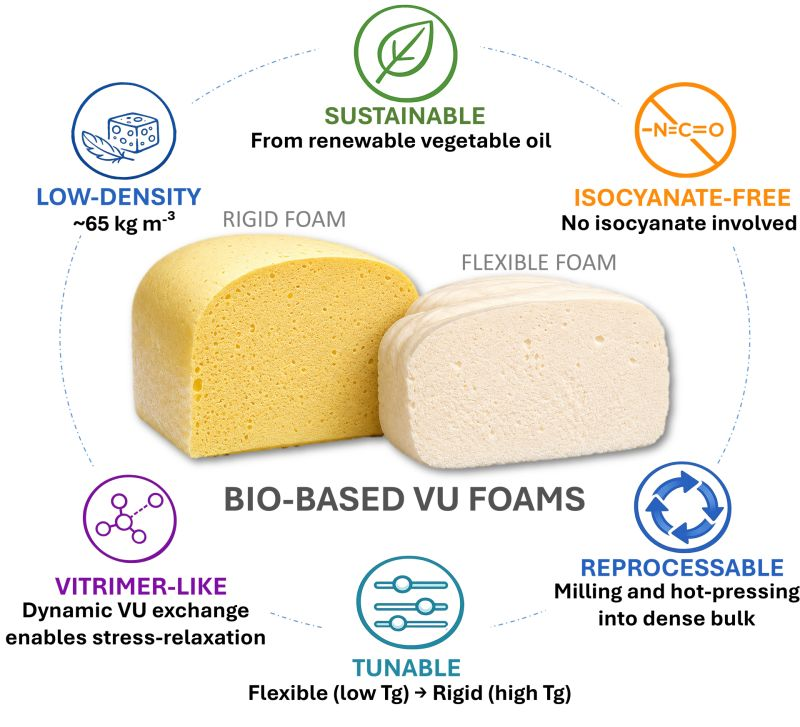
The research team has developed a new foam material (vinylogous urethane foam) based on vegetable oils, which does not require hazardous isocyanates in its production. One of the most significant achievements of this research is the efficiency of the production process: the foam material is obtained in approximately 60 seconds – moreover, this takes place under relatively mild conditions, ranging from room temperature to 60°C.
The material's properties can be easily adjusted during the production process. By changing the composition of the raw materials, the same vegetable oils can be used to produce both very soft, flexible foams (suitable for comfort mattresses) and a rigid, hard material (suitable for load-bearing building insulation). Despite its plant-based origin, the new material retains the light weight characteristic of commercial counterparts – its density is only 60–70 kg/m³.
"Smart" Bonds Make the Material Recyclable
Traditional polyurethane foam cannot be melted down and reused, but scientists have incorporated "dynamic chemical bonds" into the new material (known in science as vitrimers). This means that when the foam materials are subjected to heat and pressure, their internal molecular bonds temporarily open and rearrange. The researchers demonstrated in the laboratory that by shredding the old foam material and placing it in a hot press, it transforms into a new, durable, plastic-like film without the addition of any extra chemicals or catalysts. This means that an old mattress or insulation panel can become a completely different, useful product at the end of its service life.
The Next Step – Industrial Production
Currently, the research results and recycling capabilities have been demonstrated under laboratory conditions. However, since the described approach is compatible with existing polyurethane foam production lines, this significantly facilitates the further development of the technology and its implementation in industry.
The authors of the study include researchers from the Institute of Macromolecular Chemistry of the Czech Academy of Sciences, Charles University in Prague and the Latvian State Institute of Wood Chemistry.
Read the full scientific publication in the journal Advanced Functional Materials:
https://advanced.onlinelibrary.wiley.com/doi/10.1002/adfm.78270