The primary task of hospitals is to care for people’s health, yet their operations also consume substantial resources, generate waste and contribute to climate change, which in turn poses a threat to human health. How can hospitals reduce their environmental impact without increasing the workload of already overstretched medical staff or making it harder for patients to access care? In the GreenCare project, researchers at Rīga Stradiņš University (RSU) analysed how Latvian hospitals are trying to become more environmentally friendly and how these changes can be aligned with the needs of patients and employees. They found that hospitals are already doing more than the researchers had initially expected, but implementing change requires not only funding, but also better cooperation, clearer goals and greater attention to the people affected by these changes.

Imagine a nurse who has just carried out a necessary procedure for a patient. Afterwards, there are gloves, an ampoule, a needle and various types of medication packaging left over. To sort the waste correctly, the nurse must know which item goes into which container and which waste requires special handling for safety reasons. To an outsider, this may seem simple. But for a nurse who is caring for several patients at the same time and working under pressure, it is yet another task in which mistakes cannot be made.
Similar everyday work situations have been observed by RSU social anthropologist Zanda Gailume-Zohara. In addition to interviewing medical and administrative staff, she spent three months conducting observations in one of the hospitals, including in clinical wards. This made it possible to understand how waste-sorting requirements and other environmentally friendly solutions fit into the daily work of medical staff.
The researcher emphasises that waste-sorting requirements are not unreasonable in themselves. Proper sorting helps reduce the amount of unnecessarily hazardous medical waste and the costs of managing it. However, in everyday practice, staff workload, differences between procedures and the need to ensure patient safety at the same time must all be taken into account. In addition, if someone works in several hospitals, they may need to adapt to different ways of organising work in each of them.
This is one example that highlights the central question of the GreenCare study: how can the green transition be implemented so that it does not become merely a new list of duties, but rather a well-considered part of hospital operations?
Hospitals Are Doing More Than It Might Seem
In the context of climate change, the healthcare sector has a dual role. On the one hand, it must adapt to the growing impacts of climate change, which also create health risks, such as heatwaves and extreme weather events. On the other hand, healthcare institutions themselves consume substantial resources and generate greenhouse gas emissions. International studies estimate that the healthcare sector accounts for around 5% of total global emissions.
However, a hospital is not an ordinary business. Its primary task is to care for patients, and environmental goals must be pursued without losing sight of this priority. This is precisely why GreenCare, or the project “Socially Responsible Green Transition: Improving Governance Solutions to Strengthen Homo Climaticus in the Healthcare Sector”, focused not only on energy efficiency or waste reduction, but also on people’s needs and governance processes.
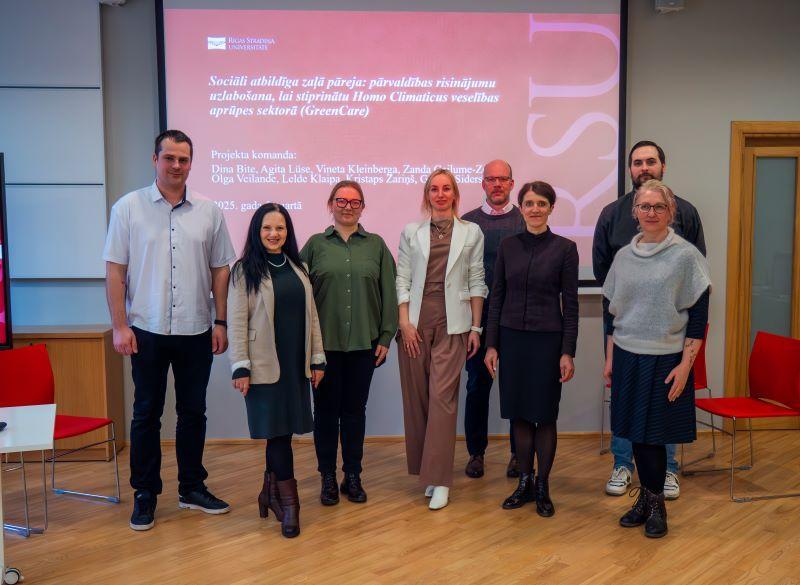
The project brings together expertise from various fields of social sciences, including social anthropology, sociology, political science, law, economics and business management. The researchers conducted an in-depth analysis of the experience of four Latvian hospitals – Children’s Clinical University Hospital, Pauls Stradiņš Clinical University Hospital, Daugavpils Regional Hospital and Vidzeme Hospital. A smaller-scale initial study was also carried out at Strenči Psychoneurological Hospital, where environmental sustainability measures have been implemented for a longer period and whose experience, in the researchers’ assessment, can be regarded as an example of good practice.
The researchers initially assumed that hospitals might have relatively few initiatives related to environmental sustainability. However, the study revealed a more diverse picture.
“Hospitals are doing more than we initially thought,” acknowledges RSU researcher Vineta Kleinberga.
Hospitals are insulating and renovating buildings, reducing energy consumption while at the same time improving conditions for patients and staff. For example, Children’s Clinical University Hospital is also implementing other environmentally friendly solutions – gradually phasing out disposable shoe covers to reduce plastic waste and deliberately moving towards paperless hospital operations. The researchers also encountered examples where the coordination of sustainability issues had been entrusted to a specialist specifically assigned to this work.
At the same time, hospitals differ both in their capacity and in their motivation to implement these measures. In some cases, reducing costs is an important consideration, while elsewhere the focus is on the well-being of patients and staff, the institution’s long-term development or a conscious desire to reduce environmental impact. Often, a single measure provides several benefits.
Thus, caring for the environment does not always mean having to choose between environmental goals and patients’ needs. However, whether both goals can be achieved depends on the specific solution and how it is implemented.
Each Hospital Is Finding Its Own Path
One of the challenges identified in the study is that hospitals largely seek sustainability solutions independently of one another. In interviews with anthropologist Zanda Gailume-Zohara, hospital representatives often acknowledged that they lacked information about how similar issues were being addressed by other healthcare institutions in Latvia. Even hospitals that are active in this area tend to gain experience through international forums rather than through cooperation with other Latvian hospitals. This means that knowledge and successful solutions do exist, but they do not always reach those who could benefit from them.
At the same time, hospitals expect a clearer vision at the national level: what sustainability goals should be achieved in healthcare, which indicators should be used to assess progress, and how the requirements should be linked to the funding available.
“Hospitals also need practical recommendations on how to implement these measures step by step,” explains Vineta Kleinberga.
The researchers emphasise that the challenges cannot be reduced solely to a lack of funding. The commitment of hospital management and its ability to incorporate sustainability issues into long-term planning are also important. Even within existing resources, hospitals can review procurement practices, energy consumption, staff engagement and other everyday decisions.
However, not everything can be solved by a hospital on its own. For example, the choice of more environmentally friendly medical equipment is influenced by what suppliers offer, while building renovation requires substantial investment and, in some cases, compliance with complex administrative procedures. Waste sorting also involves more than simply placing the right containers in the hospital. It must be clear how the relevant materials are managed after collection and whether they can be recycled safely.
The study therefore highlights the need for a coordinated approach in which hospital management and staff, healthcare policymakers and cooperation partners all play a role. One practical solution would be to establish a shared platform for exchanging experience – a regular opportunity for meetings and discussions where representatives of Latvian hospitals could address sustainability issues, share successful solutions and jointly seek answers to similar challenges.
Is the Green Transition Equally Accessible to Everyone?
One of the key questions addressed by GreenCare was social inequality. Could more environmentally friendly solutions create additional difficulties for people who already face limited access to healthcare? The researchers’ answer is nuanced. The green transition does not necessarily create new inequalities, but its implementation can reveal differences that already exist.
This is evident both at the level of hospitals and at the level of patients. Hospitals differ in their financial resources, infrastructure and ability to attract specialists. The researchers observed that, broadly speaking, larger and smaller hospitals assess their advantages and difficulties differently. Therefore, it would not be justified simply to claim that implementing the green transition is always easier for one particular group of hospitals.
From the patient’s perspective, telemedicine is a good example. A remote consultation can eliminate the need to travel to a hospital, reduce time spent on the journey and lessen the environmental impact associated with travel. This can be particularly important for people who live far from a healthcare institution.
However, not every patient has a suitable device, a stable internet connection or the necessary digital skills. Nor can all medical consultations and procedures be provided remotely.
“The green transition very clearly highlights existing inequalities,” notes Zanda Gailume-Zohara.
This example illustrates the essence of a socially responsible green transition: it is not enough to assess only the potential environmental benefits. It is also necessary to understand how the changes affect different groups in society.
Climate Change Seems More Distant to People Than It Really Is
Alongside the study of four hospitals, GreenCare researchers also conducted a survey of the Latvian population involving 1,002 respondents. The survey examined people’s attitudes towards climate change, their everyday habits, and their willingness to use certain healthcare solutions that could help reduce environmental impact.
The survey results reveal a significant difference in how important people perceive climate change to be at different levels. Eight out of ten respondents (81.2%) consider it a significant global problem. More than half of those surveyed (52.5%) believe that climate change is a serious problem in Latvia. However, only around one in four respondents (25.9%) consider it a serious problem for themselves and their families. This trend also persists over the long term and suggests that climate change is often perceived as a geographically and personally distant issue. Contrary to a commonly held assumption, this sense of distance is even more pronounced among young people: in 2025, only 17% of respondents aged 18–24 considered climate change a serious problem for them personally, compared with 25.9% of the population overall.
The survey shows that only a small proportion of people in Latvia associate the effects of climate change with their everyday experience. Around one in five respondents (22%) said they were concerned about the future quality of life of their children or grandchildren, while a substantially smaller proportion reported consequences they had experienced directly: 14% mentioned economic losses caused by weather or environmental changes, 13% reported worsening working conditions, and only 2% said that climate change had reduced the value of their property. Around 12% of respondents indicated that they had felt their lives were threatened because of climate change.
A similar picture can also be seen in the area of health. Most respondents said that climate change had not affected their health or well-being. Only 14% believed that climate change had negatively affected their health, 12% their sleep quality, and 15% their mood or mental health. Among young people, the proportion who reported a negative impact on health was slightly higher than in the population overall: 15% of respondents aged 18–24 acknowledged that climate change had negatively affected their health. This suggests that although young people are less likely to perceive climate change as a personal problem, some of them are more likely than average to recognise its potential impact on health.
The survey also indicates that people have not particularly noticed environmentally friendly measures in healthcare institutions, including hospitals. One possible explanation is that everyday concerns about expenses and worries about the geopolitical situation feel more pressing to many people than sustainability issues. However, these reasons should be regarded as possible explanations rather than causal relationships demonstrated by the survey.
The researchers’ attention was also drawn to differences in everyday habits between generations. Certain resource-saving habits are more common among older people, although this does not necessarily mean that these actions are consciously motivated by climate concerns. For example, in 2025, almost two thirds of Latvia’s population (64.4%) reported sorting waste, while almost one third (32.8%) repaired broken items rather than buying new ones. However, investments requiring greater financial resources were made much less frequently, such as insulating homes (5.4%) or installing solar panels (1.2%). Interestingly, young people are more likely than the population average to choose second-hand goods and more environmentally friendly modes of transport, but are less likely to focus on saving energy at home, which may be related both to differences in lifestyle and to having less control over decisions concerning the maintenance of their homes.
RSU researcher Vineta Kleinberga emphasises that these habits should not automatically be interpreted as climate-conscious behaviour. For example, saving electricity may be motivated by a desire to reduce everyday expenses, while buying second-hand goods may be driven by financial considerations. Travel habits are also often influenced by available infrastructure, place of residence or transport costs, rather than solely by concern for the environment. Therefore, when analysing people’s behaviour, it is important to distinguish the habits themselves from the motives behind them.
These results complement the findings from the hospital study: when developing more environmentally friendly healthcare, it is not enough simply to choose suitable technical solutions. It is also necessary to understand what people consider important, what opportunities they have, and what may influence their willingness to use new healthcare services.
Change Cannot Be Implemented Without Hospital Staff
Similar attention must also be paid to hospital staff. The study found that sustainability measures can sometimes mean additional responsibilities for people whose workload is already high. If new procedures are introduced without sufficiently involving employees and without assessing how everyday work is organised, resistance may arise.
Zanda Gailume-Zohara emphasises that the experience of medical staff helps reveal problems that are not always visible from a management perspective. A waste-sorting system that seems logical in theory may require additional time and attention in practice. New premises and technologies can improve conditions for patients, but at the same time they can also change the rhythm of staff work. It is therefore important not only to explain why changes are necessary, but also to listen to the employees who will implement them and to provide appropriate training.
One option is to create staff teams within hospitals to help identify and test more environmentally friendly solutions. This approach has been used, for example, in the Nordic countries, where representatives of different professions work together in so-called “green teams”. The researchers also mention examples of employees voluntarily becoming involved in informing colleagues about sustainability issues. However, change cannot rely on enthusiasm alone – it is important for management to provide staff with the necessary knowledge, time and resources without making it more difficult for them to carry out their core duties.
From Research Findings to Practical Solutions
GreenCare researchers have not only identified the experience and challenges of Latvian hospitals, but have also developed a sustainable hospital operations model, implementation roadmaps for specific hospitals, and recommendations for healthcare policymakers. Their aim is to help hospitals identify the most important improvements and plan their implementation while taking into account both environmental goals and the needs of patients and staff.
The researchers recommend that hospitals begin with two or three priorities that are most important for the specific institution, assigning responsible persons and defining the results to be achieved for each of them. Existing bills, meter readings and inventory records can be used to assess resource consumption. The selected solutions should first be tested on a small scale, evaluating not only potential savings but also how the changes affect patient care and staff working time.
One example of how the study findings have already been used to plan further action is the cooperation with Vidzeme Hospital. Based on the research carried out at the hospital, its representatives and the GreenCare researchers jointly agreed on priorities for the further implementation of sustainability measures. This is a concrete step towards applying the knowledge gained from the study to improve hospital operations.
One area in which the researchers see opportunities for improvement is hospital procurement. When selecting medical equipment and materials, hospitals should consider not only the purchase price, but also their service life, energy consumption, repair options and end-of-life costs. When assessing the use of reusable materials, patient safety and the additional workload that may arise for staff should also be taken into account. The researchers also recommend developing procurement templates tailored to healthcare, with clear and verifiable criteria that would make it easier for hospitals to compare offers.
However, change also requires the involvement of the state and municipalities. The researchers recommend setting clear sustainability goals for hospitals and agreeing on how progress towards achieving them will be assessed. In state-owned hospitals, these goals could be included in the Ministry of Health’s letters of expectations – documents in which the state, as the holder of the hospital’s capital shares, sets out the sustainability results it expects from hospital management. The researchers recommend a similar approach for municipalities. It is also important to provide funding and other forms of support to help achieve these goals.
Climate change is also creating new challenges for hospitals. For example, during heatwaves, hospitals must be able to maintain suitable temperatures for patients and staff. Power outages following storms, meanwhile, can threaten the operation of life-saving medical equipment. The GreenCare researchers therefore recommend that the Ministry of Climate and Energy, in cooperation with the Ministry of Health, define these healthcare needs more clearly in policy documents, for example by including them in the National Energy and Climate Plan. This would mean considering not only how to reduce the energy consumption of hospital buildings, but also how to provide cooling during periods of extreme heat and ensure an uninterrupted energy supply.
Sustainable healthcare begins even before a person reaches the hospital. International practice is placing increasing emphasis on disease prevention and timely care. The more illnesses and complications can be prevented, the less need there is for complex treatment that consumes substantial resources. Therefore, when considering how to reduce the environmental impact of healthcare, it is important to look not only at how hospitals operate, but also at how accessible prevention and healthcare services are to people close to where they live.
The Primary Role of Hospitals Remains Unchanged
The GreenCare study shows that environmentally friendly changes are already taking place in Latvian hospitals. However, for individual initiatives to become part of hospitals’ everyday work and long-term planning, a common approach is needed. The model and recommendations developed by the researchers offer a way to implement these changes more thoughtfully, through cooperation and without losing sight of the needs of patients and staff.
The project “Socially Responsible Green Transition: Improving Governance Solutions to Strengthen Homo Climaticus in the Healthcare Sector” / GreenCare (No. lzp-2023/1-0341) is funded by the Latvian Council of Science within the Fundamental and Applied Research Projects programme (2024–2026).