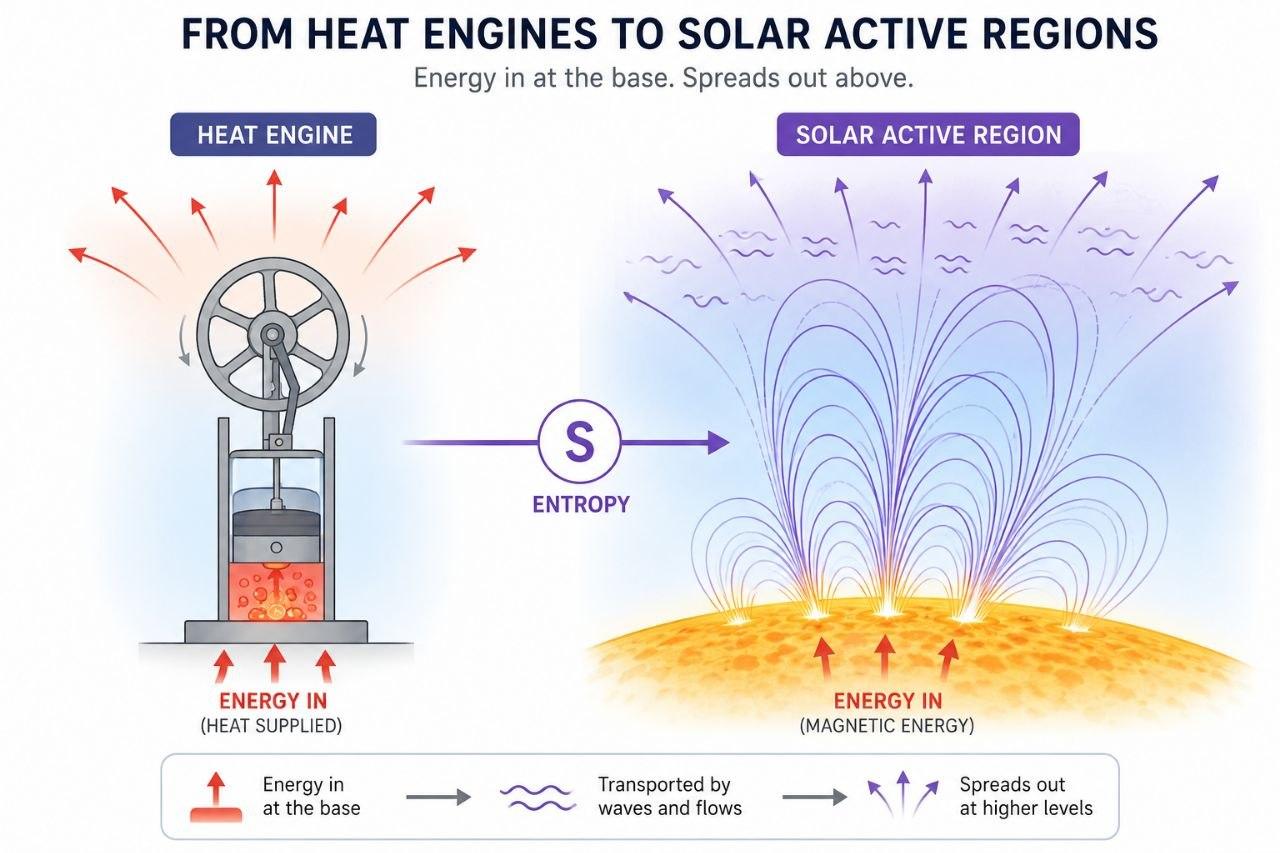
A team of solar physicists has discovered a new way to detect and measure entropy variations in the Sun’s atmosphere – a breakthrough that could help researchers better understand how energy moves through the solar corona and why the Sun’s outer atmosphere is millions of degrees hotter than its surface.
Entropy is a concept that dates back to the 1860s, when German physicist Rudolf Clausius introduced it while studying the efficiency of heat engines and the famous Carnot cycle. Since then, entropy has become one of the most fundamental ideas in physics, helping scientists describe how energy is distributed and transformed in systems ranging from steam engines and black holes to stars and even the Universe itself.
Despite its importance, entropy has remained notoriously difficult to measure directly in the Sun's atmosphere.
In a new study currently in press in The Astrophysical Journal Letters, researchers from the University of Warwick, the Ventspils International Radio Astronomy Centre (VIRAC, Ventspils University of Applied Sciences), and University College London have shown that entropy leaves observable fingerprints in waves that travel through the Sun's hot, magnetised atmosphere, known as the corona.
"Entropy is one of the key quantities that tells us how energy is organised within a physical system," explains lead author Dmitrii Kolotkov, Stephen Hawking Fellow. "In a conceptual sense, we can think of solar active regions as natural heat engines, continuously converting and transporting energy through hot magnetised plasma. Their behaviour and efficiency are closely linked to entropy. The concept itself has deep roots in thermodynamics and even plays a central role in black hole physics, where entropy is associated with the fundamental limits of information and energy storage. When entropy remains unchanged, energy tends to stay more organised and localised. When entropy is perturbed, energy becomes redistributed and spreads through the surrounding plasma. If we can measure how entropy changes in solar active regions, we gain a new way of tracking how energy is transported, dissipated, and ultimately converted into heat."

Understanding these processes is one of the major challenges in solar physics. The solar corona reaches temperatures of more than a million degrees Celsius, far hotter than the visible surface below it. Scientists have been trying for decades to identify the mechanisms responsible for transporting and releasing enough energy to maintain these extreme temperatures.
The new study suggests that entropy perturbations – small departures from the local thermodynamic balance of the plasma – can be detected through subtle signatures in coronal oscillations that are routinely observed in active regions and coronal loops.
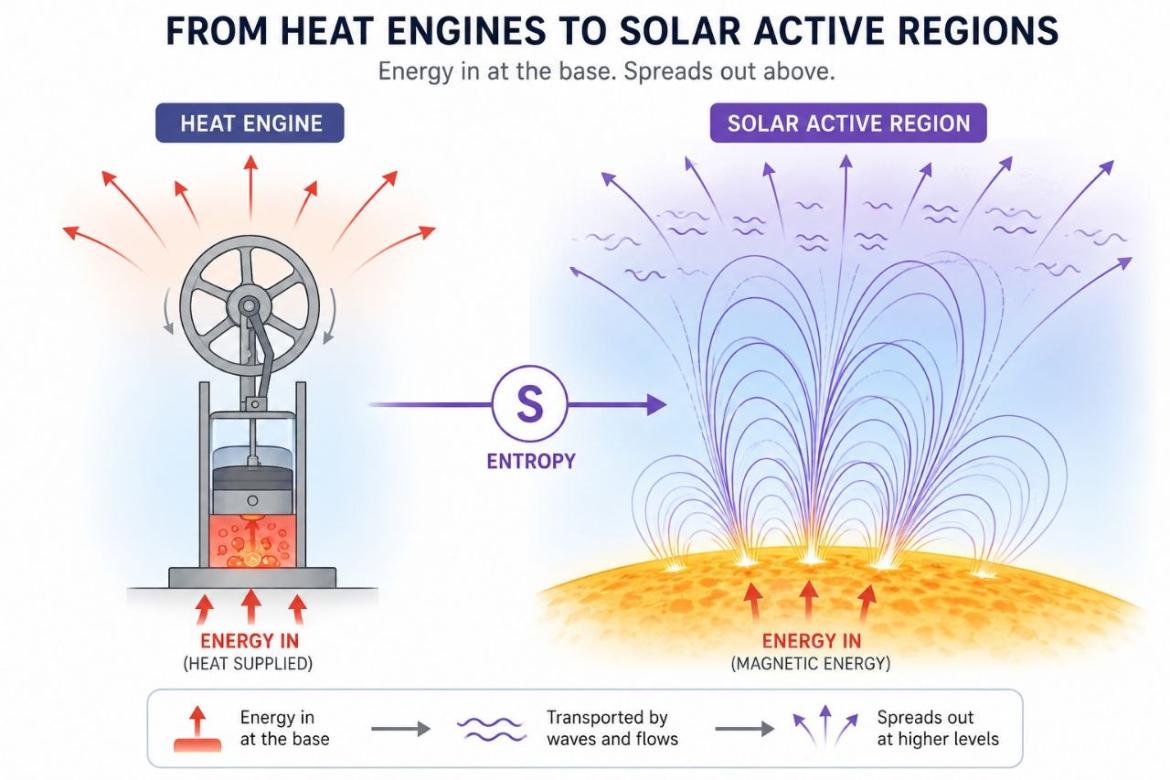
Rather than observing entropy directly, the researchers found a way to infer its presence from how these waves evolve over time. This effectively transforms entropy from a largely theoretical quantity into something that can be measured using observations.
The ability to diagnose entropy in the corona could provide a powerful new tool for investigating how energy spreads through solar active regions, how plasma responds to heating, and how different physical processes contribute to the overall energy balance of the Sun.
Beyond solar physics, the findings may also help scientists study other magnetised plasmas found throughout the Universe, including the atmospheres of distant stars.
The work highlights how ideas developed more than 150 years ago to understand steam engines continue to find new applications in modern astrophysics. By uncovering a practical way to measure entropy in the Sun, the researchers have opened a new observational window onto one of the most fundamental quantities in nature.
As new generations of solar observatories continue to deliver increasingly precise measurements of the Sun, scientists may soon be able to map entropy variations across active regions and use them to reveal how energy flows through the solar atmosphere — bringing us closer to solving the long-standing mystery of coronal heating.
Link to the article preprint: https://arxiv.org/abs/2606.05360
DOI: 10.3847/2041-8213/ae7720
Kolotkov et al. The Astrophysical Journal Letters.