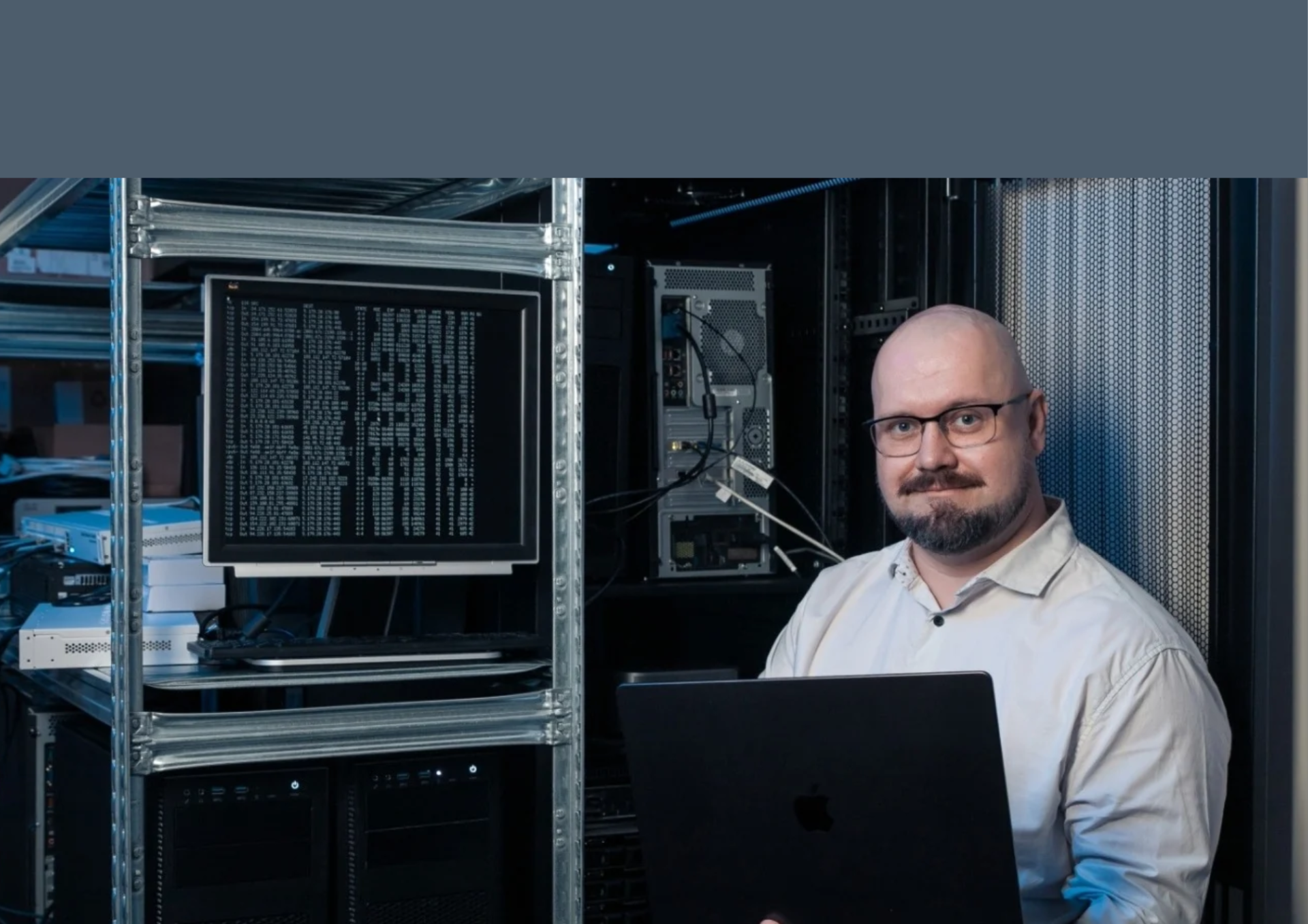
The opportunity to create something himself and immediately see how it works was one of the main reasons why Pēteris Paikens chose to study computer science. He began his career in software development, working in various positions in the financial sector for approximately 12 years. However, he has now been working in research for more than 15 years at the Artificial Intelligence Laboratory of the Institute of Mathematics and Computer Science of the University of Latvia, which he joined when he began his doctoral studies. Since September 1, 2026, Pēteris has been a Tenure Professor at the Faculty of Science and Technology of the University of Latvia (UL) and is actively working on the development of a new specialised master's study programme in cybersecurity.
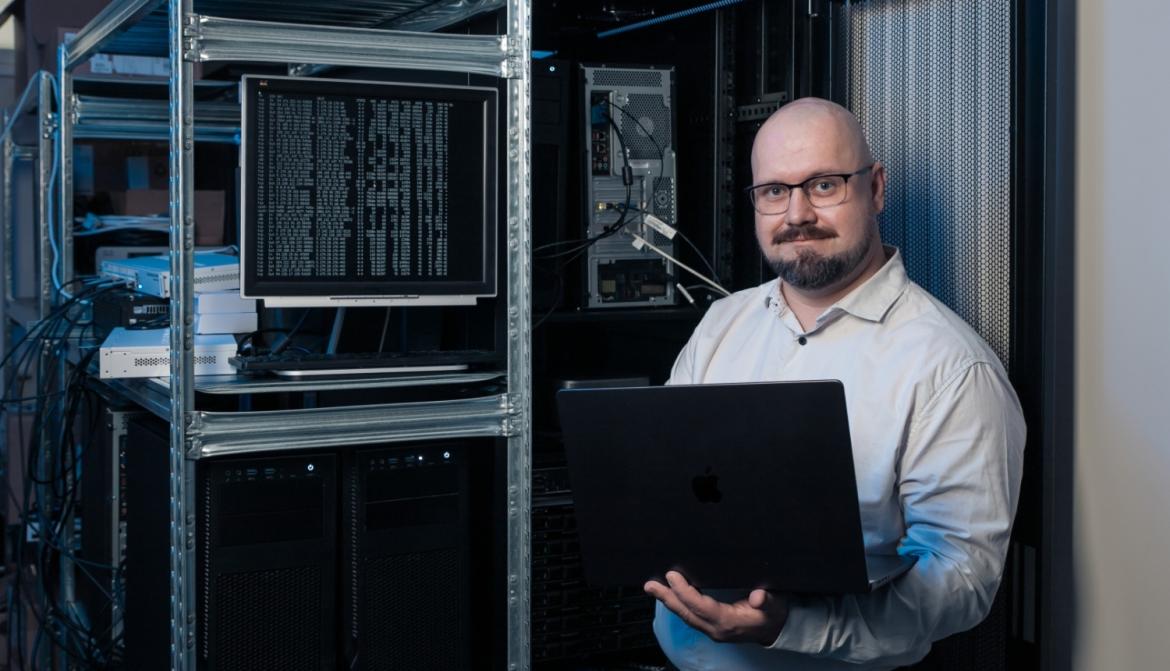
The transition from the private sector to academia did not happen overnight. Pēteris became interested in research during his studies, and later pursued it alongside his main job, participating in various scientific projects, including in the field of language technologies. “It was not as if I decided one day to completely change my professional life. For some time, I combined software development with research, and several things had to fall into place in the right combination for me to take the next step. Gradually, research became an increasingly important part of my work until I devoted myself to it fully,” he recalls.
Pēteris has not regretted this decision. “Of course, working in the private sector has its practical advantages, but I would say that it is more interesting here,” he admits. Academia offers opportunities to seek answers to questions that have not yet been resolved, create new study content and work with future industry specialists.
One of Pēteris's main responsibilities in his new position is currently the development of the new master's study programme “Smart Cybersecurity”. It is being developed as part of the joint project “Intelligent Cybersecurity” implemented by the University of Latvia and Riga Technical University.
Although cybersecurity management can already be studied in several study programmes available in Latvia, the aim of the new programme will be to prepare technical experts who are capable of investigating cyber incidents in practice, designing secure system architectures and dealing with complex threats. Particular attention will also be paid to the interaction between cybersecurity and artificial intelligence.
“There are people in Latvia who have acquired these skills to a very high level through self-study and work. The problem is not their qualifications – there are simply too few of them. Moreover, until now, in many technical fields, there has been no opportunity to systematically acquire the necessary knowledge at university. This is what we want to change with the new programme,” explains Pēteris.
The programme will include six specialisation blocks – machine learning security, cyber-physical systems security, cyber incident investigation, active defence, cryptography and security management. Each student will be able to choose the two areas most relevant to them and study them in depth.
Cybersecurity practitioners working in the private sector also play an important role in the development of the programme. In several narrow technical fields, there are few academic specialists in Latvia, while companies employ professionals with valuable practical experience. “If we want to provide students with advanced technical skills, the specific topic must be taught by someone who has actually done this work themselves,” emphasises Pēteris.
The programme is currently in the final stage of licensing. Once the licence has been obtained, the first admission round is planned to be announced, offering 40 state-funded study places and approximately 20 tuition-fee-paying places. It is planned that the first group of students could begin their studies in January 2027.
However, the development of the new master's programme is only one of the activities of the “Intelligent Cybersecurity” project. For people who cannot devote two years to master's studies, shorter professional development and lifelong learning courses are planned. These will allow participants to acquire the necessary skills in individual thematic blocks. Educational tests and practical tools are also planned to help the wider public assess their knowledge and learn safer practices in the digital environment.
The project will also strengthen cybersecurity research in Latvia. Four research groups will be developed within the project, including the Smart Cybersecurity Laboratory led by Pēteris, new researchers will be recruited, and support will be provided to doctoral students. There are also plans to develop a professional standard for technical cybersecurity specialists and establish a cooperation platform for employers, employees and educational institutions. Thus, the project's aim is not only to create a new study programme but also to strengthen cybersecurity knowledge, research and the training of specialists in Latvia in the long term.
When working on the new programme, it is important for Pēteris to combine academic knowledge with practical experience. Therefore, both teaching staff from the University of Latvia and Riga Technical University and professionals from the private sector are involved in its development. “The great value lies in the fact that, instead of each of us working in our own corner, we can find the best people in Latvia for each field and together create a programme of the highest possible quality,” he emphasises.
Working in such a rapidly changing field means that he must also constantly keep learning. This is precisely what continues to give Pēteris the greatest satisfaction. “I really enjoy learning new things, which is why I am particularly drawn to rapidly developing fields such as artificial intelligence and cybersecurity. In these fields, you cannot simply learn something once and then continue working in the same way for years – new questions constantly arise, technologies change, and new solutions must continually be sought. This is precisely what makes the work interesting and prevents it from becoming routine,” says Pēteris.
In computer science and cybersecurity, artificial intelligence also creates both new opportunities and new challenges. At the same time, Pēteris encourages people not to lose the desire to think, learn and understand how the technologies they use work. “Artificial intelligence opens up extensive opportunities in many fields, but the fact that a tool can do something for us does not mean that we no longer need to develop our own skills. It is important to try to understand why a particular solution works and what lies behind the answer provided by artificial intelligence. This sharpens the mind, helps maintain independent judgement and prevents us from becoming overly dependent on technology. In my opinion, this applies not only to computer science but to every field,” emphasises Pēteris.
This story was produced with the support of EU funds.