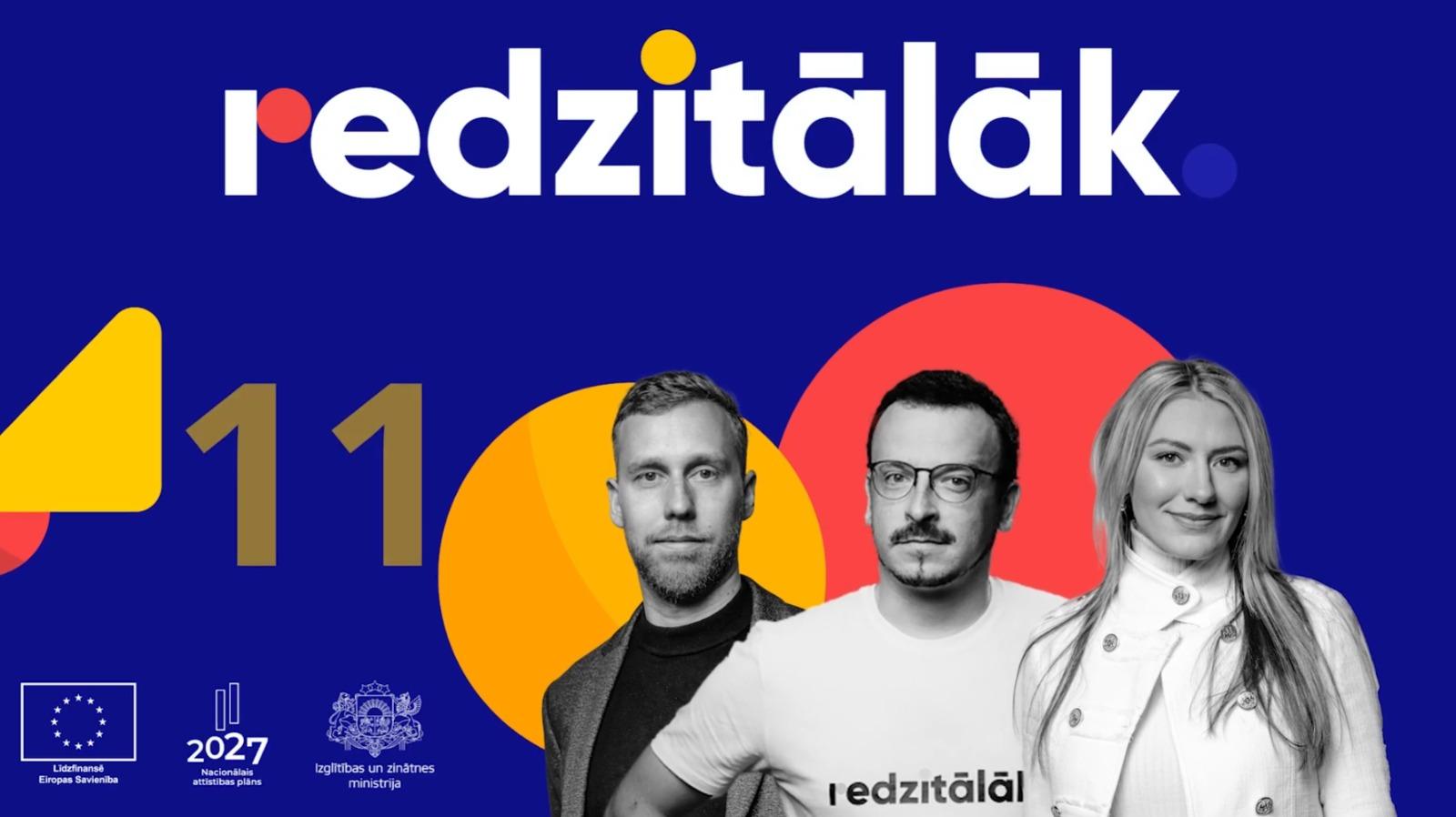
The 11th episode of the Ministry of Education and Science’s EU‑funded podcast “See Further!” is dedicated to careers in science, together with experts highlighting the path from a student’s first ideas to high‑level research and international competitiveness.
With the arrival of spring, many young people find themselves at a decisive moment when choosing their future field of study. It is likely that among them there will also be someone who wishes to take their path into the field of science. As we reveal in this episode, the journey from the first idea to its implementation in the global market is full of challenges, but it is precisely within these challenges that the greatest creative satisfaction lies.
In the episode “A Career in Science: From Student to Researcher” we meet physicist Dr. Edgars Butanovs, lead researcher at the University of Latvia’s Institute of Solid State Physics Thin Films Laboratory and head of the Semiconductor Nanotechnology Group.
In childhood, Edgars dreamed of becoming a road worker, an archaeologist, or an inventor. But now he admits that it is physics that has turned out to be the gateway through which it became possible to fulfil the dream of inventing.
The second guest of the podcast is Elizabete Universa, head of the Student Innovation Grant Project and the Student Business Incubator at the Latvia University of Life Sciences and Technologies. Elizabete is also a doctoral candidate in engineering and technology.
Looking back at her choice to build a career in science, the researcher highlights a significant change of environment: from an ethereal and fluid atmosphere while growing up in an artists’ family, to the vast strictness and theoretical foundations of science (specifically, healthcare).
Latvia is currently in a transition from low value‑added production to a high‑productivity innovation economy. By using the Smart Specialisation Strategy (RIS3), Latvia focuses on research that provides immediate returns to the national economy.
When academic discoveries turn into commercially competitive products, the value of knowledge and research increases. In this context, the strategic focus on the sustainability of natural resources and climate neutrality is not only an environmental issue — it is Latvia’s economic independence from external resource and energy “surprises”, by concentrating on creating smart solutions that can adapt to challenges caused by unstable geopolitical situations and that can also be exported.
In the conversation with Edgars Butanovs and Elizabete Universa, the podcast discusses their experience in securing funding for their work in science. Edgars provides insight into participation in the EU’s main research and innovation funding programme “Horizon Europe” and in a European Space Agency programme, while Elizabete introduces the Student Business Incubator and the Innovation Grant Programme at the Latvia University of Life Sciences and Technologies, outlining the involvement of entrepreneurs in offering research ideas to emerging researchers.
A significant part of the podcast discussion emphasised the essential skill scientists need — the ability to present both their research and themselves, in order to convince expert committees managing specific funds, as well as to inform the wider public about the results of their work.
streaming platform Spotify, watched in the Ministry of Education and Science’s YouTube playlist, as well as on the MES website. The creation of the podcast is provided by the Ministry of Education and Science with the support of European Union funds.
The podcast “See Further!” can also be listened to on the streaming platform Spotify, watched in the Ministry of Education and Science’s YouTube playlist, kā arī IZM tīmekļa vietnē. The creation of the podcast is provided by the Ministry of Education and Science with the support of European Union funds.