
Laila Silamiķele is a leading researcher at the National Institute for Research and Innovation (NIRI), where she studies both the molecular mechanisms of osteoarthritis and the role of the microbiome in the progression of various diseases. Laila has experience in both managing and implementing research projects, as well as in international cooperation. Laila is also an Assistant Professor at the Faculty of Medicine and Life Sciences of the University of Latvia. She is a board member of the Latvian Association of Young Researchers (LJZA) and actively works on issues related to academic ethics. To learn more about diseases at the molecular level, researchers' responsibility and the passion for confronting the unknown, we invite Laila to a conversation in the interview series "Meet the Young Scientist!"

What motivated you to study natural sciences, and how did you come to pursue research in molecular biology and biomedicine?
Most likely, it was my analytical mind and natural inclination towards intellectual challenges. Like other school subjects, I found biology interesting and was good at it. When I started studying, molecular biology seemed to be the most fascinating, most challenging and least explored field of biology. We cannot simply see the objects of its research, such as DNA molecules, yet they play such a crucial role in every life process. Moreover, in the field of biomedicine, for example, by studying the molecular mechanisms of diseases and looking for ways to treat them, there is an opportunity to use this knowledge to help people. That is how I chose to build my scientific career in this field. However, my research is now becoming increasingly interdisciplinary.
How would you briefly explain why your research is important to society?
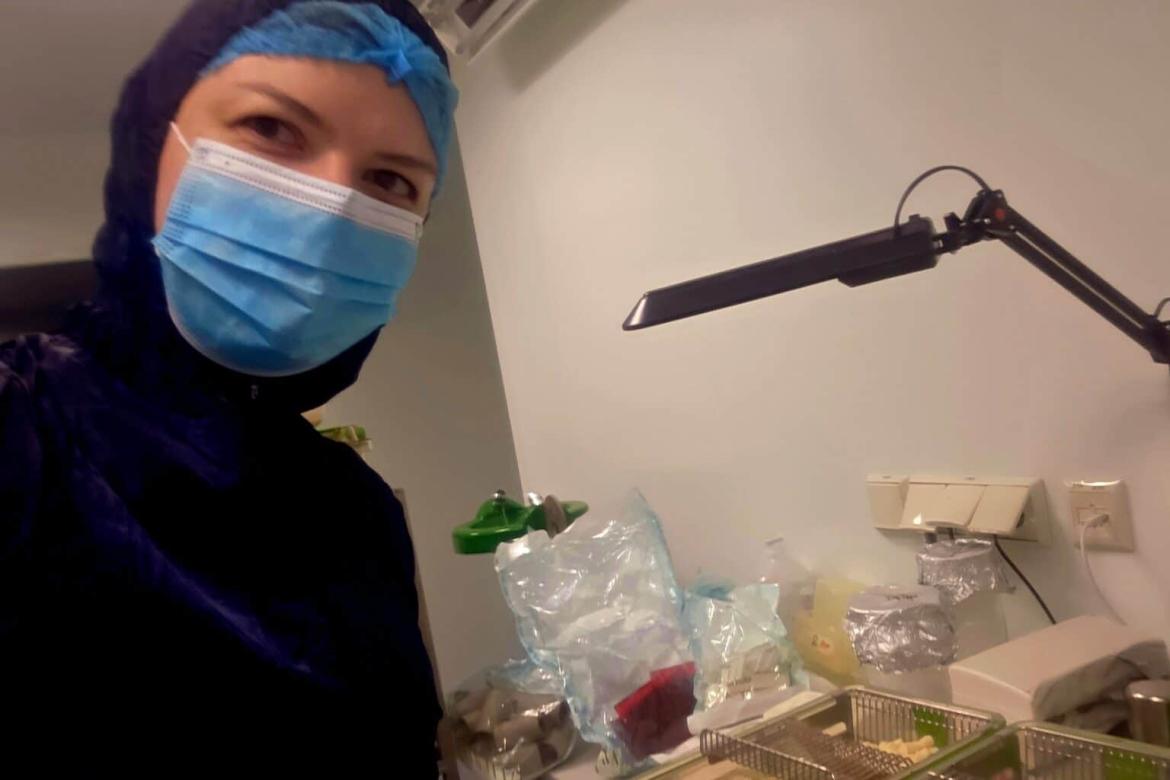
One in three people suffers from osteoarthritis in old age (the data vary depending on the age group), and women are affected more often than men. It is a chronic joint disease that causes persistent pain and reduced range of motion. The disease also affects people of working age, who are often forced to leave the labour market. This not only creates a significant socioeconomic burden on society as a whole but also reduces the quality of life of the patients themselves.
The scientific approach is currently changing, and we can no longer regard osteoarthritis as simply a disease caused by mechanical wear and tear of the joints – it has various subtypes. Our focus is specifically on the inflammatory subtype of osteoarthritis, which is characterised by local inflammation of the joint lining. My current project aims to "decode" this disease at the molecular level – we are looking for specific molecules and cellular characteristics so that the disease can be diagnosed earlier, more accurately and with less discomfort for the patient, as well as to enable the development of targeted therapies in future research. In simple terms, this research will help ensure that people can move without pain and live fulfilling lives in old age.
What motivates you in your daily work?
My main motivation is the desire to explore and improve things, as well as to do work that I find interesting. The profession of a researcher uniquely combines almost everything that is important to me. On the one hand, science gives me complete independence and the opportunity to challenge myself, while on the other hand, it involves close cooperation with others and being surrounded by very active, knowledgeable people. There is no room for routine here. This work requires creativity and offers the opportunity to work in an international environment, addressing globally meaningful issues. It is also an opportunity to teach, share knowledge and inspire others. All of this together creates a sense that the work has a greater purpose.
You are currently working on several research projects and have experience both as a project leader and as a project team member. These are great achievements and an opportunity to contribute to the field. At the same time, focusing on different topics simultaneously can be challenging. What is currently the most "demanding" part of research, and how do you find a balance between your various responsibilities at work?
The most demanding part of research is precisely combining all the different fields and roles, which does not always work out as well as I would like. Recently, I have been involved in several scientific projects simultaneously, each focusing on different diseases and contexts. This means constantly learning something new while applying the skills I have already acquired in preclinical research. On top of all this, there are various additional activities that are only indirectly related to research itself but also require time and energy. I am still learning to find a work-life balance, and I naively hope that one day I will succeed.
You have had successful experience in several COST (European Cooperation in Science and Technology) Actions. What are the greatest benefits of participating in international networks in your field of science?
COST Actions provide an opportunity to network and collaborate with other European experts in a very straightforward way. Since I have interdisciplinary interests, each Action has focused on a different topic – from laboratory animal science and the inclusion of both sexes in research to an osteoarthritis network and the application of large language models in drug development. These diverse experiences complement one another and help shape me into a researcher with a broad range of expertise. This allows me not only to keep up with the latest developments in the field but also to actively contribute to its advancement by participating in discussions and activities, and each such trip is inspiring.
What prompted you to focus more deeply on research ethics?
When I attended certification courses for working with laboratory animals at the University of Porto, I was very fortunate to have wonderful lecturers who are among Europe's leading experts in this field. Through their example, these people opened up a completely new world to me, more specifically, an interest in research ethics in the field of laboratory animal science, as well as how such experiments should be properly conducted so that they are meaningful, as ethical as possible, and as reproducible as possible.
As I delved deeper into this topic, I developed an increasingly clear understanding of the concept of ethics. Ethics is not only about the moral status and protection of research subjects, or so-called research ethics, but also about research integrity – how responsibly we, as researchers, conduct our studies, report their results and interact with colleagues. This is already part of the broader field of academic ethics, which is relevant to every field of research, not just biomedicine. This deeper interest has also logically developed into my practical responsibilities – I currently serve on both a national research ethics committee and the recently established NIRI Ethics Committee, which focuses on academic ethics.
As a board member of LJZA, you look at ethical issues from an even broader perspective. You certainly deserve a big thank you for raising awareness of academic ethics and research integrity issues in Latvia. Even more so – for actively seeking solutions. LJZA both participates in international academic ethics events and takes targeted steps towards establishing a centralised academic ethics office in Latvia. Many young researchers remember the Ethics Debates you organised at the LJZA Summer Schools in 2025 and 2026. How has the understanding of academic ethics changed in Latvia in recent years?
I am grateful to LJZA for the trust and the opportunity to be involved in this, and I would also like to express my sincere thanks to LJZA board members Raimonda Soloha and Rasma Pīpiķe for our joint work in advancing these issues at the national level, as well as to all the other LJZA representatives who were involved in the Ethics Working Group even before I joined LJZA.
I am very pleased that the Ethics Debates have now become a strong tradition at the LJZA Summer Schools and that participants actively engage in them. It is a tangible way to demonstrate in practice how complex and ambiguous situations in the academic environment can be. For some young researchers, this is the first time they reflect on and realise that certain situations they see around them are neither right nor acceptable. Overall, awareness in Latvia is beginning to develop thanks to various international projects and initiatives implemented by professionals in the field, but there is still a great deal of work to be done. It is important to mention here that, unlike most European countries, Latvia still does not have a single centralised body dealing with these issues, including education and prevention. This is precisely what we at LJZA want to achieve.
What motivated you to join LJZA, and did you know right away that you would become an active member of the community and even a member of the LJZA board?
I had heard about LJZA several years before joining, but at that time I was not yet following the association's activities in detail. Shortly after obtaining my doctoral degree, I realised that I was ready to learn more and get involved. Immediately after joining, I began actively participating in the Ethics Working Group. To my own surprise, just a year later, I decided to run for election and became a board member. Serving on the board has significantly broadened my perspective on science in Latvia and around the world, as well as given me an understanding of policymaking. All of this is still something new, unfamiliar and very interesting to me.
The greatest value of LJZA is the opportunity to meet young researchers from a wide variety of fields. We have different experiences but similar goals. This greatly broadens our horizons and helps us see our work in a wider context. Moreover, this environment provides excellent training. Even two scientists from the same field do not always immediately understand the specifics of each other's research, let alone those from different fields and society as a whole. LJZA is one of the opportunities to learn how to talk about your research in a way that others can truly understand.
What myth or stereotype about scientists would you like to challenge?
Scientists are not people who know everything. Quite the opposite – scientists are the ones who are most aware of how much they still do not know. And it is precisely this desire to explore the unknown that, in my opinion, motivates most of them to choose this path.
Since we base our work solely on evidence and facts, scientists usually speak very cautiously and thoughtfully. That is why we sometimes appear less visible or quieter in the public sphere than various spreaders of disinformation, who are not characterised by doubt. Scientists are often criticised for not talking enough about our work. However, our daily work of conducting research and securing funding for it is so intensive that there is often too little time left for communication. While we are still learning to find this balance, society needs to maintain critical thinking.
What would you like to wish or recommend to aspiring and young scientists regarding career development after obtaining a doctoral degree?
To realise that obtaining a doctoral degree is only the beginning, not the finish line, of a scientific career. That is why I encourage young researchers to be active in the international scientific community, always maintain high standards of scientific work and become a driving force behind high-quality, honest science themselves. Do not be afraid to challenge yourselves and the system, because it is precisely the energy and vision of young scientists that drive both our field and society as a whole forward.