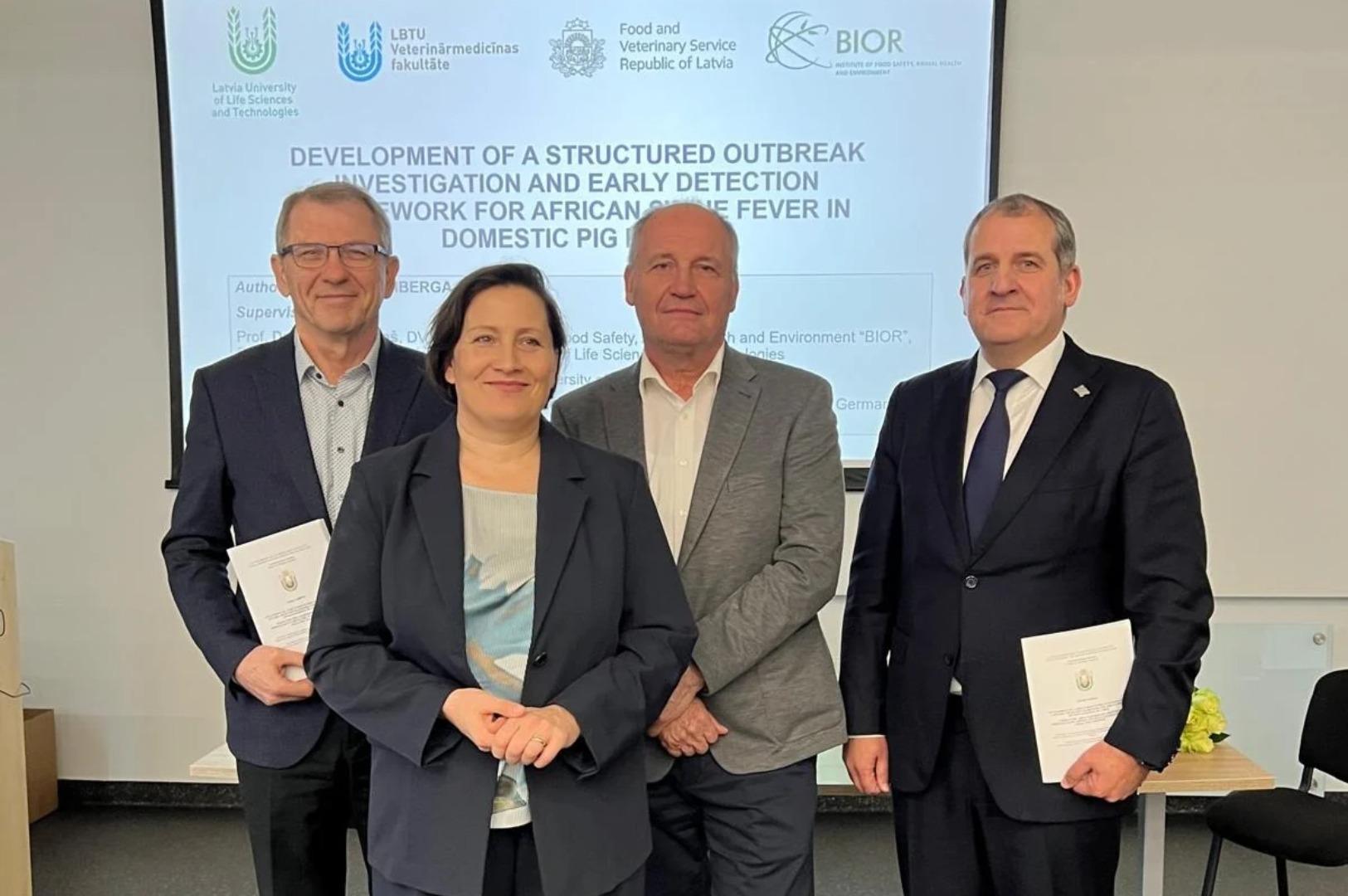
On 30 October, Kristīne Lamberga defended her doctoral thesis, a thematically unified collection of scientific publications entitled "Development of a Structured Outbreak Investigation and Early Detection Framework for African Swine Fever in Domestic Pig Farms", at the Faculty of Veterinary Medicine of the Latvia University of Life Sciences and Technologies (LBTU VMF), and obtained a Doctor of Philosophy (Ph.D.) degree in Agricultural, Forestry and Veterinary Sciences.
The aim of the study was to improve African swine fever (ASF) control strategies by enhancing and strengthening approaches to early outbreak detection and epidemiological investigation in affected pig farms, evaluating existing surveillance systems and outbreak investigation methodologies.
As the young scientist K. Lamberga explains: "African swine fever (ASF) is one of the most significant infectious diseases of pigs, causing severe socioeconomic consequences, characterised by unpredictable cross-border spread, and for which effective treatment or vaccination options are still unavailable. ASF is a notifiable infectious animal disease. ASF was first described in Kenya in 1921. The disease was first detected in Europe in Portugal in 1957, where it was initially successfully eradicated. However, in 1960, ASF was reintroduced into Portugal and spread from there to Spain, becoming endemic in the Iberian Peninsula during the 1970s and 1980s and causing significant economic losses. During this period, outbreaks were also sporadically detected in other European and American countries, including the Netherlands, Belgium, France, northern Italy, Cuba, Brazil, the Dominican Republic and Haiti, although the disease was successfully eradicated in these countries. In 1978, ASF was detected in Sardinia, where it remained endemic for more than four decades, until the competent authorities of Sardinia recently succeeded in eradicating the disease. The source of infection in primary outbreaks was most often contaminated food waste from aircraft and ships involved in international transport. Therefore, from an epidemiological perspective, it has been concluded that human activity and non-compliance with biosecurity requirements are the main factors contributing to both intercontinental and regional spread of ASF."
To achieve the set objective, several research tasks were carried out: possible routes of ASF virus introduction into pig herds were investigated using a hypothesis-based epidemiological approach and evaluating information obtained from non-experts (I, IV); sampling strategies for assessing the spread of the ASF virus in affected pig farms were evaluated and improved (II, III); the suitability of on-site lateral flow devices (LFDs) as an additional diagnostic tool in ASF outbreak investigations was assessed, and their performance was compared with standard laboratory diagnostic methods, including polymerase chain reaction (PCR), immunoperoxidase test (IPT) and enzyme-linked immunosorbent assay (ELISA) (III); the main epidemiological parameters required to reconstruct the high-risk period (HRP) of an ASF outbreak in affected pig farms were identified and analysed (I, II); and the effectiveness of ASF surveillance approaches used in Latvia for early outbreak detection was evaluated (I, II).
Scientific supervisors of the doctoral thesis: Prof. Dr. Aivars Bērziņš (ORCID: https://orcid.org/0000-0003-2933-3709), DVM PhD, Institute of Food Safety, Animal Health and Environment "BIOR", Faculty of Veterinary Medicine, Latvia University of Life Sciences and Technologies, Latvia, and Prof. Dr. Arvo Viltrop (ORCID: https://orcid.org/0000-0003-0133-980X), DVM PhD, Institute of Veterinary Medicine and Animal Sciences, Estonian University of Life Sciences, Tartu, Estonia.
Summary of the doctoral thesis for obtaining the Doctor of Philosophy (Ph.D.) degree in Agricultural, Forestry and Veterinary Sciences.
Thematically unified collection of scientific publications of the doctoral thesis for obtaining the Doctor of Philosophy (Ph.D.) degree in Agricultural, Forestry and Veterinary Sciences.