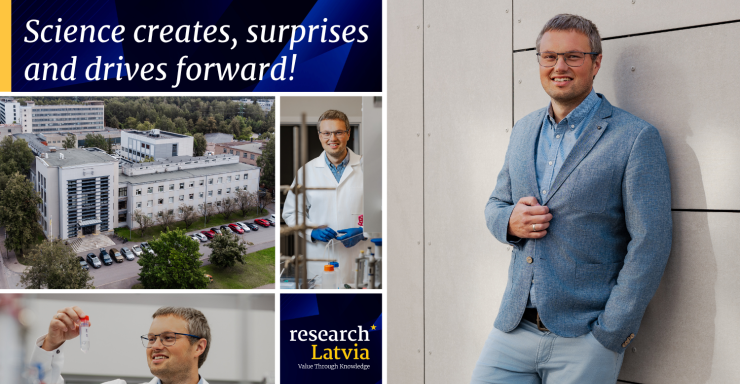
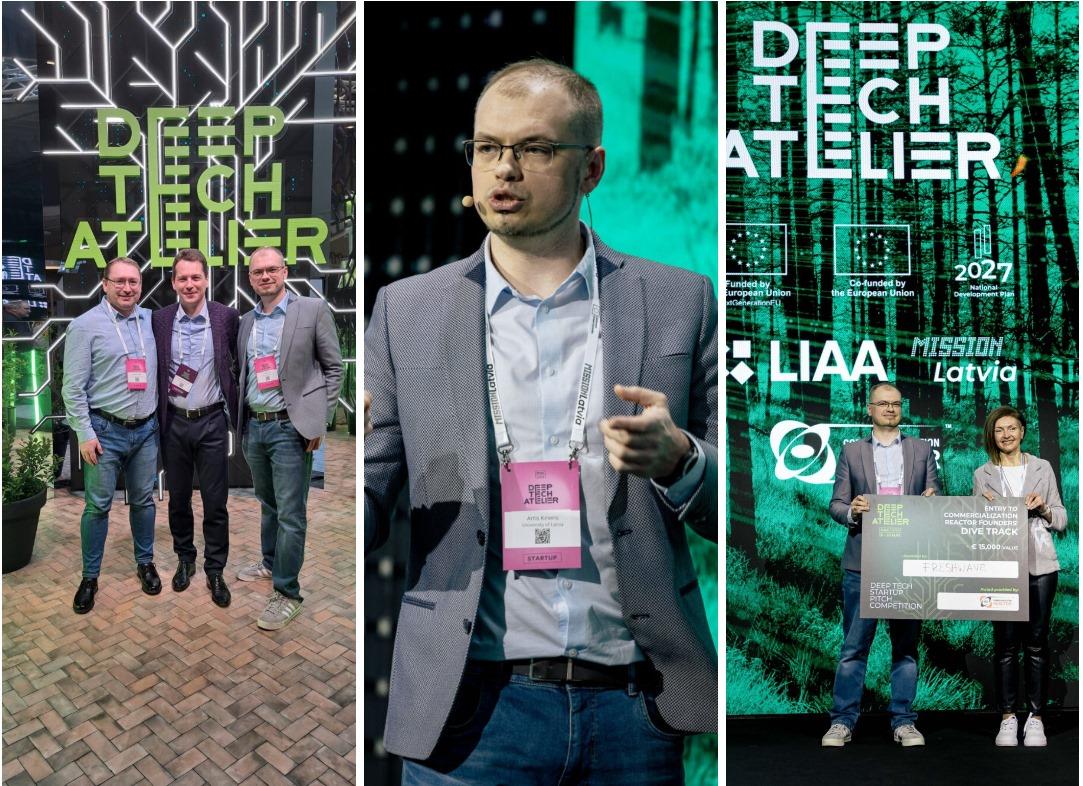
A scientist who can solve the current needs of an entrepreneur and speaks in a language he understands is becoming increasingly in demand these days. It is not for nothing that Doctor of Chemistry, OSI Researcher Acting and UL Associate Professor Artis Kinēns just received the Commercialization Reactor Award for a convincing presentation of an idea to investors at the ambitious Baltic Science-Based Technology Forum — Deep Tech Atelier 2025 and got the opportunity to learn commercialization knowledge for the next six months.
How fresh is the fish?
Together with his team members – Roman Viters, a leading researcher at the Institute of Atomic Physics and Spectroscopy of the University of Latvia, and Jurij Jastrzembski, an expert in the commercialisation of science – Artis Kinēns has created an original solution for controlling the freshness of fish products, FRESHWAVE. An optical sensor embedded in fish packaging will allow you to accurately determine the degree of freshness of the product and will help to more accurately direct the fish for freezing, smoking, processing or to the store shelf.
Currently, there is no effective method on the global market to quickly and accurately verify the freshness of fish, especially in packaging.
The solution created by scientists will reduce the number of fish that currently end up in production waste. The amount of food produced and thrown away unnecessarily worldwide reaches up to 35% of total production.
Investors are still silent, but watching carefully
Deep Tech Atelier 2025 brought together European and global entrepreneurs, scientists, investors and policymakers in Riga in mid-May. Scientists from various European countries had applied to present their ideas publicly at the event, but when selecting ideas, only 30 projects were given the opportunity. Among them – FRESHWAVE. The members of the jury, who evaluated the presentations – representatives of large investment companies and investors. The FRESHWAVE presentation reached the final of the competition and received the Commercialisation Reactor Award for further preparation of the idea for the market.
"Yes! Investors find our fish freshness control sensors interesting, but they are looking for almost ready-made products," says Artis Kinēns. "We already have more than an idea, but no product yet."
Flickering. Indicator. Accurate data.
Currently, the laboratory has developed an optical material that is highly sensitive to specific substances released by fish spoilage. It must be many times more sensitive than previously known solutions. Its optical properties change in response to a small concentration of fish spoilage substances in the air. Depending on the degree of glow of the optical material, it will be possible to determine the freshness of the fish. The authors of the project plan to incorporate it into fish packaging.
Although changes in the degree of glow will be obvious when scanning the product in the warehouse, the program will read the changes in the optical indicator and accurately calculate the degree of freshness and shelf life of the fish.
From invention to usable "product"
"We are preparing for the FRESHWAVE BioPhoT (state support program for science projects with market potential) presentation competition, which will take place at the beginning of next week. We are aware that our project needs a lot of investment to move forward and develop a finished product," says Artis Kinēns.
"We need to 'build' the manufacturing process. We need to create a solution to turn the optical material into a printable ink, find a suitable 'printer' for it, and incorporate it into the packaging. This will no longer be just scientific work with flasks and liquids, but also a technical, organisational, dynamic time, searching for and working with partners, with the help of which each of the project stages can be turned into a manufacturing process."
Born in Latvia
Meanwhile, major global investors are closely monitoring the development of projects that interest them, as their job is to join and invest in the project at the right time, when the “product is ready”, but other players have not yet managed to take it under their wing. FRESHWAVE is exactly such a noteworthy novelty on the market, which is being formed and spreading its wings right here in Latvia!