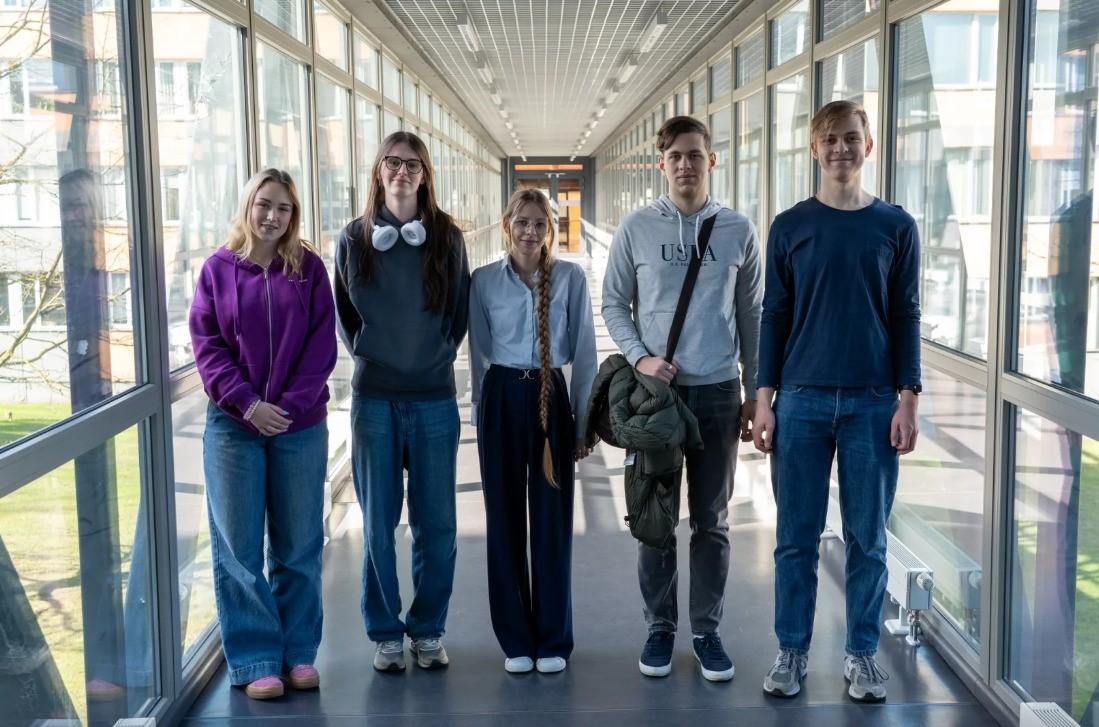
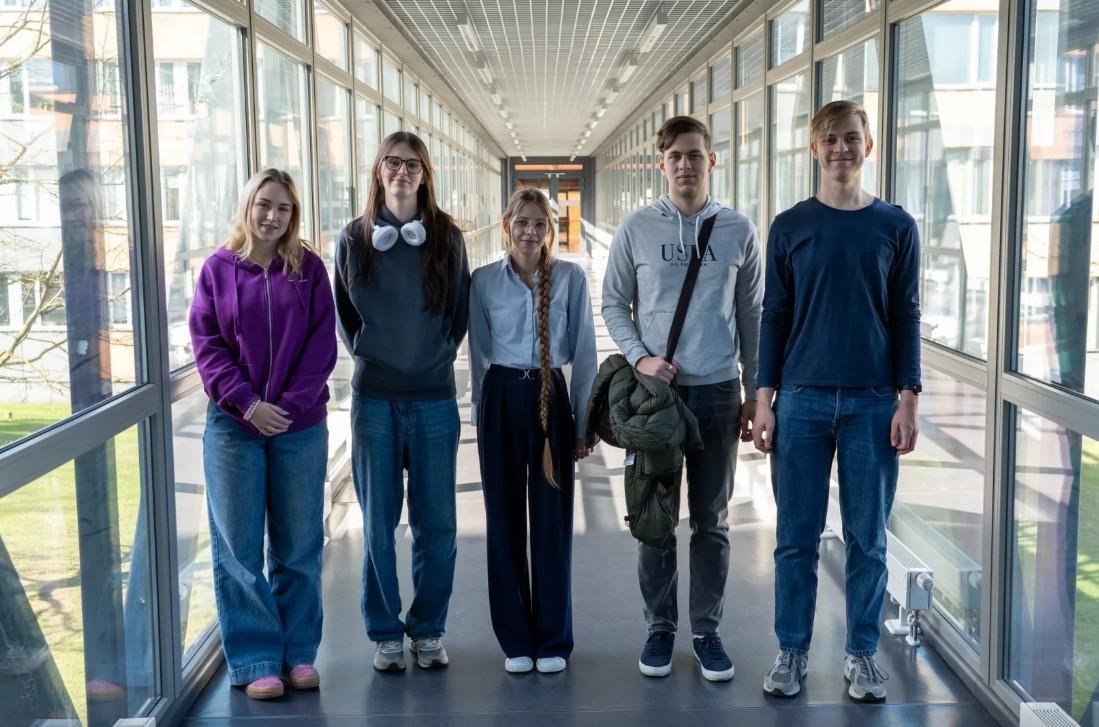
Five high school students who wish to build their future careers in particle physics and accelerator technologies will once again have the opportunity, during Job Shadow Day, to visit the European Organization for Nuclear Research (CERN) in Switzerland and learn about the work of scientists from Riga Technical University (RTU) and the University of Latvia (LU) at this globally influential research centre.
Latvian scientists at CERN will host their “shadows” from April 13 to 15, while in Latvia Job Shadow Day will take place on April 1, when RTU scientists and staff will also welcome students. Registration for Job Shadow Day will open on February 27 on the website enudiena.lv.
Work of the Scientists Available for Shadowing at CERN
At CERN, students are offered the opportunity to shadow several scientists.
Two students will have the chance to shadow Kārlis Dreimanis, particle physicist and Director of the Institute of Particle Physics and Accelerator Technologies at Riga Technical University (RTU). One student each will shadow RTU research engineer Guntis Pikurs and doctoral student Patrīcija Kalniņa from the joint RTU and University of Latvia (UL) study programme “Particle Physics and Accelerator Technologies.” Patrīcija’s shadow will also have the opportunity to learn about the work of her colleague Edgars Mamis.
Doctoral student and physicist Ojārs Mārtiņš Eberliņš will host one shadow, who will also be introduced to the work of his colleague, doctoral student Mārtiņš Klevs.
Kārlis Dreimanis
Kārlis is Director of RTU’s Institute of Particle Physics and Accelerator Technologies and leads the Latvian research group participating in the CMS (Compact Muon Solenoid) experiment at CERN.
CMS is one of the four large physics experiments located at the Large Hadron Collider (LHC), the largest scientific instrument in the world. Around 6,000 people from nearly 60 countries work in CMS, and the Latvian research group plays an important role, performing measurements of the top quark, the Higgs boson, and Standard Model vector bosons, as well as contributing to the development of a new particle detection system — the MIP Timing Detector (MTD).
Kārlis’s daily scientific work is closely connected with the MTD project, where he serves as co-project leader of one of its subsystems, the Barrel Timing Layer (BTL), and is also involved in CMS operational and data acquisition (online) activities. His main research interests focus on precision measurements of particle collisions and fundamental particle properties.
Guntis Pikurs
Guntis is the first RTU doctoral graduate to have developed his PhD thesis at CERN. His dissertation, “Research on the Novel Manufacturing Technology for Compact Radio Frequency Quadrupole Design and Production,” focuses on additive manufacturing technologies and their application in accelerator construction.
Based on Guntis’s design, a prototype of a Radio Frequency Quadrupole (RFQ) accelerator component was produced from pure copper for the first time using additive manufacturing (AM Laser Powder Bed Fusion).
Working at CERN together with Latvian and international scientists, Guntis explores how additive manufacturing — which builds objects layer by layer from a pre-designed 3D model - can be used to develop future accelerator technologies. This approach allows for more intricate designs and cost savings, as traditional RF accelerator production is highly time-consuming and expensive.
Patrīcija Kalniņa
Patrīcija is a second-year doctoral student in the joint UL and RTU programme “Particle Physics and Accelerator Technologies” and a researcher at the Institute of Chemical Physics of the UL Faculty of Chemistry. She works at CERN on the MEDICIS (Medical Isotopes Collected from ISOLDE) project.
MEDICIS aims to produce novel radioactive isotopes used in oncology for diagnosing and treating cancer by precisely destroying diseased cells while sparing healthy ones.
Patrīcija works alongside her colleague Edgars Mamis, who completed his doctoral dissertation at CERN. Her shadow will also have the opportunity to learn about Edgars’s work. Their daily activities include laboratory work, physical and mathematical calculations, simulations, and technical material research.
Ojārs Mārtiņš Eberliņš
Ojārs Mārtiņš is a doctoral student in the joint RTU and UL programme “Particle Physics and Accelerator Technologies.” Within the CMS experiment at CERN, he works on experimental particle physics analysis, studying final-state radiation in Z boson decay processes.
In practice, this involves working with specialized CMS data analysis software and coding. In addition, Ojārs contributes to the development of the new MTD subdetector. His responsibilities include both assembling detector components and developing its control and safety systems, which are already being tested in dedicated setups simulating real CMS conditions.
His shadow will also have the opportunity to learn about the work of his colleague, physicist and doctoral student Mārtiņš Klevs.
How to Apply for Job Shadow Day at CERN
Applications to shadow Latvian scientists working at CERN will take place only during the first and second application rounds — from February 27 to March 2 and from March 6 to March 9 — in order to complete all necessary travel formalities for the visit to Switzerland from April 13 to 15.
To apply, students must select “Riga Technical University” in the vacancies section of the Job Shadow Day website and choose their preferred scientist’s position.
Applicants must submit a motivation letter explaining:
- their interest in CERN and the work of RTU and UL scientists there,
- what they would like to learn at CERN,
- and where they plan to study after graduating from high school.
The motivation letter will serve as the main basis for scientists when selecting their shadows.
Selection for CERN shadows will take place until March 12, and selected students will be announced on March 13. Applications for other RTU shadowing positions will proceed in the usual manner until March 25.
Students traveling to Switzerland will fly to CERN accompanied by a staff member from the CERN National Contact Point. Travel and accommodation expenses will be covered by funding allocated by the Ministry of Education and Science from the state budget to support the CERN Contact Point in Latvia in 2026.
About CERN
For young people interested in careers in the exact sciences, visiting CERN can be highly valuable — it may become their future workplace. Latvia became an associate member state of CERN in 2021, opening opportunities for young Latvian scientists to work there.
For 70 years, CERN has been the world’s leading research centre for fundamental physics. Its discoveries include the experimental confirmation of the Higgs boson. At the same time, CERN scientists created the World Wide Web (www), and many CERN-developed technologies have found applications in medicine, including magnetic resonance imaging systems and advanced technologies for cancer diagnostics and targeted treatment.