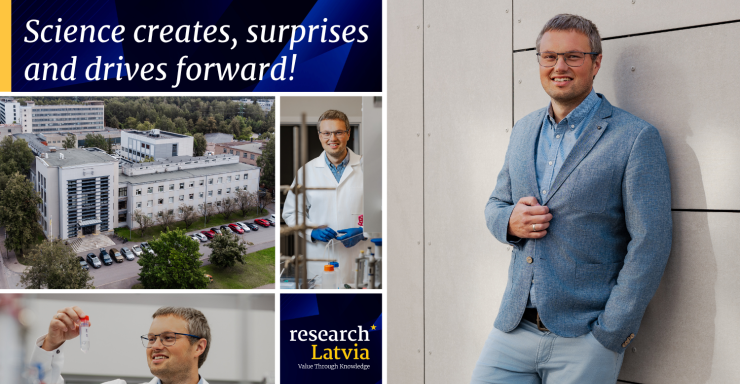
We are all born with the ability to feel what mathematicians feel, but life leads us down different tracks, said Jānis Lazovskis, researcher at the University of Latvia’s Institute of Clinical and Preventive Medicine, on the “Science Matters” programme on Radio NABA. He also pointed out that many young people have never had a “good encounter” with mathematics because they need an environment where a spark is lit, and the desire to continue grows. Meanwhile, a mathematics student in the United Kingdom and chairman of the board of the association “Latvian Student Network of Mathematical Analysis”, Nils Žuravļovs, noted that in many schools, mathematics is taught using ready-made formulas, without explaining why such a formula exists in the first place.
When did you first feel that mathematics was your path?
Jānis Lazovskis: I didn’t begin studying mathematics with the idea that “this is what I’ll do for the rest of my life”. I liked mathematics, and at that moment I wanted more of it. That began already in primary school, and especially in secondary school. In 11th grade, I had a teacher who explained things in precisely the way that worked for me. Later, my classmates said they really disliked that teacher, but in my view, he was perfect, which shows how vital individual approaches are. What pulled me into mathematical topology was the moment I realised that you can draw in mathematics, too. In my third year of studies, we had a lecturer whose classes suddenly turned theorems into pictures. The proof literally appeared in the drawing without words! Of course, the technical language is still needed, but the image lets you grasp the idea immediately; it makes discussions with others — and with yourself — easier. I thought that was simply amazing.
Nils Žuravļovs: At Riga State Gymnasium No. 1, algebra was taught by Dainis Kriķis. Naturally, the impressions were very positive; the lessons gave me the inner spark to keep learning mathematics. We also had to complete a scientific research project. I received first-degree recognition at the National Conference for my paper “Generating Matrices of Pell and Modified Pell Numbers in Right-Angled Triangles.” I discovered new topics and want to continue researching in this way.
What keeps you connected to mathematics daily?
Jānis Lazovskis: At the moment, the work and the projects I want to accomplish. I’ve tried other jobs, but none of them spoke to me. Mathematics holds me there. In the private sector, I’ve worked as a data analyst and data scientist. There I learned to define goals precisely, track progress, and change course when needed. At the university, researchers have more freedom; we’re usually left in peace. That’s both good and bad. Now I try to take the best from both worlds — academia and the private sector.
Nils Žuravļovs: In everyday life, I view almost every object very geometrically. Mathematics gives me the ability to observe what’s happening around me from an analytical perspective. I look at a wave in the sea or the movement of tree leaves in the wind and think — that’s a vibration you could describe mathematically.
What qualities help someone become a good mathematician?
Jānis Lazovskis: More than innate talent, the environment matters. An adult who answers questions thoughtfully and honestly. Opportunities to get involved. A kind of openness, curiosity. A large part of talent is work. In the long run, getting up, doing the work, going to sleep, and doing it again the next morning. Anyone can experience what mathematics can give!
We are indeed all born with the potential to feel what mathematicians feel, but life takes us down different paths.
Our everyday situations are often more complicated than any exercise. Mathematics is another working language that helps organise our thoughts. It matters to me that people understand that mathematics is a part of all of us.
What is missing in school mathematics lessons?
Nils Žuravļovs: In many schools, mathematics is taught through ready-made formulas — a sort of “template” format. For example, the quadratic discriminant formula is repeatedly applied to different equations, with only the numbers changing. Students write the same formula again and again. But they lack the clear understanding of why such a formula exists in the first place. How can we prove it? I see that in many secondary schools, proofs are not explained well. That may be why young people lack a creative feel for mathematics — they encounter repeated formulas obtained in some unclear way, without the mental training of thinking about proofs and the question of why? Teaching could be improved by implementing evidence-based approaches for each mathematical idea.
Jānis Lazovskis: Often, students are made to complete exercises without explaining why. It’s not enough to show one or two examples and then generalise. But we must also say — teachers work under time pressure, with large classes and low pay. The beauty of mathematics can be found in classrooms, but the system must support an environment that allows teachers to reveal it. If I could change something, I would give time and opportunity to explain “why.” Less mechanical work and more variety. And I would support teachers so they can teach with calm and care.
What to do if mathematics feels difficult? How to help a young person who “just doesn’t get math”?
Jānis Lazovskis: I often take students back to the very basics and then go through them together again. In 10th grade, they talk about complicated theorems, but they’ve forgotten the basics from 8th grade. Once the first steps are restored, you can safely move forward. Deep understanding comes from apparent fundamentals. At the same time, in mathematics, you can experience something big even without a full foundational course. An excellent example is the artist in a team who, a few years ago, discovered a new type of shape that tiles a surface without repeating the arrangement. The artist, with no mathematical background, played around and saw it.
Many young people have never had a good encounter with mathematics — they need an environment where a spark is lit, and they want more.
Nils Žuravļovs: One can try returning to the basics and revisiting the initial mathematical ideas to understand the first step from which everything else unfolds deeply. It would be hard to think about university-level topics without a direct grasp of fundamental concepts. We can offer our theoretical materials available on our website. For the second year in a row, we are developing materials for secondary school students that introduce the foundations of mathematical analysis — limits, differentiation, and integration. We invite young people to study independently so they can become aware of the fundamental ideas in mathematics.
Jānis Lazovskis: Mathematics is, in a sense, a social science. Young people come to the Saturday morning Mathematics Discussion Club because their friends come, because the environment is interesting and unusual. It requires great effort from the organisers, but it pays off. A place where you want to be helps maintain rhythm even through the challenging parts and proofs. In my bubble, people talk a lot about mathematics. But in public discourse, explanations often lack — why results are the way they are, and what they change. I advocate for broader collaboration between the small “bubbles” so a shared space emerges where ideas circulate freely. So that everyone has the chance to feel that mathematics isn’t dry.
It can be as artistic as sculpture, revealing both the dark and light, the logical contrasts that surround us. Mathematics is right beside us in everyday life.
What is the Latvian Student Mathematical Analysis Tournament?
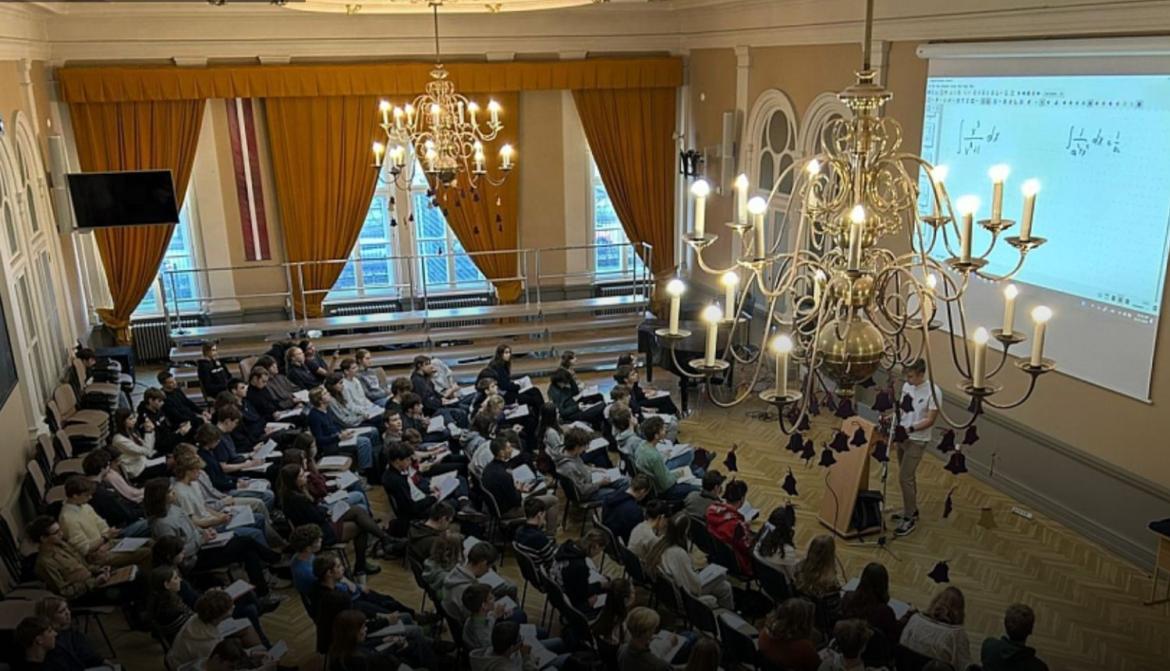
Nils Žuravļovs: The tournament began as an informal initiative at Riga State Gymnasium No. 1 and quickly grew into a widespread tradition. It is organised in two stages — the preliminary round and the final. In the initial round, participants solve 20 short-term problems in 20 minutes. In the final, a more difficult integral is solved on the chalkboard. The student who first circles the correct answer advances. We were inspired by the format used at MIT — the “Integration Bee.” Winners receive sponsored prizes, but most importantly, they experience the competitive spirit of the event. It is a contest of honour, and each participant feels their own sense of achievement. Participants range from beginners to students who independently study university-level topics in secondary school. This year, the preliminaries will take place on December 3 and the final on December 17. The registration form is available on our website.
How does mathematics help in medicine, such as in early cancer diagnostics?
Jānis Lazovskis: In my postdoctoral project “Effective Topological Invariants for Representation Discovery in Image Diagnostics”, I work with topological data analysis. Topology is the mathematics of spaces. In medicine, an image is taken, for example, a black-and-white picture of a tissue section under a microscope. Each pixel has its own brightness level. From these values, in each grid cell we can create a topological space and filter it — for instance, selecting all completely black pixels, then lowering the sensitivity threshold so that more and more pixels appear.
As adjacent pixels connect at each filtering step, a topological space emerges. This space has its own properties, and mathematics can describe them, creating filtered features. That allows us to determine what has changed in an image. Medical professionals have an enormous number of images, and mathematics helps determine what is essential. It helps them set priorities and spend more time on the pictures where the algorithm has noticed something unusual. Information technologies have always been closely linked to medicine; we simply now know how to use them better for our health. Our algorithm will complement machine-learning methods. The best part is that, with topology, global properties can be determined from local information alone. When you put everything together like a three- or four-dimensional puzzle, you obtain properties that otherwise would be visible only in the whole, complex, hard-to-grasp picture. The result of the project will be an algorithm that may eventually be developed into a commercial product.
Jānis Lazovskis receives funding from the postdoctoral research programme 1.1.1.9, application No. 1.1.1.9/LZP/1/24/125 “Effective Topological Invariants for Representation Discovery in Image Diagnostics.”