Providing electrical power during long-duration and deep-space missions has always been a challenge. Scientists at the Institute of Physics of the University of Latvia (UL) are developing a new technology that could provide electricity for extended space missions.
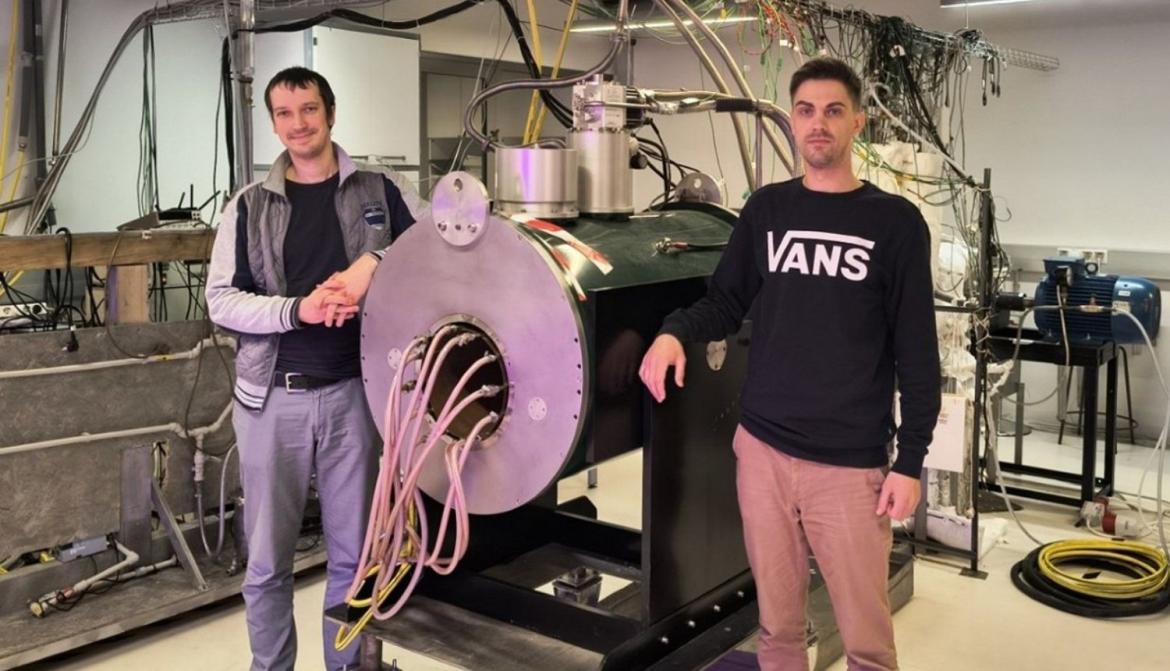
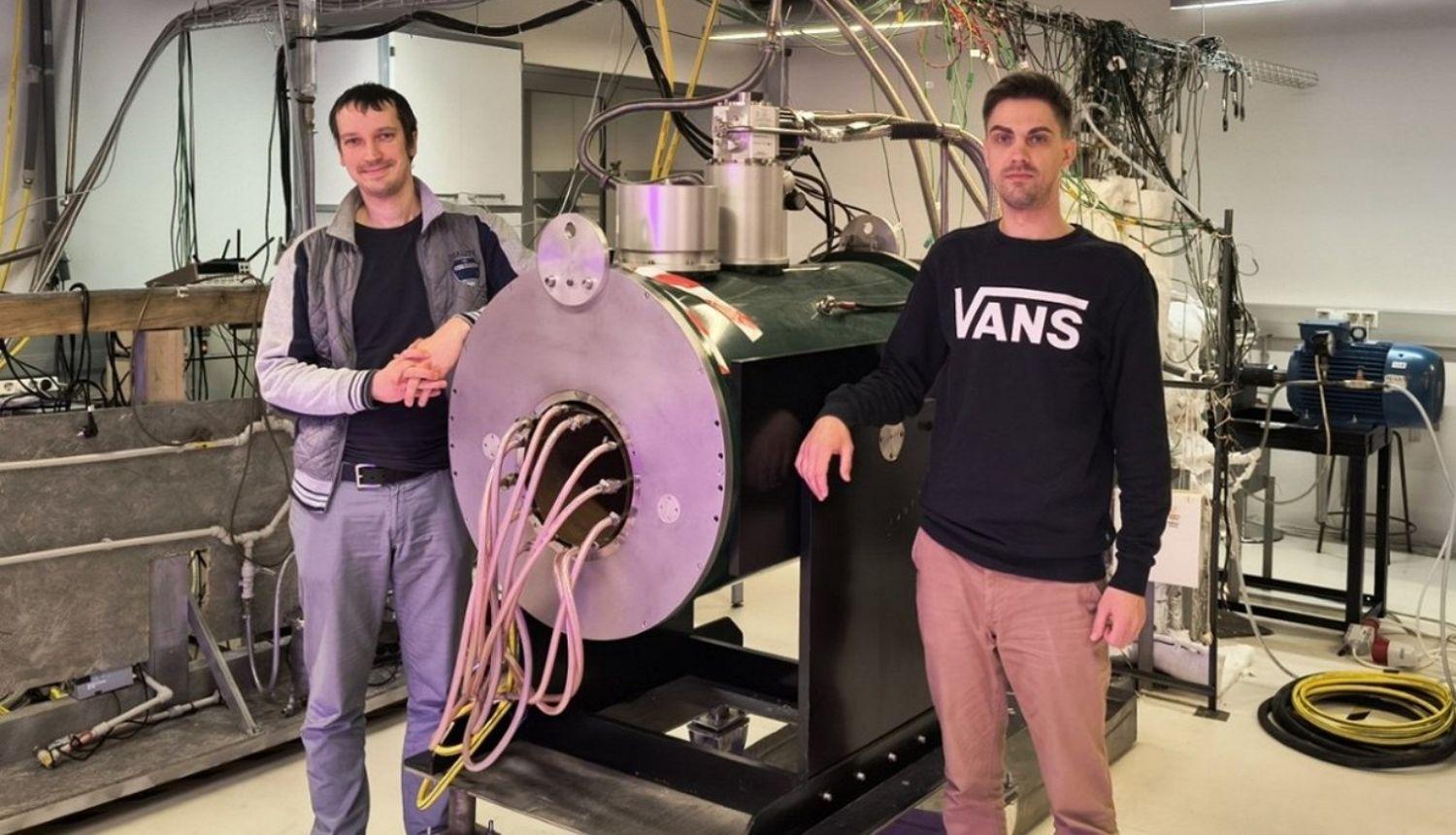
At the end of last year, we conducted a complex, unique experiment in a strong magnetic field, and the results are already being used in the international project "SpaceTRIPS." Its goal is to develop a special thermoacoustic generator, a solution that could be more efficient than existing methods and suitable for operation where solar energy is unavailable.
In NASA's widely publicised "Artemis II" lunar mission, power was supplied by conventional photovoltaic solar panels. These are useful near the Sun and when solar radiation is available, such as during lunar missions.
However, in areas where solar energy is unavailable, radioisotope thermoelectric generators have typically been used. For example, this approach was used in NASA's Voyager probes, launched half a century ago and now having reached interstellar space. However, the efficiency of these generators is low, typically only a few per cent.
In contrast, lesser-known thermoacoustic technologies can generate electricity from a radioisotope or another heat source, achieving efficiency that is an order of magnitude higher.
First in the World
The thermoacoustic principle means that heat is converted into mechanical oscillations of gas, producing sound. This phenomenon was first observed in ancient times. In ancient Egypt, glassblowers noticed that heating glass produced sound. A deeper understanding of thermoacoustics began to develop only at the beginning of this century, mainly at Los Alamos National Laboratory in the United States.
Electric current in the generator is generated by vibrations of a molten liquid metal driven by gas oscillations in a magnetic field. This means the technology contains no solid, mechanically wearing, or moving parts, an important advantage for space missions, where maintenance is impossible, and equipment must be highly reliable.
Sodium has been selected as the working fluid (molten medium). It is a metal with very high electrical conductivity in liquid form. It is also lightweight, similar to water, which is important in oscillatory motion, where inertia plays a significant role.
However, the use of such technology in space is limited by various stability issues. To ensure stable operation and electricity generation, the vibrating liquid metal in the generation zone must remain stable.
The UL research team has developed and demonstrated a new method, stabilisation of liquid metal in a magnetic field, which has not been achieved anywhere else in the world.
From Vibrations to Stability – A Complex Experiment
To investigate the proposed stabilisation mechanism, a complex experimental setup was developed with a superconducting magnet capable of producing magnetic fields up to 5 teslas. For comparison, refrigerator souvenir magnets generate only a few milliteslas, thousands of times weaker.
The superconducting magnet is essentially a direct-current coil cooled to –270°C, close to absolute zero.
At this temperature, the coil material becomes superconducting, with its electrical resistance approaching zero. To reach superconductivity and achieve the required magnetic field strength, the research team had to solve several technological challenges, such as magnetic field dispersion in the laboratory.
The electricity generation principle of "SpaceTRIPS" is fundamentally new and has not been studied elsewhere in the world, so nearly everything related to operating this technology is challenging. This also applies to the liquid's behaviour inside the device. Moreover, from a technical standpoint, our superconducting magnet had not previously been operated in such a mode or in a vertical position.
All of this created uncertainty and risk regarding whether everything would work as planned. However, the results exceeded expectations. Significant contributions also came from effective collaboration with UL infrastructure services. Additionally, new insights emerged on how the results could be further applied, including for industrial uses.
The experiments used a gallium–indium–tin alloy (GaInSn), which is non-toxic and liquid at room temperature.
Surface vibrations of the alloy were induced using a specially adapted sound system that provides low-frequency oscillations.
The vibrating liquid metal was placed inside the superconducting magnet, and researchers analysed wave stability by varying the magnetic field strength, frequency, and amplitude. These waves are known as Faraday waves.
At a certain magnetic field strength, the liquid metal effectively solidifies and stops forming waves. This property enables addressing problems related to the effects of microgravity on generator operation in space.
The Power of Interdisciplinarity in Science
Researchers, engineers, and technicians from physics, mathematics, electronics, computer science, and other fields participated in the study. Every scientific and technical aspect was important for developing, conducting, and analysing the experiments.
Collaboration between institutes was also crucial. For example, physical processes were modelled in cooperation with the UL Institute of Numerical Modelling (INM). Computer simulations were used to model fluid motion, allowing prediction of wave behaviour and, consequently, generator performance.
In such complex studies, mathematical and numerical modelling is especially important, as it helps reduce experimental costs and risks while also aiding in analysing and explaining observed physical phenomena.
High school students Ņikita Voitkevičs and Veronika Kutepova from Riga Purvciems Secondary School gained experience in this complex experiment. Assisting in the experiment, they developed and successfully defended their research projects at school.
Applications Not Only in Space but Also on Earth
However, no research is ever finished. There are always aspects that can be studied in more detail, measured more precisely, and understood better. Future work on this research will include additional experiments and numerical calculations. Plans also include developing and testing new prototypes of thermoacoustic generators, applying this technology not only in space but also in Earth-based energy systems.
With the development of the revolutionary "SpaceTRIPS" technology and its successful demonstration, the UL Institute of Physics team attracted international interest as early as 2014.
Recognition has also been received in Latvia; the Latvian Academy of Sciences has acknowledged the international research team in the competition for the most significant scientific achievements.
Meanwhile, the coordinator of the "SpaceTRIPS" consortium and director of the Grenoble National Research Centre, Professor Antoine Alemany, has been awarded an honorary doctorate by the University of Latvia for his long-standing contributions to the university's development.
The research was carried out within UL postdoctoral projects: No. 1.1.1.9/LZP/1/24/026 and LU-BA-PG-2024/1-0002.