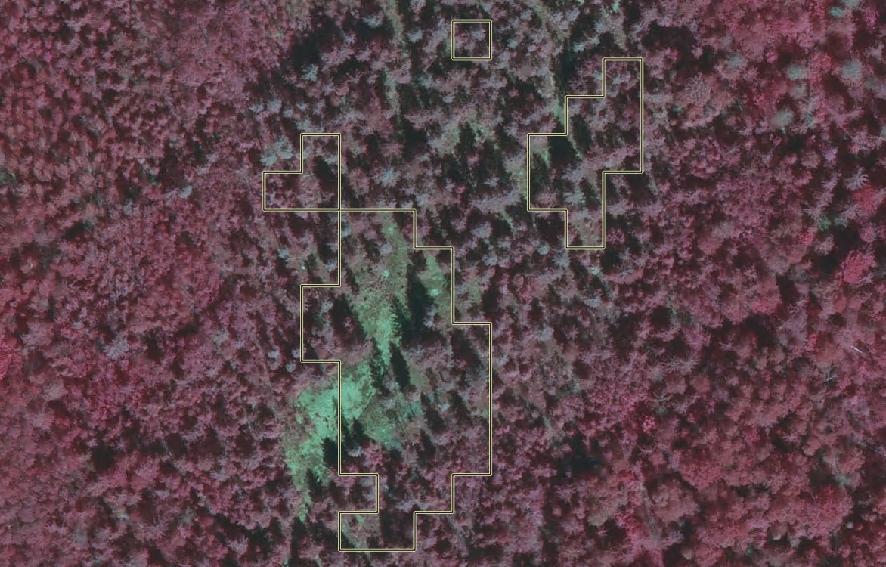
Due to the increase in damage by the eight-toothed spruce bark beetles in the managed territory, last year the Joint Stock Company “Latvia’s State Forests” (LVM) started work on the development of an algorithm for identifying potentially damaged spruce stands, so that in the long term economic activity could be planned to limit damage by bark beetles in the designated stands. The algorithm is based on high-resolution Sentinel-2 satellite images covering the entire territory of the country.
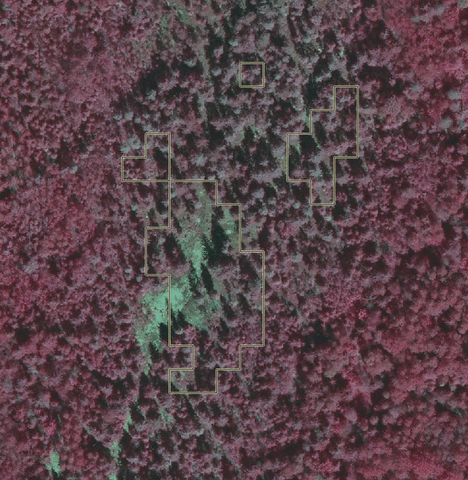
"The information generated by the algorithm about potential damage to spruce stands is primarily informative. The data represent changes in various vegetation indices of specific spruce stands over several years, indicating changes in the vitality of the stand. These changes can be caused by spruce bark beetle damage, increased water levels in the forest, windthrow, partial forestry activities, and other factors. Therefore, it is crucial to implement stand control measures when receiving data from the algorithm about the threatened condition of the stand," explains Edijs Leišavnieks, Head of Forest Protection and Fire Safety at LVM.
The algorithm displays potential damage locations in the forest, which may be individual groups of 5 to 10 trees or can cover areas up to 7 hectares, indicating long-term damage to the forest stand over several years. The LVM algorithm does not take into account whether there are any restrictions on forestry activities, registered micro-protected areas, or other environmental protection restrictions in a particular forest compartment.
Cooperation with the State Forest Service (VMD)
In cooperation with the State Forest Service (VMD), LVM has carried out data validation for potential damage locations outside the LVM-managed area to eliminate discrepancies in data regarding forest stands where forestry activities have been carried out, based on received felling certificates.
In 2024, VMD also conducted high-resolution satellite data analysis to obtain the most reliable information about vitality disturbances in spruce stands on private lands. Similarly, VMD identified weakened spruce stands that may have been damaged by the bark beetle or affected by other adverse factors. The data collected by VMD in November 2024 were published in the State Forest Register as a separate layer titled "2024 Detected Potential Damage in Spruce Stands."
LVM GEO Application and Map Viewer
To make the information about the algorithm-identified threatened or damaged forest stands available to as many forest owners as possible, LVM has published the data in the "LVM GEO Mobile" application and in the map viewer solution at https://lvmgeo.lvm.lv, under the layer name "Potential Damage in Spruce Stands."
For the convenience of other forest owners, the "LVM GEO Mobile" and LVM map viewer solutions also feature data prepared by VMD about weakened spruce stands outside the LVM-managed area.
LVM and VMD encourage forest owners to pay attention to stands with potential damage locations and to examine the surrounding area and nearby potential damage locations. Whenever possible, forest owners should inspect their spruce stands on-site to ensure that they have not been primarily damaged by the spruce bark beetle, which is the most destructive forest pest in Latvia, and to plan further damage prevention measures to improve the stand’s sanitary condition in the long term.
Data Should Be Verified On-Site
There may be inaccuracies in the data calculated by the LVM algorithm, primarily due to changes in other tree or shrub species and ground vegetation. Therefore, LVM encourages forest owners to carefully examine their territory using current orthophoto maps and then make a decision about conducting on-site inspections.
Edijs Leišavnieks emphasizes: “Although this winter has not provided us with prolonged cold spells, the winter months are still the best time to remove damaged trees, including wind-felled trees, from the forest before the spruce bark beetles start emerging in spring.”
The damage identified by the algorithm may not match the actual situation in the field, so special attention should be paid to data accuracy in the following areas:
- Forest gaps and edges of swampy areas
- Edges of planned and completed felling areas, where shadows may indicate potential damage
- Possible displacement of the damage location compared to the actual situation in the field. The precise damage in the field may be located near the identified area, so the entire forest compartment should be assessed during the inspection
- Damage may be shown in a much smaller area than it is found in the field, and the damage may also be present in neighboring compartments where spruce is not the dominant species
- Mixed stand with a predominance of deciduous trees in the field, but where spruce is the dominant species according to forest stand parameters. Changes in deciduous stands, not spruce stands, may be identified
- Wind-felled trees may also be identified.